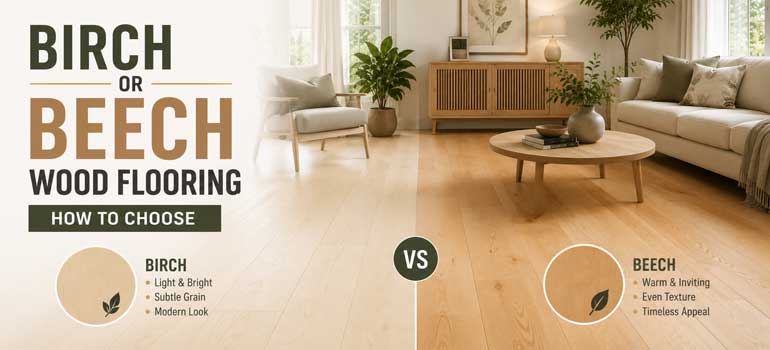
Birch and beech get confused with each other constantly, and it's easy to see why: they grow in similar climates, share a straight, subtle grain, and both rival oak in overall durability. Look closer, though, and the differences in colour, cost, and wear characteristics are genuinely worth understanding before choosing between them.
Colour And Grain
The most immediately visible difference is tone:
- Birch carries a creamy, yellowish colour with fine, mostly uniform grain and relatively little visible pattern.
- Beech leans toward pink or amber tones, giving it a warmer overall appearance than birch's cooler cream base.
Both share a straight, understated grain pattern, which is part of why they're both such a natural fit for minimalist and Scandinavian-inspired interiors, where a calm, low-pattern floor supports the room's overall simplicity.
Hardness And Durability
This is where it's worth being precise, since the two properties involved aren't quite the same thing. Hardness (measured on the Janka scale) reflects resistance to denting, while toughness reflects resistance to shock and impact, and birch and beech split these differently.
- Birch sits only slightly softer than red oak on the Janka hardness scale, a modest difference rather than a dramatic one, but it has genuinely strong shock and impact resistance, meaning it holds up well against knocks and drops even though its dent resistance is moderate rather than exceptional.
- Beech sits close to oak in Janka hardness, giving it strong dent resistance, but it's somewhat more prone to denting under sustained pressure or heavy furniture than birch's toughness would suggest.
Neither wood is simply "harder" than the other in every sense, it depends on which kind of daily wear matters more in your specific space.
Cost
Beech generally costs less than birch, making it a practical option for anyone wanting a hardwood floor with genuine durability at a more accessible price point than some alternatives.
Choosing Between Them For Your Space
Since both share a similar light palette and grain style, the decision often comes down to the type of wear your room actually experiences. A hallway or busy family area that takes frequent knocks and impacts, dropped objects, and moved furniture might suit birch's shock resistance well. A room where dent resistance matters more than impact resistance, under heavier static furniture, for instance, may suit beech's closer-to-oak hardness better. Budget is worth weighing in too, given beech's typical cost advantage.
Birch and beech aren't among the species most commonly stocked for UK flooring projects, so it's genuinely worth checking current availability and sourcing with a supplier before committing to either, rather than assuming they're as readily available as oak.
Birch Vs Beech Flooring: Common Questions
Is birch really 25% softer than oak?
No, that's a significant overstatement. Birch sits only marginally softer than red oak on the Janka hardness scale, a difference of a few percent rather than anything close to a quarter.
Which is more durable, birch or beech?
It depends what kind of wear matters most. Birch has better resistance to shocks and impacts, while beech has hardness closer to oak, giving it stronger resistance to denting under sustained pressure.
Is beech cheaper than birch?
Generally, yes, making it a practical option for anyone wanting genuine hardwood durability without birch's typical price premium.
Do birch and beech suit the same interior styles?
Largely yes. Both share a straight, understated grain and light palette that work particularly well in minimalist and Scandinavian-inspired interiors, though beech's warmer pink-amber tone gives it a slightly different character from birch's cooler cream base.
If you're considering solid wood flooring in birch or beech, call us on 020 7036 0625 or request a free site visit and we'll advise on availability and the right species for your space.