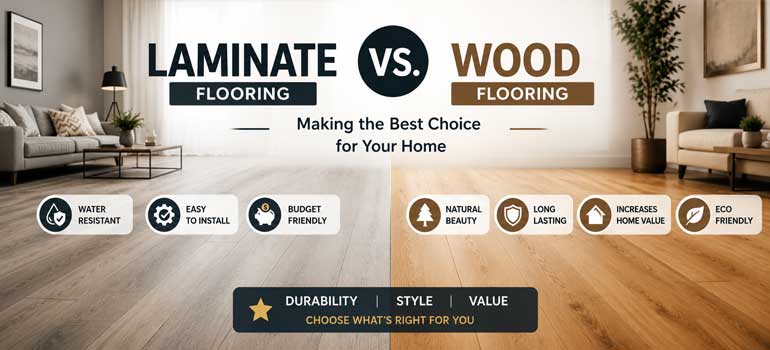
Both laminate and wood flooring have genuine strengths, and neither is simply the "better" option overall. The right choice depends on your budget, how the room actually gets used, and how much you value being able to restore a floor versus just replacing it. Here's how the two actually compare where it matters.
Upfront Cost Versus Long-Term Cost
Laminate is cheaper to buy and, in many cases, cheaper to fit, which is exactly why it remains such a popular choice for budget-conscious renovations. Wood, particularly certain species and grades, costs more upfront.
That gap narrows considerably over time, though. Wood flooring can be sanded and refinished repeatedly, effectively resetting its appearance every couple of decades. Laminate has no equivalent option. Once it's worn out, it gets replaced in full. Looked at over ten or twenty years rather than a single purchase, the cost comparison isn't as one-sided as the upfront price tags suggest.
How Each Handles Daily Wear
Laminate's wear layer is genuinely tough against everyday scuffs and scratches, often more resistant to surface damage than an unfinished wood floor in a busy household. This makes it a strong option for rentals, family homes with pets, and any room that takes heavy daily traffic.
Wood is more vulnerable to surface scratching, particularly softer species, but it has an advantage laminate can't match: damage doesn't have to be permanent. Scuffs and scratches can often be addressed directly, and deeper wear can be sanded away entirely.
Moisture And Humidity: Getting This Right
This is a point worth being precise about, since it's commonly misunderstood. Laminate is more moisture-resistant than solid wood, but it isn't waterproof. Standing water, or prolonged high humidity, can still cause the fibreboard core to swell, particularly at the seams between boards, and that kind of damage isn't reversible. Solid wood has similar vulnerabilities to sustained moisture, if not worse in some cases.
If a room genuinely deals with high humidity or standing water, a cellar, a bathroom, or somewhere prone to damp, neither laminate nor solid wood is really the right answer. LVT or a well-sealed engineered wood product tends to be the safer choice in those specific conditions.
Day-To-Day Maintenance
Laminate's care routine is about as simple as flooring gets: a mop and a suitable cleaning product cover most of it. Wood needs a bit more attention, appropriate cleaning products, prompt spill cleanup, and periodic finish maintenance, but it's not the labour-intensive routine people sometimes assume. Both are genuinely manageable for a busy household; wood just asks for slightly more consistency.
What Happens When It Wears Out
This is where the two options diverge most clearly. Old, worn wood flooring can often be brought back to looking close to new through sanding and refinishing, and localised issues like scratch damage can usually be addressed without touching the rest of the floor at all.
Laminate doesn't offer that path. It can't be sanded, and matching a replacement board's colour to an older, sun-faded floor years later isn't guaranteed to work, discontinued colourways and slight batch variation both make an invisible repair harder to pull off than it would be with wood flooring repair.
A Quick Way To Decide
A few situations where the choice tends to be clearer than others:
- Renting, or planning to move within a few years — laminate's lower cost and easier installation usually make more sense here.
- A forever home, or a period property — wood's ability to be refinished repeatedly tends to justify the higher upfront cost over time.
- Heavy daily traffic from kids or pets — laminate's tough wear layer handles this well, though a well-finished wood floor can too with a bit more care.
- A room prone to damp or humidity — neither is ideal; LVT is usually the more sensible choice.
Frequently Asked Questions
Is laminate flooring actually cheaper than wood in the long run?
Not necessarily. Laminate is cheaper upfront, but since it can't be refinished and needs full replacement once worn, wood's ability to be sanded repeatedly can make it the more economical option over a longer time horizon.
Can laminate flooring be installed in a damp room?
It's more moisture-resistant than solid wood, but it isn't waterproof, and standing water or high humidity can still damage it over time. For genuinely damp rooms, LVT is usually a safer choice than either laminate or wood.
Which is easier to repair, laminate or wood?
Wood, by a clear margin. Scratches and worn patches can often be sanded or spot-repaired, while laminate typically needs a full plank replacement, and matching the colour to an older, faded floor isn't always possible.
Does laminate flooring add value to a property the way wood does?
Generally not to the same extent. Wood flooring, particularly in period properties, tends to be viewed more favourably by buyers than laminate, though laminate's practicality still has genuine appeal for certain buyers and property types.
Call us on 020 7036 0625 or request a free site visit and we'll help you weigh up what's right for your specific room and budget.