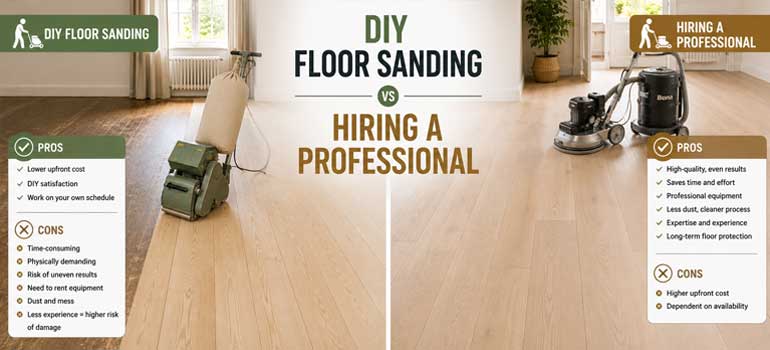
Sanding your own floor is genuinely possible, but it's worth going in with a clear picture of what's actually involved before deciding it's the cheaper option. The equipment, the skill required, and the margin for error are all bigger than they look from the outside.
What DIY Sanding Actually Involves
A proper sanding job needs more than a single tool. You're typically looking at a drum or belt sander for the main floor area, an edging sander for the perimeter and corners the big machine can't reach, and often a buffer for the final smoothing pass before finishing. Each one handles differently, and the drum sander in particular is genuinely unforgiving, it removes material fast, and a moment's hesitation while it's running can gouge a visible dip into the floor that no amount of buffing will fix afterwards.
On top of the machines themselves, you'll need a full range of sandpaper grits, working from coarse to fine across several passes, since skipping grits leaves visible scratch patterns that the finish will only highlight rather than hide.
The Most Common DIY Mistakes
A few issues come up again and again with first-time DIY sanding:
- Gouging from the drum sander, usually caused by keeping the machine stationary for even a second too long in one spot.
- Uneven pressure, leaving some areas over-sanded and others under-sanded, which becomes obvious once the finish is applied and catches the light differently across the room.
- Skipping sandpaper grits to save time, which leaves scratch marks visible under the final finish rather than a smooth, even surface.
- Missing edges and corners, since the edging sander requires a different technique to the main drum sander and is easy to underestimate.
None of these are necessarily disqualifying if you're genuinely experienced, but they're worth being honest with yourself about before starting on a whole room.
Dust: The Part People Underestimate
This is one of the most commonly overlooked parts of the job. Professional sanding uses proper dust extraction equipment designed to capture up to 99% of particles at the source, keeping the mess largely contained to the machine rather than spread across the room and the rest of the property. DIY setups, particularly rented equipment, often manage this far less effectively, and fine sanding dust has a way of finding its way into other rooms, soft furnishings, and even other floors through open doorways.
Weighing Up The Real Cost
Hiring the equipment, buying sandpaper across multiple grits, and sourcing the right finish products all add up, and that's before factoring in your own time, which for a whole room can run into a full weekend or more for someone doing this for the first time. Set against that is the cost of a professional job, which is higher upfront but comes with the experience, the equipment, and the guarantee of an even result the first time. For a small area you're confident about, DIY can genuinely work out cheaper. For a full room, particularly one with a floor you actually care about, the cost gap narrows considerably once your own time and the risk of mistakes are factored in properly.
When DIY Genuinely Makes Sense, And When It Doesn't
DIY tends to work reasonably well for small, low-risk areas, a single small room, a hallway, somewhere a slightly imperfect result wouldn't be a major loss if things don't go perfectly. It also makes more sense if you've done this before, or have genuinely relevant experience with power tools and finishing work.
It makes far less sense for larger rooms, valuable or antique flooring, or engineered wood with a thin veneer, where there's very little room for error and a mistake can mean permanent damage rather than something easily corrected. If a scratch or gouge does happen partway through a DIY attempt, professional scratch repair can sometimes fix isolated damage, but a widespread uneven sanding across a whole room usually needs a full professional resand to properly correct.
Frequently Asked Questions
Is DIY floor sanding actually cheaper than hiring a professional?
For a small area, often yes. For a full room, the gap narrows considerably once you factor in equipment hire, materials, your own time, and the real risk of costly mistakes that can be harder to fix than the original problem.
What's the biggest risk with DIY drum sanding?
Gouging the floor by leaving the machine stationary for even a moment too long in one spot. This kind of damage is difficult, sometimes impossible, to fully correct without further sanding down the whole area.
How much dust does floor sanding actually create?
A significant amount, particularly without proper extraction equipment. Professional-grade dust extraction can capture up to 99% of particles at the source, which is considerably more effective than most DIY setups manage.
Can a botched DIY sanding job be fixed?
Often, yes, though it usually means bringing in a professional to sand the affected area again, sometimes the whole floor, properly. This is exactly the extra cost that makes DIY less appealing for larger or higher-value floors.
Call us on 020 7036 0625 or request a free site visit if you'd rather leave the sanding to us, or want a professional opinion before deciding.