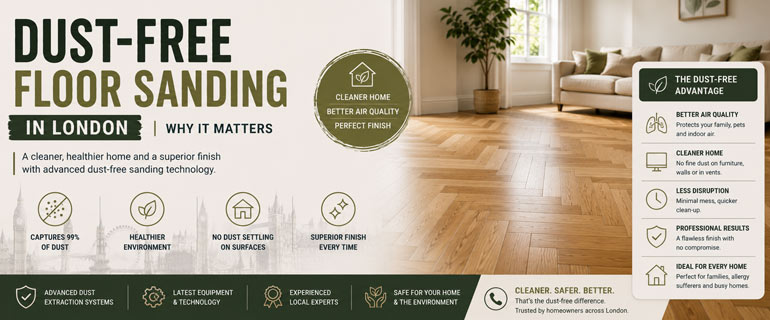
Anyone who has had floors sanded using older methods knows the aftermath. Fine wood dust works its way into every room, settles on surfaces, and takes days to clear properly. In London general properties where rooms open onto shared hallways or where open-plan layouts connect living spaces, the spread of dust can be particularly frustrating.
Beyond the mess, there are genuine health implications. Fine wood dust is classified as a respiratory irritant, and prolonged exposure is associated with more serious conditions. That matters not just for the contractors doing the work, but for anyone living in the property during or shortly after sanding.
How Dust-Free Sanding Works
Modern dust-free floor sanding equipment used by contractors in London connects the sanding machines directly to high-powered extraction units. These units use HEPA filtration to capture fine particles before they become airborne. The sanding drum or belt is sealed against the floor surface so that dust is drawn into the extraction hose at the point of generation rather than being thrown into the air.
The result is not completely dust-free in an absolute sense. A small amount of fine dust still escapes, particularly during edge sanding and corner work where handheld tools are used. But the reduction compared to older belt sanders without extraction is substantial. Most homeowners in London general who have used a contractor with proper dust-free equipment report being able to remain in other parts of the house during the work.
Health Benefits for Homeowners in London
For households in London general with young children, elderly occupants, or anyone with asthma or other respiratory conditions, dust-free sanding is not just a convenience. It is a meaningful reduction in risk. Traditional sanding creates clouds of particles small enough to penetrate deep into the lungs, and clearing a property of this dust takes considerable time even after the work is finished.
Dust-free extraction removes most of this risk at source. The air quality during a job with proper extraction in a London home is significantly better than with older methods, and the post-job cleaning is far less extensive.
- Reduced airborne particles during and after sanding
- Lower risk of respiratory irritation for household members
- Less contamination of soft furnishings, bedding, and electronics
- Faster return to normal use of the property
What It Means for Your Home in London general
Practically speaking, dust-free sanding in London means you spend far less time cleaning up after the job. The dust that does escape is minimal and can usually be cleared with a single vacuum pass of adjacent rooms. Curtains, sofas, and bookshelves that might otherwise need cleaning down are largely unaffected.
For homeowners who cannot easily move out of the property during the work, which is common in London general where renting temporary accommodation is expensive, this is a significant benefit. The ability to carry on using most of the house while one or two rooms are being sanded makes the whole process far less disruptive.
Does Dust-Free Equipment Affect Quality?
Some homeowners in London worry that extraction attachments on sanding machines reduce the effectiveness of the sanding itself. In practice, the opposite tends to be true. Removing dust from the surface as it is generated means the abrasive paper stays cleaner for longer and cuts more efficiently. This can actually improve the quality of the finish and reduce the number of passes needed.
The limitation is that some older or specialist sanding machines used for detailed work do not have extraction options available. In these cases, a contractor in London general will use handheld scrapers or sanding blocks instead, which generate relatively little dust compared to powered machines.
Asking Your Contractor About Dust Extraction
When getting quotes for floor sanding in London, ask specifically what extraction equipment the contractor uses. Not all companies invest in high-specification dust-free systems, and some older machines with basic bag filters are far less effective than modern HEPA extraction units.
Questions worth asking:
- Do your main sanding machines have integrated dust extraction?
- What filtration standard do your extraction units use?
- Will edge sanding and corner work also use extraction where possible?
- What dust precautions do you recommend for adjacent rooms?
A contractor who takes dust management seriously will have clear answers to all of these. In London general where many properties have limited space and homes are occupied during renovations, dust control is a reasonable expectation rather than a premium extra.
After the Job
Even with excellent dust extraction, a thorough vacuum of the sanded room before the finish is applied is standard practice. Any remaining dust on the surface will show through the finish if left. A tack cloth pass after vacuuming picks up the last fine particles. Contractors working in London who follow this sequence consistently produce better results, and the extra few minutes it takes is well worth it for the quality of the final finish.