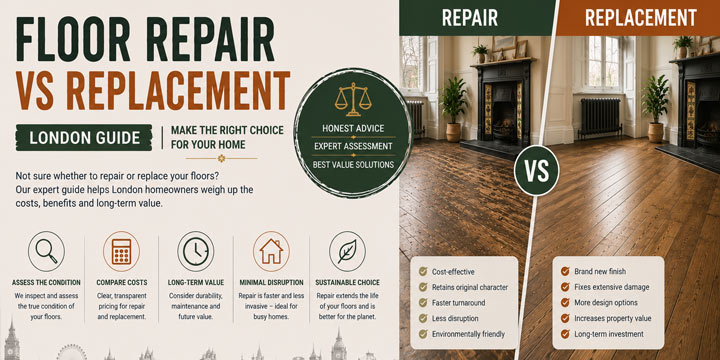
When a wooden floor is looking tired, damaged, or worn, the decision between repairing and replacing it is not always obvious. In London, where property costs are high and original features carry real value, getting this decision right matters. This guide works through the factors that should shape your thinking and helps you arrive at a conclusion that makes sense for your specific situation.
Start With an Honest Assessment
Before deciding anything, you need to understand the actual condition of the floor. This means getting a professional to look at it rather than relying on what you can see from the surface. An experienced floor contractor can assess:
- Board thickness and how much material remains for sanding
- Structural integrity -- whether boards are still properly supported and fixed
- The extent of any damage, staining, or decay
- Whether the subfloor is sound
- The potential quality of the result if restoration is pursued
This assessment visit typically takes 20 to 30 minutes and should be free from any reputable London contractor. Do not make a major financial decision based on guesswork.
When Repair and Restoration Is the Right Choice
In most cases, repairing and restoring an existing wooden floor is the better option in a London home. Here is when restoration clearly wins.
Original Boards in a Period Property
Original Victorian or Edwardian pine or oak boards are genuinely irreplaceable. You cannot buy new timber of equivalent age, character, or patina. A good restoration job on original boards will almost always look better than fitting new flooring, at a lower total cost. If the boards are at least 18mm thick with reasonable condition timber, restoration should be the default choice.
Cost Differential Is Significant
Sanding and finishing an existing floor in London typically costs £25 to £45 per m2. Replacing with new engineered wood of equivalent quality costs £50 to £100 per m2 for materials alone, plus £20 to £40 per m2 for fitting and subfloor preparation. The economics strongly favour restoration unless the existing floor is genuinely beyond help.
Partial Damage That Can Be Addressed
Many London floors that look poor are suffering from relatively limited damage: a few cracked boards, some staining, worn finish in heavy traffic areas. All of these can be addressed as part of a restoration. Board replacement is skilled work but relatively affordable -- replacing five to ten boards before a resand typically adds £150 to £400 to the total cost, while the rest of the floor benefits from a full restoration.
When Replacement Makes More Sense
There are situations where replacing the floor is the genuinely better decision.
Structural Failure
If the subfloor or the boards themselves have structural problems -- joists that have rotted, boards that have been cut through for pipework repeatedly, or widespread infestation damage -- restoration is not appropriate until the structural issues are resolved. Once that work is done, new flooring may be more practical than working around a compromised original floor.
Insufficient Board Thickness
A board that has been sanded multiple times previously may simply not have enough material left to sand again. If the boards are less than 15mm thick or if the wear layer on an engineered floor is 2mm or less, there is not enough material for a meaningful resand. In this situation, replacement is the only option for a lasting result.
Wrong Floor for the Purpose
Sometimes the existing floor is simply not suited to the way a room is being used. If you are converting a ground-floor room to a wet room or adding underfloor heating under a solid wood floor that cannot accommodate it, replacement with a more appropriate product is the logical decision regardless of the floor's condition.
The Financial Case in London
London's property market gives floor decisions a financial dimension that matters. Original period floors -- particularly parquet and well-preserved pine boards -- add measurable value to London properties. Estate agents in areas like Islington, Southwark, and Wandsworth consistently note that buyers pay more for properties with original or well-restored wooden floors than for those with carpet or modern replacements.
The cost of restoration is invariably lower than replacement. For most London homeowners making this decision, the financial, aesthetic, and environmental case for restoration is compelling -- provided the floor is structurally sound and has sufficient material remaining for the work to be done properly.
Getting the Right Advice
The most reliable way to make this decision is to get two or three assessments from experienced London floor contractors. A contractor who looks at your floor, measures the boards, and gives you an honest view of what restoration can achieve is more valuable than any general guide. Ask specifically: "If this were your floor, what would you do?" Good contractors will tell you honestly if replacement is the better option, even though restoration represents more work for them.