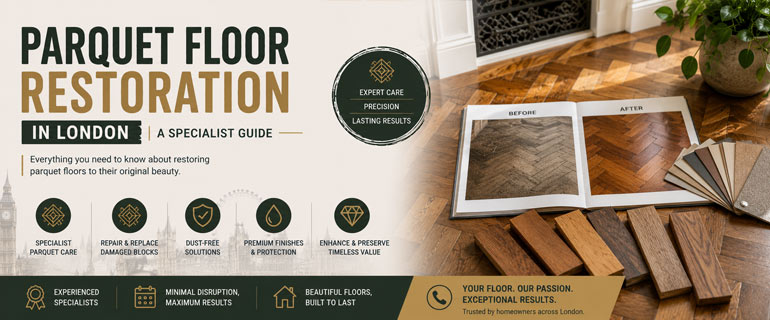
Parquet flooring is found in many homes across London general, particularly in properties built between the 1930s and 1970s. These floors were often laid in living rooms and hallways, sometimes covered by carpet decades ago and forgotten about entirely. Uncovering one in good condition is something of a find. Even in poor condition, most parquet floors in London are restorable, though the process is more involved than standard board sanding.
Common Parquet Patterns in London Properties
The most common pattern you will find in London general is the herringbone, where rectangular blocks are laid at 45 or 90 degrees to form a distinctive zigzag. Basket-weave and brick-bond patterns also appear, though less frequently. Each pattern creates different sanding challenges because the grain direction changes across the floor.
Original parquet blocks in UK properties are typically made from oak, pine, or teak, though beech and elm are also found. The blocks themselves are small, usually around 230mm by 70mm and 20mm thick, which means there is less material to work with compared to standard floorboards. This limits how many times the floor can be sanded in its lifetime.
Assessing the Condition
Before any sanding begins, the floor needs a thorough inspection. In London, parquet floors often suffer from a few specific problems:
- Loose or lifting blocks caused by bitumen adhesive failure
- Cracked or split blocks from movement or moisture
- Missing blocks, particularly near doorways and radiators
- Heavy contamination from old wax polish layers
- Cupping or crowning where moisture has got underneath
A specialist working in London general will re-bond any loose blocks using a suitable adhesive before sanding starts. Missing blocks need to be sourced and matched as closely as possible, which can take time if the original timber species is unusual.
The Sanding Process for Parquet
Sanding parquet floors in London requires a different technique to sanding straight-run boards. The sanding machine must work diagonally across the blocks to cut across the grain evenly, rather than following one direction. This is typically done at 45 degrees in two opposite directions before a final pass along the main axis.
Because the blocks are small and the grain changes direction frequently, any deviation from the correct technique will leave visible scratch marks that show through the finish. This is one of the main reasons parquet restoration in London general is better left to contractors who specialise in it rather than general floor sanding companies.
The edge sanding and corner work on a herringbone floor is also time-consuming. The perimeter blocks often run at an angle to the walls, which means careful hand scraping and small machine work is needed to blend the edges with the field.
Finishing Parquet Floors
Traditional parquet floors in London were often finished with wax, and many homeowners still prefer this look. Wax gives a low-sheen, natural finish that is easy to maintain and repair in sections. The downside is that it needs more regular upkeep than a lacquer or oil finish.
For a lower-maintenance option, hard wax oil is a good choice. It penetrates the timber rather than sitting on top, which gives a durable and natural-looking result. Water-based lacquer is also used on parquet in London general, though the high sheen of gloss lacquers can look at odds with the character of older blocks.
If staining, test the colour on a spare block or hidden corner first. Parquet timber species absorb stain at different rates, and a colour that looks even on solid oak boards may come out patchy on mixed-species or reclaimed blocks.
Costs for Parquet Restoration in London
Parquet restoration costs more than standard board sanding, reflecting the additional time and skill involved. Expect to pay £35 to £55 per square metre in London general for a full restoration including re-bonding loose blocks, sanding, and finishing. If significant block replacement is needed, sourcing materials adds to the bill. For an average living room of around 20 square metres, the total cost typically falls between £700 and £1,100.
Maintaining a Restored Parquet Floor
Once restored, parquet floors in London properties are relatively low maintenance. Sweep or vacuum regularly to keep grit off the surface, as fine particles will scratch any finish over time. Use a slightly damp mop with a pH-neutral cleaner for periodic washing, and avoid soaking the floor.
In London general homes with older single-glazed windows or less efficient heating systems, humidity fluctuations can cause parquet blocks to move slightly with the seasons. This is normal and rarely causes problems if the floor was properly bonded. Keep the heating consistent where possible, and the floor will stay stable for many years.