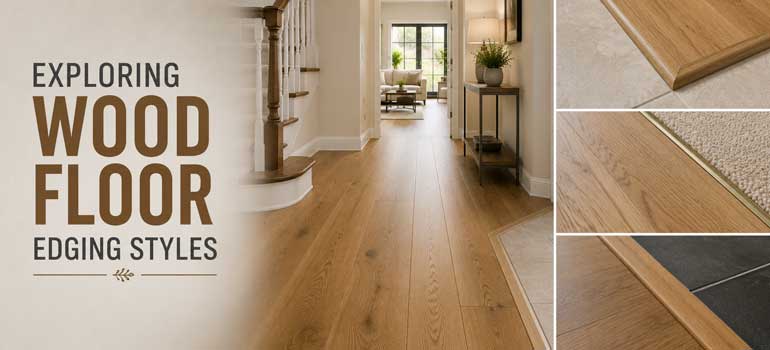
The edge profile on a wood floorboard is easy to overlook when you're focused on species, colour, and finish, but it genuinely changes how the finished floor looks and behaves. A few different profiles dominate the market, and each one comes with real trade-offs worth understanding before you choose.
Square Edge
Square-edged boards are cut at a clean 90 degrees with no further shaping. Fitted correctly, they sit flush against each other and create the most uniform, seamless look of any edge type, which is why they're often associated with a high-end, contemporary finish.
- Pros: the cleanest, most seamless overall appearance; no visible groove between boards; suits minimalist or contemporary interiors particularly well.
- Cons: requires genuinely precise fitting, since any unevenness in the boards or subfloor shows up clearly with nothing to disguise it; generally more expensive to produce and fit; not the easiest option for a confident DIY attempt.
Bevelled Edge
Bevelled boards have a distinct angled groove cut along each edge, creating a clearly defined line between boards once fitted.
- Pros: more forgiving to install than square edge, since the bevel disguises minor unevenness in the boards or subfloor; the visible groove also makes gaps and small imperfections between boards far less noticeable.
- Cons: the groove itself becomes a genuine dirt and dust trap over time, contrary to what's sometimes claimed, a bevelled floor generally needs more frequent, careful cleaning to keep the grooves free of built-up grime than a flush square-edged floor does.
Micro-Bevelled Edge
A smaller, more subtle version of the bevel, cut as a fine V-shaped groove rather than a pronounced angle.
- Pros: gives a largely uniform, smooth appearance while still offering a slight visual definition between boards; strikes a middle ground between square edge's seamlessness and bevelled edge's forgiveness.
- Cons: the groove is smaller than a full bevel, but it's still a groove, so some of the same dirt-trapping consideration applies, just to a lesser degree.
Eased Edge
A profile the original version of this guide left out entirely: eased edge boards have their top corners softened or slightly rounded rather than left sharp, without a full bevel groove.
- Pros: gives a subtle, gently defined line between boards without the pronounced groove of a full bevel; genuinely easy to keep clean, since there's no deep channel for dirt to collect in; versatile enough to suit both contemporary and more traditional interiors.
- Cons: less dramatic definition than a full bevel if you're specifically after a strongly delineated plank-by-plank look.
Choosing Between Them For Your Room
A few patterns generally hold up when matching edge type to room and style:
- Formal, contemporary rooms where a seamless look matters most tend to suit square edge best, provided the subfloor and fitting can support the precision it needs.
- Period properties or rooms with a slightly uneven existing subfloor often do better with bevelled or micro-bevelled edges, since the groove disguises minor imperfections that would otherwise be obvious with a flush square edge.
- High-traffic areas like hallways and kitchens, where easy cleaning matters more than a dramatic groove, tend to suit eased edge well, since it avoids the dirt-trapping downside of a full bevel.
Whichever edge you're drawn to, it's worth discussing your specific subfloor condition with whoever's fitting the floor, since floorboards fitting and general wood floor fitting both depend heavily on a properly prepared subfloor to get the chosen edge profile looking its best, particularly with less forgiving square-edge boards.
Choosing The Right Floor Edge: Common Questions
Do bevelled edges really collect more dirt than square edges?
Yes, genuinely. The groove creates a physical channel where dust and grime can build up over time, so bevelled floors typically need more attention when cleaning than a flush square-edged floor.
Is square edge flooring harder to install than bevelled?
Yes, it requires more precision, since there's no groove to disguise minor unevenness in the boards or the subfloor. It's generally best left to a professional installer rather than attempted as a DIY project.
What's the difference between a full bevel and a micro-bevel?
Scale, mainly. A full bevel has a more pronounced angled groove, while a micro-bevel is a smaller, subtler version that gives some definition between boards without as strong a visual line.
Is eased edge a good all-round choice if I can't decide?
It's a genuinely solid middle-ground option, offering a subtle line between boards without the dirt-trapping downside of a full bevel, and it suits a wide range of interior styles.
Call us on 020 7036 0625 or request a free site visit and we'll help you choose the right edge profile for your room and subfloor.