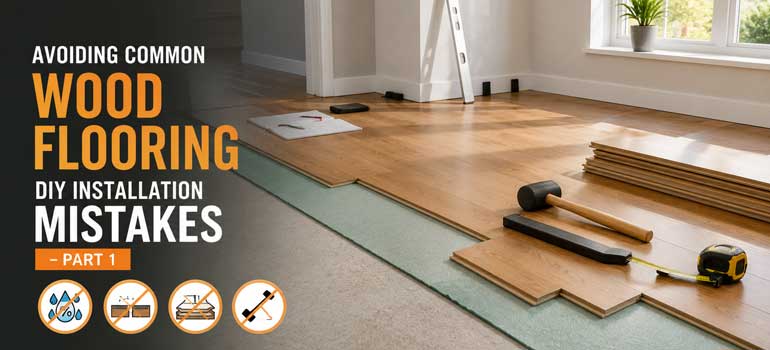
Most DIY flooring problems don't actually happen during the fitting itself, they're set up beforehand, in the preparation stage that's easy to rush or skip entirely. This first part covers the mistakes people make before a single board goes down, the ones that quietly determine whether the rest of the project goes smoothly or not.
1. Overestimating your own skill level
Wood flooring isn't an especially complicated job on paper, but it does demand real precision, and the gap between "I've watched some videos" and "I can actually cut a clean, tight joint" is bigger than it looks. Overconfidence here shows up later as visible gaps, uneven boards, or an early squeak that traces back to a rushed first attempt. There's no shame in getting partway through and calling in a professional to finish or correct the job, that's a far better outcome than living with a permanently disappointing floor.
2. Skipping the acclimation period
New flooring needs time in the room it's actually being fitted in, generally at least 48 hours, to adjust to that specific space's temperature and humidity before installation. Skipping this step is one of the most common causes of movement, gapping, or unevenness that shows up weeks or months after fitting, once the wood has finally settled into conditions it should have acclimated to before it was ever nailed or glued down.
3. Not checking the subfloor's condition and moisture level
A subfloor that's uneven, damp, or otherwise unprepared undermines everything laid on top of it, regardless of how carefully the flooring itself is fitted. This is genuinely one of the easiest steps to skip because it doesn't feel like "real" progress on the project, but installing directly over an unchecked subfloor is asking for problems, cupping, hollow spots, or adhesive failure, that are far more expensive to fix once the floor is already down.
4. Starting without the right tools
Improvising with whatever's already in the shed is a common shortcut, and it's a genuine false economy. Missing the right tools, a proper tapping block, expansion wedges, a board puller for tight final rows, leads to damaged board edges, uneven gaps, and a slower, more frustrating process overall. Gathering everything needed before starting, rather than working it out as problems come up, makes a measurable difference to the final result.
5. Underestimating how much material you'll actually need
Ordering exactly the square footage of the room, with no allowance for cutting waste, is a mistake that catches out a lot of first-time fitters. A shortfall partway through a job means a delay while more material is sourced, and if it's from a different batch, colour and shade variation between batches can make the join genuinely visible once the floor is finished.
6. Assuming the job will take less time than it will
A first attempt at fitting a wood floor almost always takes longer than expected, and rushing to hit an unrealistic timeline is exactly how corners get cut in ways that show up later. It's worth planning for the room to be out of action for a few days rather than assuming a weekend will comfortably cover it, particularly for a first-time DIY attempt.
If working through this list leaves you feeling like a professional wood floor fitting might be the more sensible route after all, that's a completely reasonable conclusion to land on, not a failure. Solid wood and engineered wood installations both benefit from the kind of precision that comes with experience, and getting it right the first time is usually cheaper than fixing a DIY attempt that went wrong.
DIY Flooring Preparation: Common Questions
How long does new wood flooring actually need to acclimate before fitting?
Generally at least 48 hours in the room it's being installed in, though this can vary depending on the product and how different the storage conditions were from the room itself.
How much extra flooring should I order beyond the room's exact measurements?
Around 10% extra is the standard guide, to account for cutting waste and offcuts, particularly around a room's edges and any awkward corners.
What's the biggest risk of installing over an unchecked subfloor?
Moisture and unevenness in the subfloor undermine the flooring above it regardless of how well it's fitted, leading to issues like cupping, hollow spots, or adhesive failure that are considerably more expensive to fix once the floor is already down.
Is it normal for a first DIY flooring project to take longer than planned?
Yes, very much so. First-time fitters routinely underestimate the time required, and planning for a few days rather than a single weekend avoids the kind of rushed shortcuts that cause problems later.
Call us on 020 7036 0625 or request a free site visit if you'd rather leave the fitting to professionals, or want a second opinion partway through a DIY project.