Monday - Friday 07:30 - 17:30, Saturday 07:30 - 16:00
Engineered Wood Floor Installation in London
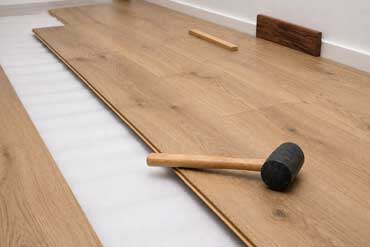
Engineered wood floor fitting is the installation of multi-layer wood flooring boards — comprising a real hardwood wear layer bonded to a stable plywood or HDF core — onto a prepared subfloor, using floating, gluing, or secret-nailing methods depending on the subfloor type, the product specification, and the conditions of the property.
Engineered wood is currently the most widely installed wood floor type in London. Its dimensional stability — the plywood core construction resists expansion and contraction with changes in humidity far better than solid timber — makes it the appropriate choice for the wide range of subfloor types found across London's varied housing stock, including concrete subfloors in post-war and modern buildings, underfloor heating systems in renovated properties, and the suspended timber subfloors of Victorian and Edwardian houses where solid wood would require more careful management of moisture and movement.
Flooring Services London installs engineered wood floors across London for residential and commercial clients, working with all major engineered flooring products and all subfloor types. Engineered floor installation is priced from £25/m² — see our prices page for full details. As part of our full floor fitting service, we carry out subfloor preparation, moisture assessment, underlay specification, and all finishing work, including door trimming and skirting or beading installation.
What Is Engineered Wood Flooring?
Engineered wood flooring consists of a real hardwood surface layer — the wear layer — bonded under high pressure to multiple layers of cross-ply plywood or HDF (high-density fibreboard). The cross-ply construction counteracts the natural tendency of timber to expand and contract across the grain with changes in temperature and humidity, producing a board that is significantly more dimensionally stable than an equivalent solid timber plank of the same species.
The wear layer — typically 3–6mm of real oak, walnut, ash, or other hardwood species — is the part of the board that is visible and that determines the floor's appearance. It can be sanded and refinished a limited number of times (typically once or twice, depending on wear layer thickness), giving the floor a meaningful service life that is genuinely comparable to solid timber for most residential applications.
Key advantages of engineered wood for London properties:
- Compatible with underfloor heating — the stable core allows use over UFH systems where solid timber would be at risk of distortion
- Suitable for concrete subfloors — can be glued directly or floated over concrete, where solid wood would require battens or a floating installation
- More forgiving of London's variable humidity — the cross-ply core reduces movement compared to solid timber, important in buildings with inconsistent heating or older single-glazed windows
- Available in wider planks — engineered construction allows stable planks of 180mm, 200mm, 220mm and wider, which are impractical in solid wood at equivalent cost
- Wide range of species, finishes, and board formats, including herringbone and chevron parquet patterns
Subfloor Types and Installation Methods in London Properties
The correct installation method for an engineered floor depends entirely on the subfloor type. This is the most critical technical decision in any engineered floor installation — getting it wrong leads to movement, noise, adhesion failure, and in the worst cases structural damage to the floor. We assess every subfloor as part of the free site visit before recommending an installation method.
Concrete Subfloors
Concrete subfloors are the most common subfloor type in London's post-war housing stock — purpose-built flats, converted commercial buildings, and many ground-floor rooms in older properties where original suspended timber has been replaced. They are also standard in London's growing stock of new-build and recently renovated properties.
Glued installation is the most reliable method for engineered wood over concrete. A flexible wood flooring adhesive — Bona R848, Mapei Ultrabond Eco S955, or equivalent — is applied to the concrete surface with a trowel, and the engineered boards are pressed into the adhesive and held in position until the adhesive cures. Gluing produces the most stable, squeak-free, and acoustically solid result of any installation method and is our recommended approach for concrete subfloors where conditions allow.
Floating installation lays the engineered boards over an underlay without adhesion to the subfloor — the boards click or glue together at their joints and the floor moves as a single unit over the underlay. Floating is quicker and less expensive than gluing, and produces a good result on flat concrete subfloors when the correct underlay is specified. However, a floating floor has more movement underfoot than a glued floor and can be noisier — particularly in flats where impact sound transmission to the flat below is a consideration.
Moisture assessment is essential before any engineered floor installation over concrete. Concrete subfloors release residual construction moisture for months or years after laying, and excess moisture reaching the underside of an engineered floor causes adhesion failure, swelling, and cupping. We measure concrete moisture content using a calibrated hygrometer before every installation over concrete, and specify a damp-proof membrane where moisture readings exceed the manufacturer's threshold for the product being installed.
Suspended Timber Subfloors
Suspended timber subfloors — joist-and-board construction — are standard in London's Victorian, Edwardian, and inter-war housing stock, typically on all upper floors and frequently on ground floors as well. They are the most common subfloor type we encounter in London residential installations.
Secret nailing through the tongue of each engineered board into the subfloor boards beneath is the preferred installation method on suspended timber. It produces a rigid, squeak-free result and allows for some natural movement of the subfloor beneath. Engineered boards must be a minimum of 14–15mm thick for secret nailing to be effective.
Floating over timber is an alternative where the existing subfloor boards are level and in good condition. This is faster than secret nailing but produces a less solid result underfoot and is more susceptible to developing squeaks over time as the floating floor moves relative to the subfloor beneath.
Subfloor condition is assessed before every installation over timber. Existing subfloor boards that are loose, squeaking, or uneven must be secured and levelled before the new floor is laid — installing engineered wood over a poor subfloor simply transfers the subfloor's problems to the new floor surface.
Underfloor Heating Systems
Underfloor heating is increasingly common in London's renovated and new-build properties — particularly in kitchens, bathrooms, and open-plan living areas in higher-specification conversions. Engineered wood is the preferred choice over UFH because its stable cross-ply core tolerates the temperature cycles of an underfloor heating system without the distortion risk that affects solid timber.
However, not all engineered floors are suitable for use over all UFH systems. The key parameters are the maximum surface temperature rating of the flooring product, the total thermal resistance (tog value) of the floor build-up including underlay, and the type of UFH system — water-fed (hydronic) systems typically have more regulated temperature control than electric mat systems, which can create more extreme temperature cycles.
We specify only engineered flooring products that are rated compatible with the specific UFH system in place, and we calculate the total floor build-up thermal resistance to ensure the heating system will perform correctly after installation. Where an existing UFH system has no documentation, we advise on appropriate products conservatively and recommend the client obtain system documentation from their heating engineer before installation proceeds.
Engineered Floor Products and Specifications
Engineered wood is available in a wide range of formats and specifications. The most common choices we install in London properties include:
Plank widths: 150mm (classic format, suits most room sizes), 180–200mm (popular in open-plan spaces and larger rooms), 220mm+ (wide-plank format, suited to loft conversions and contemporary interiors). Wider planks tend to show more natural grain variation and are more likely to require gluing rather than floating for stability.
Wear layer thickness: 3mm (suitable for floating installation, limited sanding life), 4–6mm (allows one or two light sands over the floor's lifetime, recommended for long-term residential use). We always confirm wear layer thickness with clients before purchase, as this affects both the installation method available and the floor's long-term maintainability.
Surface finishes: Pre-finished lacquered (most popular — ready to use immediately after installation), pre-finished oiled or hard-wax oiled (natural appearance, requires periodic re-oiling maintenance), unfinished (sanded and finished on site after installation for a bespoke result).
Formats: Standard plank (straight-lay or diagonal), herringbone parquet, chevron parquet. Herringbone and chevron engineered floors are increasingly popular in London's period flat conversions and open-plan kitchen-living areas — they provide the look of traditional parquet without the complexity and cost of solid block installation. See our parquet floor fitting page for details on parquet-format engineered installation.
Engineered Floor Fitting Process
1. Free site visit and assessment — We visit the property, assess the subfloor type and condition, measure moisture levels, identify any levelling or preparation work required, discuss product options and specifications, and provide a fixed-price written quote. Additional charges for subfloor levelling, door trimming, and skirting or beading installation are always stated clearly in the quote — see our prices page.
2. Acclimatisation — Engineered boards should acclimatise to the room's temperature and humidity conditions for a minimum of 48 hours before installation. We advise on acclimatisation requirements for the specific product being installed.
3. Subfloor preparation — Any required levelling compound applied to concrete subfloors; loose or squeaking subfloor boards secured on timber subfloors; damp-proof membrane installed where moisture readings require it. The subfloor must be flat to within 3mm over a 1.8m span before installation begins.
4. Underlay installation — Appropriate underlay selected and laid based on subfloor type, installation method, and acoustic requirements. For flats in London mansion blocks and apartment buildings, acoustic underlay is often a lease requirement — we advise on compliant underlay specifications and can provide documentation for managing agents.
5. Floor installation — Boards installed in the specified direction and pattern using the appropriate fixing method — gluing, secret nailing, or floating. Expansion gaps maintained at all fixed perimeters. Threshold strips fitted at doorways and room transitions.
6. Finishing work — Door trimming where reduced floor-to-door clearance requires it; skirting board or beading installation to cover expansion gaps at walls. Site finishing (sanding and lacquer or oil application) carried out where unfinished boards have been specified — see our floor sanding page.
7. Final inspection and clean-up — Floor inspected for alignment, gaps, and finish consistency. All installation debris removed. Written aftercare instructions and maintenance product recommendations provided.
Engineered Floor Installation Costs in London
Engineered floor installation is priced from £25/m² for the fitting labour. Additional charges may apply for:
- Subfloor levelling (concrete or timber)
- Door trimming
- Skirting board or beading installation
- Damp-proof membrane
- Acoustic underlay (where specified for lease compliance)
All additional charges are assessed during the site visit and stated explicitly in the written quote — nothing is added on the day. See our prices page for the full price list. Properties within the London ULEZ and Congestion Charge zones may include a daily access surcharge, stated in the quote.
Frequently Asked Questions — Engineered Floor Installation in London
Is engineered wood suitable for underfloor heating?
Yes — engineered wood is the recommended wood floor choice for use over underfloor heating. The cross-ply core construction provides the dimensional stability needed to tolerate UFH temperature cycles without distorting. However, the specific product must be rated compatible with UFH by the manufacturer, and the total thermal resistance of the floor build-up must be within the system's operating parameters. We confirm compatibility and calculate floor build-up values before every UFH installation.
Can engineered wood be installed in a ground-floor flat with a concrete subfloor?
Yes — concrete subfloor installation is one of the most common scenarios we handle in London. The key requirements are that the concrete is sufficiently dry (moisture content within the manufacturer's threshold), adequately flat (within 3mm over 1.8m), and structurally sound. We measure moisture and assess flatness during the site visit and advise on any preparation needed before installation.
My lease says I need acoustic underlay — what does this mean?
Many London leasehold flat leases — particularly in mansion blocks and purpose-built apartment buildings — require a minimum level of impact sound insulation between floors, typically expressed as a minimum Lw reduction value. The underlay specification needed to meet this requirement depends on the existing floor construction and the flooring product being installed. We advise on compliant underlay options and can provide a written specification for your managing agent or freeholder on request.
How long does engineered floor installation take?
A standard room (15–25 m²) typically takes one day, including subfloor preparation and installation. A complete ground floor (50–80 m²) usually takes two to three days. Larger projects or those requiring significant subfloor levelling work take longer — the expected duration is confirmed in the written quote after the site visit.
Can engineered wood be installed in a kitchen or bathroom?
Engineered wood can be installed in kitchens where the floor will be properly sealed, and water exposure is managed — spills wiped up promptly, no standing water around appliances. It is not recommended in wet rooms, shower rooms, or areas with frequent, prolonged water exposure. For areas immediately adjacent to bathrooms or utility areas, we advise on product selection and installation method to maximise moisture resistance.
Call us on 020 7036 0625 or request a free quote online — we respond to all engineered floor fitting enquiries the same working day.