Monday - Friday 07:30 - 17:30, Saturday 07:30 - 16:00
Staircase Floor Fitting in London
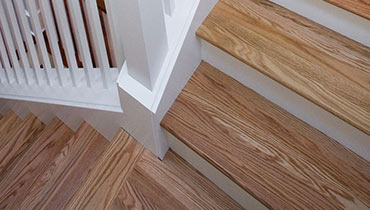
Staircase floor fitting is the installation of hardwood or engineered wood treads, risers, string capping, and landing boards onto an existing staircase structure — replacing worn carpet, old timber, or damaged stair surfaces with a clean, durable wood finish that matches or complements the floors on adjacent landings and hallways.
A staircase is one of the most visible and most used surfaces in any London home. In period London properties — the Victorian and Edwardian terraces and townhouses that make up the majority of the city's housing stock — the staircase is typically the first thing you see when you enter the house, connecting the entrance hall to the upper floors in full view. Fitting hardwood to a staircase transforms the entire feel of the property and is one of the most impactful single improvements a London homeowner can make to their interior.
Staircase fitting is also among the most technically demanding flooring services we carry out. Every tread must be precisely cut to the exact depth and width of the individual step, fitted securely enough to be safe underfoot, and finished to match the flooring on adjacent landings. Cutting corners on a staircase — loose treads, poorly fitted nosings, uneven risers — is both visually obvious and a genuine safety concern.
Flooring Services London fits hardwood staircases across London, working on both period and modern properties as part of our full floor fitting service. Staircase fitting is priced on survey — contact us for a free site visit and written quote.
Staircase Components We Install
Understanding the components of a staircase helps clarify what is involved in a typical staircase fitting project:
Treads — the horizontal boards you walk on. The tread is the most critical component — it must be cut precisely to the step depth, secured firmly to the stringer (the structural side frame) and to the riser beneath, and finished with a bullnose or pencil-round nosing at the front edge. The nosing is a rounded or slightly angled front edge that provides a safe, comfortable transition between steps and reduces the visual sharpness of the step edge. Treads are typically 20–22mm solid hardwood or engineered hardwood and are the most visible element of the finished staircase.
Risers — the vertical boards between treads. Risers can be open (no board, space between treads) or closed (a board fills the vertical space between each tread). Fitting closed risers in hardwood gives a clean, fully finished appearance and is the standard specification for most London residential staircase projects. Open riser staircases — increasingly common in London's contemporary conversions and loft extensions — require no riser boards but demand very precise tread installation as both the top and underside of each tread are visible.
String capping — the board that covers the top of the stringer (the angled side frame of the staircase) on the open side of a staircase. String capping is cut to follow the profile of the stringer exactly and is mitred at the base to meet the skirting board or floor at landing level. In London period properties, the string capping is often the most complex piece of the staircase fitting job — the Victorian and Edwardian stringer profiles are not always uniform and require careful scribing to fit cleanly.
Landing boards — the flooring on the landing at the top of the staircase. Landing boards must match or complement the treads and the flooring in adjacent rooms. We fit landing boards as part of staircase projects and ensure a clean, consistent transition between the staircase and the landing floor.
Newel post and baluster surrounds — where the staircase has a newel post at the bottom, the surrounding floor area requires careful cutting and scribing around the post base. We fit floor boards and landing boards around newel posts and existing balustrade structures without disturbing the structural fixings.
Timber Species and Materials for London Staircases
Oak is the most widely specified material for London staircase fitting, in both solid and engineered formats. European oak is hard enough to withstand the concentrated impact loading of stair treads — significantly more demanding than floor loading — and takes lacquer and oil finishes well. Solid oak treads are the standard specification for most London residential projects.
Engineered oak treads are available where solid oak is not appropriate — for example, where the staircase is in a room with underfloor heating affecting the ambient temperature, or where specific plank dimensions are needed that are not readily available in solid timber. Engineered treads have a real oak wear layer and perform very similarly to solid treads in normal staircase use.
Walnut — darker and richer than oak, walnut treads are specified in London's higher-specification residential properties where a more dramatic or contemporary staircase aesthetic is desired. Slightly softer than oak but entirely suitable for staircase use in normal residential settings.
Pine and softwood — for period London properties where the existing staircase has original pine treads and the brief is to restore or replace them in keeping with the original character, new or reclaimed pine treads can be fitted to match. See our floorboards fitting page for details on softwood timber sourcing for period restoration projects.
Matching the adjacent floor — in most London staircase projects the brief is to match the staircase timber and finish to the flooring on the ground floor hallway and first-floor landing. We advise on the closest available timber specification and finishing approach to achieve a consistent result across the staircase and adjacent floors, including where the hall floor has already been fitted or sanded by us or by another contractor.
Staircase Fitting in London Period Properties
The majority of staircase fitting work we carry out in London is in Victorian and Edwardian terraced houses and townhouses — properties built between approximately 1840 and 1920 that make up an enormous proportion of London's residential housing stock, particularly in inner boroughs including Islington, Hackney, Lambeth, Wandsworth, Hammersmith, and Kensington.
These staircases have specific characteristics that affect how fitting is carried out:
Non-uniform step dimensions — Victorian and Edwardian staircases were built by hand and individual step depths and heights often vary slightly between treads, particularly in older properties. Each tread must be measured and cut individually — copying a single measurement and cutting all treads to the same dimension will result in gaps or overlaps at multiple steps. We measure every step individually before cutting any timber.
Existing carpet gripper and underlay removal — most London period staircases we work on have been carpeted at some point, leaving carpet gripper rods and tack strips along the nosing edge and at the back of each tread. These must be removed cleanly without damaging the underlying stringer structure before new treads are fitted.
Original pine treads beneath carpet — in many London Victorian terraces the original pine treads are still in place beneath the carpet. Where these are in sound structural condition, we assess whether they can be restored through sanding and refinishing rather than being replaced — restoration is almost always more cost-effective and preserves the original character of the staircase.
Winding stairs and curved strings — some London period staircases have winding treads at the bottom — the wider triangular or fan-shaped treads at the base of a turn staircase — and curved or swept string profiles. These require more complex cutting and scribing than straight staircases and add to the overall installation time and cost. We assess all configuration details during the site visit and price accordingly.
Staircase Fitting Process
1. Free site visit and assessment — We examine the staircase structure, measure every step individually, assess the condition of the existing treads and risers, discuss timber species and finish options, and provide a fixed-price written quote. We confirm whether restoration of existing treads is a viable alternative to replacement.
2. Preparation — Existing carpet, gripper rods, and old tread surfaces removed. Stringer and riser structures checked for soundness. Any loose or squeaking structural elements are secured before new timber is fitted.
3. Precision cutting — Each tread is cut individually to the exact dimensions of its specific step. Nosing profile routed or shaped as specified. Risers cut to height. String capping cut to follow the stringer profile precisely.
4. Fitting and fixing — Treads fixed securely using a combination of construction adhesive and countersunk screws, with screw holes filled and sanded flush. Risers fitted and secured. String capping is scribed to the stringer and fixed. All fixings concealed or filled.
5. Sanding and finishing — New timber sanded smooth and finished with the specified product — typically water-based lacquer (Bona Traffic HD is the preferred choice for staircases due to its exceptional hardness and resistance to concentrated impact loading) or hard-wax oil where a more natural finish is preferred. Finish matched to adjacent landing and hallway floors where possible.
6. Final inspection — Every tread is checked for security and level. Nosings checked for consistent projection. The finish is inspected for evenness. Written aftercare instructions provided.
Frequently Asked Questions — Staircase Floor Fitting in London
Can you sand and restore my existing Victorian pine stair treads rather than replacing them? In many cases, yes — and this is often the more cost-effective and sympathetic approach. Original Victorian pine treads, even those that look badly worn or marked, can frequently be restored through sanding and refinishing to a very good standard. We assess the tread condition during the site visit and give an honest comparison of restoration vs. replacement costs and results. Where treads are structurally sound — no cracks, no rot, adequate thickness — restoration is almost always worth considering first.
What finish is best for staircase treads in a London home? Bona Traffic HD water-based lacquer is our most recommended finish for staircase treads. It is the hardest-wearing lacquer we apply — formulated for commercial-grade impact resistance — and significantly outperforms standard residential lacquers in the concentrated point-load conditions of stair use. It is available in extra matt, matt, satin, and semi-gloss sheens. For a more natural appearance, hard-wax oil (Osmo Polyx) is an alternative — it wears differently to lacquer and can be spot-repaired more easily, but requires more frequent maintenance on a heavily used staircase.
How long does staircase fitting take? A standard straight flight of 12–14 steps with closed risers and string capping typically takes two to three days, including fitting, sanding, and two finish coats. More complex staircases — with winding treads, curved strings, or open risers — take longer. We confirm the expected duration in the written quote after measuring the staircase.
Can the staircase be used during fitting? For most London households, this is a practical necessity — we fit staircases in occupied properties regularly. We typically work in a way that keeps at least one side of each step accessible at all times during installation, and we schedule finish coats to allow adequate drying time overnight before the staircase is used the following morning. We discuss scheduling and access requirements with you before work begins.
Do you match staircase timber and finish to an existing floor? Yes — achieving a consistent result between the staircase and the adjacent hallway and landing floors is always a priority. We advise on the closest available timber match and use the same finish product and sheen level as the adjacent floors where possible. Where the existing floors were sanded and finished by us previously, matching is straightforward. Where another contractor fitted the floors, we assess the existing finish during the site visit and advise on the closest achievable match.
Call us on 020 7036 0625 or request a free quote online — we respond to all staircase floor fitting enquiries the same working day.