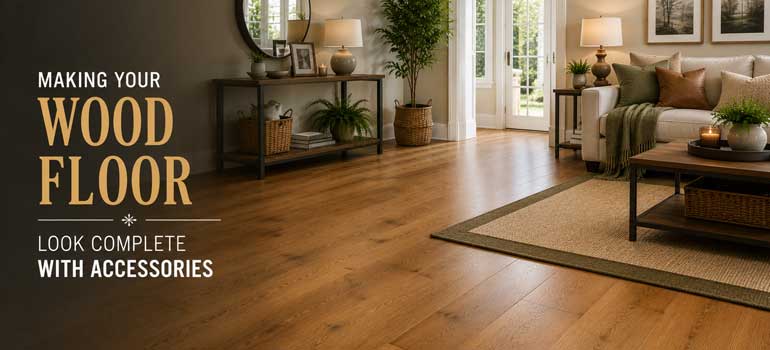
Choosing the right wood, tone, and pattern for a new floor takes most of the decision-making, but it's rarely the whole job. A surprising number of otherwise well-fitted floors look unfinished simply because the details around the edges, at doorways, around pipes, along skirting, never got proper attention. Here's what actually matters and why.
Accessories That Solve A Real Problem
These aren't purely decorative. Skip them and you'll run into an actual issue sooner or later, not just a slightly less polished look.
- Beading covers the expansion gap every floor needs. Wood expands and contracts with humidity, so every proper installation leaves a small gap between the boards and the walls to allow for that movement. Leave that gap uncovered and it looks unfinished; fill it in solid and you risk the boards cracking as they try to expand into a space that isn't there. Beading solves this by covering the gap while still leaving it free to do its job. There are two common types: scotia, a curved decorative moulding that covers the gap without needing the skirting removed, and quadrant, a simpler angled profile. Both come in a range of finishes that can be matched to the floor itself.
- Thresholds manage the transition between rooms. Wherever flooring changes type, wood meeting tile, or one wood floor meeting another at a different level, a threshold (sometimes called a door bar) creates a clean, secure transition rather than an abrupt, unfinished edge. Beyond looking tidier, it also protects both floor edges from the wear that a doorway naturally gets more of than the rest of the room.
- Stair nosing finishes where flooring meets a staircase. If your wood flooring continues onto or alongside a staircase, the edge of each step needs proper nosing to look finished and to hold up to the heavier wear steps take. Staircase floor fitting as a dedicated job typically includes this as standard, since stairs genuinely need a different approach to flat flooring rather than an afterthought once the main floor is done.
Accessories That Are More About The Finish
These matter less structurally, but they're often what separates a floor that looks genuinely considered from one that looks like the trim was an afterthought.
- Pipe roses cover the gaps around radiator pipes. Also called pipe covers, these small discs sit around the base of a pipe where it emerges through the floor, hiding the rough cut edge that would otherwise be left exposed. They're inexpensive, quick to fit, and available in wood, plastic, or metal finishes to match whatever look you're going for.
- Skirting boards deserve a second thought once new flooring goes in. New flooring can shift how existing skirting looks, either because the floor height has changed slightly or because the tone of the new floor no longer sits well against it. It's worth considering whether the skirting should be replaced, repainted, or left as-is once the flooring decision is made, rather than treating it as a separate, unrelated job.
- Vents and register covers can be matched rather than left generic. Where floor vents interrupt a run of flooring, a wood-finish or colour-matched cover keeps the visual line of the floor intact rather than leaving an obviously mismatched metal grille sitting in the middle of it.
Getting It To Look Considered, Not Just Installed
None of these accessories are expensive relative to the cost of the flooring itself, but skipping them, or choosing them as an afterthought once the main floor installation is finished, is one of the most common reasons a floor ends up looking slightly unresolved even when the flooring itself is genuinely good quality. Getting the trims, thresholds, and covers matched to the floor from the outset, rather than bolted on separately later, is usually what makes the difference between a floor that looks fitted and one that looks finished.
A Few Questions Worth Answering Before You Start
Do I really need beading, or can I just leave the expansion gap covered by skirting?
If your existing skirting already covers the gap fully without restricting movement, you may not need separate beading. In most cases, particularly where skirting is being kept as-is, beading gives a cleaner result and is worth including.
Does beading come in enough finishes to match unusual wood tones?
Generally yes. Most suppliers offer beading in a range of wood species and colour-matched finishes, so matching to anything from a pale oak to a dark walnut is usually straightforward.
Is a threshold necessary if both rooms have the same flooring?
Not always, if the floor runs continuously without a height or material change, a threshold isn't strictly needed. It becomes worthwhile wherever the flooring type, direction, or level actually changes.
Should stair nosing match the flooring exactly, or can it be a contrasting accent?
Either works. Matching gives the most seamless, unified look, while a contrasting nosing can add definition and improve visibility on the stair edge itself, which some households prefer for safety reasons.
Call us on 020 7036 0625 or request a free site visit and we'll help you get the finishing details right alongside the main installation.