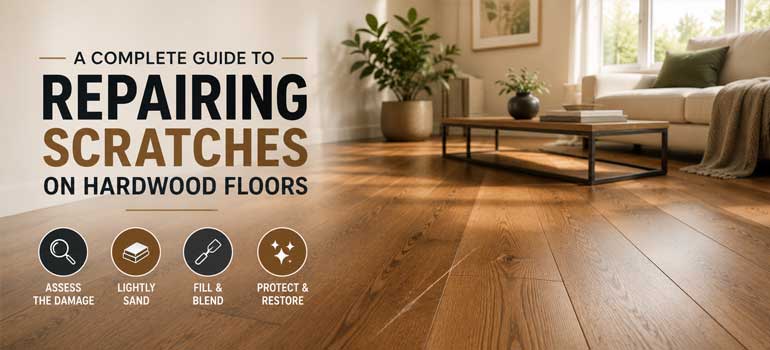
Scratches on a wood floor are more or less inevitable with everyday use, but they don't have to stay visible. Most minor scratches can be treated at home with the right approach, and even some deeper ones can be made to disappear almost entirely with a bit of patience.
Work Out What You're Actually Dealing With
Before doing anything, take a proper look at the scratch. Surface scratches sit only in the finish, the lacquer or oil layer, and haven't reached the bare wood underneath. Deeper scratches have gone through the finish into the timber itself. This distinction matters, because the right fix is completely different depending on which one you're looking at, and treating a deep scratch like a surface one usually makes it more noticeable, not less.
If a scratch is genuinely deep, runs across several boards, or you're not confident about matching the existing finish, it's worth getting a professional opinion before attempting a fix yourself. A botched repair is often harder to correct afterward than the original scratch ever was.
Fixing Light Surface Scratches
For scratches that haven't reached bare wood, the fix is usually straightforward:
- Clean the area first, removing any dust or grit so you're not grinding debris into the finish while working.
- Rub gently with fine steel wool (grade 0000 is ideal), always working along the direction of the grain rather than across it, since going against the grain tends to widen the scratch's appearance rather than blend it.
- Buff the area with a soft cloth afterward to even out the sheen against the surrounding finish.
For very light scratches, this alone is often enough to make them essentially disappear.
Fixing Deeper Scratches That Reach The Wood
Where a scratch has actually broken through into the timber, a bit more work is needed:
- Lightly sand the scratch with fine-grit sandpaper, working with the grain, just enough to smooth the damaged fibres without creating a noticeable dip.
- Clean the area thoroughly with a soft cloth and a wood-appropriate cleaner, then let it dry completely, ideally for a couple of hours, before continuing.
- Apply a colour-matched wood filler with a filling knife if the scratch has left a visible gap in the timber, choosing a shade as close as possible to your floor's actual colour rather than a generic match.
- Sand away any excess filler once it's dried, so the repair sits flush with the surrounding surface.
- Apply a matching finish over the repaired area with a small brush, letting it dry fully, and repeat with a second coat if needed for full colour depth.
Stain markers, pens that combine stain and a protective coating in one product, are a genuinely useful shortcut for smaller repairs, and blending two shades together often gets closer to your floor's actual colour than any single marker will on its own. It's worth remembering that real wood naturally varies in tone across a floor anyway, so a very slight mismatch is rarely as noticeable as it seems while you're working close-up.
When To Call A Professional Instead
DIY repair works well for isolated, minor damage, but there's a point where it stops being the sensible option. Widespread scratching across a large area, structural damage, or a floor that's due a refinish anyway is usually better handled with professional scratch repair, or in more extensive cases, a full sanding and refinishing that resets the whole floor rather than patching individual marks.
If your floor is generally in decent shape but the finish overall has started looking a little tired alongside the scratches, a professional floor polishing can refresh the whole surface at the same time, giving a more even result than treating scratches in isolation.
Frequently Asked Questions
Can all wood floor scratches be fixed at home?
Light surface scratches, yes, in most cases. Deeper scratches can often be improved significantly with the right technique, but widespread or structural damage is better left to a professional to avoid making things worse.
What's the difference between wood filler and gap filling?
Wood filler is used to fill an individual scratch or small area of damage. Gap filling is a different service specifically for the gaps that develop between floorboards over time, and it's typically only carried out as part of a full sanding job rather than as a standalone fix.
How long should I wait before walking on a repaired scratch?
Let the finish dry fully before regular use, which is usually a few hours per coat, though this varies by product. Rushing this step is one of the most common causes of a repair not holding up.
Is it worth trying to match the stain colour exactly?
Get as close as you reasonably can, but don't stress over a perfect match. Real wood floors naturally have some shade variation across their surface, so a small difference is far less noticeable in the room than it appears while you're working up close.
Call us on 020 7036 0625 or request a free site visit if a scratch is more than you'd like to tackle yourself, or if it's time for a full refinish.