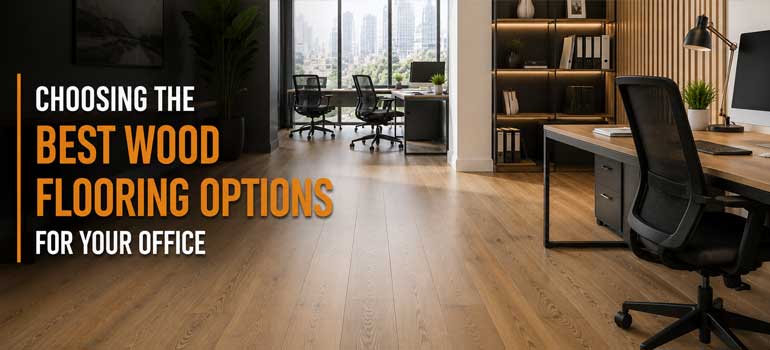
An office floor has to do two jobs at once. It needs to look professional and presentable, since it's often the first thing a client or visitor notices when they walk in, and it needs to survive daily footfall from staff, deliveries, and rolling office chairs without falling apart within a few years. Getting that balance right matters more in a commercial space than almost anywhere else.
Why Wood Is Usually The Right Answer
Real wood flooring tends to tick every box an office needs. It's durable enough for heavy daily use, straightforward to keep clean and presentable, and it carries a sense of quality and permanence that vinyl or carpet tile simply doesn't communicate in the same way. It also comes in a genuinely wide range of tones and finishes, so it's rarely difficult to find something that fits a company's branding or interior design.
There are two main categories worth understanding before choosing between them: solid wood and engineered wood. Both are real timber, both can look identical once fitted, and both are suitable for commercial use, but they behave differently under the specific pressures of an office environment.
Solid Wood In A Commercial Setting
Solid wood makes a strong impression. Its natural depth and character is often associated with professionalism and quality, which is exactly the reaction most businesses want from clients walking through reception. If the goal is to make the strongest possible visual statement, solid wood usually wins on looks alone.
The trade-off is sensitivity to the environment. Office buildings often have less stable humidity and temperature control than a typical home, particularly in older buildings or where heating and air conditioning cycle heavily through the day. That instability can, over time, cause the kind of movement solid wood is prone to, so it's worth getting a proper assessment of the building's conditions before committing to it, especially in high-traffic areas like reception.
Engineered Wood For Busy Areas
Engineered wood is built to handle exactly the kind of demanding conditions a commercial space creates. Its layered, cross-grain construction, with several layers of lumber or plywood bonded together beneath a real wood veneer, makes it considerably more resistant to the movement and wear that solid wood can struggle with. This is a large part of why engineered wood is so often recommended specifically for busy commercial areas.
It's also generally more flexible to install, particularly over the kind of concrete or uneven subfloors common in office buildings, and it holds up well over long corridors and open-plan floor areas that see continuous footfall throughout the working day.
Matching The Floor To The Space
Different parts of an office typically call for different priorities:
- Reception areas take the heaviest traffic and create the first impression, so durability and appearance both matter equally here. Engineered wood in a striking finish is often the best balance of the two.
- Meeting rooms and private offices see lighter use and more time spent by clients, so this is where solid wood's stronger visual impact can be worth the extra sensitivity to environment.
- Open-plan work areas and corridors need to prioritise durability above all else, given the constant footfall and rolling chairs, which typically points toward engineered wood as the more practical choice.
- Break rooms and kitchenettes carry more risk of spills, so a floor with good moisture resistance, or a well-sealed finish, matters more here than in other parts of the office.
Keeping An Office Floor Looking Its Best
Wood floors in commercial spaces need more frequent attention than the same floor in a quiet home, simply because of the volume of daily traffic. Regular floor maintenance keeps the finish protected and the floor looking sharp for visitors, and when a floor does eventually show heavier wear, professional commercial floor sanding can bring it back to a like-new condition without the disruption and cost of a full replacement. This is one of wood's biggest long-term advantages over other commercial flooring types, which typically can't be restored this way at all.
Frequently Asked Questions
Is wood flooring practical for a high-traffic office?
Yes, particularly engineered wood, which is specifically built to resist the kind of movement and wear that heavy daily foot traffic causes. A well-specified commercial floor, properly finished, holds up reliably even in constantly used spaces.
Should I choose solid or engineered wood for my office?
It depends on the area. Solid wood tends to suit lower-traffic spaces like meeting rooms where its visual impact matters most, while engineered wood is generally the more practical choice for reception areas, corridors, and open-plan spaces with constant footfall.
How often does an office wood floor need to be resanded?
It varies with traffic levels, but a busy reception area typically needs attention sooner than a quiet private office. Regular maintenance between full sands can meaningfully extend the gap between restorations.
Can commercial floor sanding be done without disrupting the working day?
Yes, this work is normally scheduled outside business hours, in the evenings or over a weekend, specifically to avoid disrupting day-to-day operations.
Call us on 020 7036 0625 or request a free site visit and we'll advise on the right wood flooring for your specific office space.