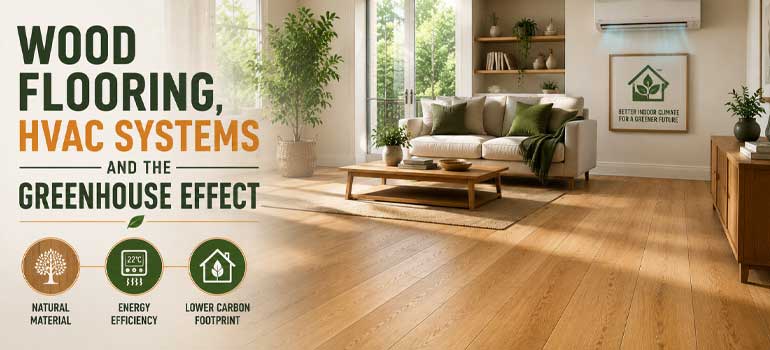
Moisture control is one of the most important factors behind a wood floor that installs cleanly and stays stable for years. HVAC systems - heating, cooling, and ventilation together, play a genuinely significant role in that, and a poorly managed system can quietly undermine an otherwise well-executed installation.
A Quick Clarification: What "Greenhouse Effect" Means Here
Worth clearing up first, since the term can be genuinely confusing: this has nothing to do with the atmospheric, climate-change greenhouse effect. In a flooring context, it refers to a much more local phenomenon: sunlight passing through windows and heating a room beyond its ambient temperature, in the same way sunlight heats the inside of a greenhouse or a parked car. That localised heating can drive humidity swings within a room independently of the wider property's climate control, which is exactly the effect this article is actually about.
Why Moisture Control Matters So Much
Excessive or fluctuating moisture, whether in the indoor air, the subfloor, or the timber itself before it's properly acclimatised, causes wood to expand and contract as it responds to its environment. Left unmanaged, this movement can lead to cupping, warping, broken boards, chipped finish, and a loose, noisy floor, problems that are considerably harder and more expensive to fix once a floor is already installed than they are to prevent beforehand.
Managing Humidity By Season And Climate
A few practical guidelines, depending on conditions:
- In humid seasons or naturally humid climates, if standard air conditioning can't keep relative humidity below roughly 50%, an additional dedicated dehumidifier is genuinely worth adding rather than hoping the AC alone will cope.
- In drier seasons or climates, where average relative humidity naturally sits below around 30%, additional humidification isn't necessarily required to maintain acceptable levels, though it's still worth monitoring rather than assuming it's automatically fine.
- In the UK specifically, the more common issue isn't naturally dry outdoor air, it's indoor heating during winter months drying the air out well below the recommended range, which is worth watching just as closely as summer humidity spikes.
Closed-Off Rooms Create Uneven Sub-Climates
Where HVAC vents are closed off in certain rooms, or those rooms simply aren't conditioned to the same temperature and humidity as the rest of the property, genuinely different micro-climates can develop within a single building. This matters directly for flooring installation, since a room with its own distinct humidity conditions may need separate acclimatisation and monitoring rather than being treated the same as the rest of the property, particularly relevant in larger homes or properties with multiple zones.
What Happens When HVAC Is Off Or Inconsistent
If heating or air conditioning is switched off for an extended period, or isn't running consistently, the room loses the regular air exchange that helps keep conditions stable. Combined with direct sunlight through windows, the localised "greenhouse" heating described earlier, this can produce humidity levels that fluctuate significantly through the day and night, driving exactly the kind of expansion and contraction that causes long-term problems. Keeping the indoor environment reasonably controlled, both before and during installation, avoids setting a floor up for movement issues from day one.
Properties or rooms prone to this kind of instability, conservatories, rooms with large south-facing windows, spaces with inconsistent heating, are also worth considering for engineered wood rather than solid timber, since its layered, cross-grain construction handles fluctuating conditions considerably more reliably.
HVAC And Wood Flooring: Common Questions
Does "greenhouse effect" in this context relate to climate change?
No, not at all. It refers to a local, room-level phenomenon, sunlight heating a space through windows beyond its ambient temperature, similar to how a greenhouse or a parked car heats up in direct sun.
Why do closed-off rooms cause problems for flooring specifically?
Because they can develop genuinely different humidity and temperature conditions from the rest of the property, which affects how wood in that specific room needs to acclimatise and behave differently from boards installed elsewhere in the same building.
Is engineered wood a better choice for rooms with unstable HVAC conditions?
Yes, generally. Its layered, cross-grain construction handles humidity swings and inconsistent conditions more reliably than solid wood, making it a sensible choice for conservatories, sunrooms, or rooms with less predictable heating.
Do I need a dehumidifier if my HVAC system already includes air conditioning?
Possibly, if the AC alone can't keep relative humidity below roughly 50% during humid periods. It's worth monitoring actual conditions rather than assuming standard air conditioning is always sufficient on its own.
Call us on 020 7036 0625 or request a free site visit and we'll assess your property's specific conditions before recommending the right flooring construction.