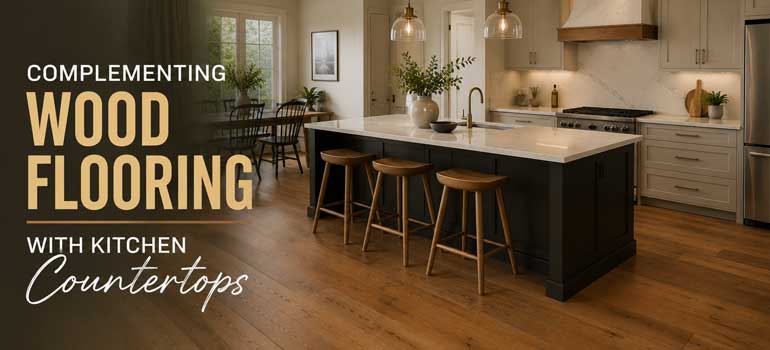
A kitchen floor and its worktops sit closer together, visually, than almost any other pairing in a home. Get the tones working together and the room feels considered and deliberate. Get them fighting each other and even good individual materials can end up looking mismatched. Here's how to approach it properly.
Why Engineered Wood Usually Makes Sense Here
Before getting into colour pairing, it's worth addressing the floor itself. Kitchens are one of the more demanding rooms in a home, dealing with humidity, temperature changes, and heavy daily traffic, all of which put real pressure on any wood floor. Engineered wood tends to hold up better here than solid timber, since its layered, cross-grain construction resists the expansion and contraction that a single-piece solid board is more prone to. Visually, it's identical to solid wood once fitted, so nothing about the pairing advice below changes based on which you choose.
Light Oak Floors
Light oak tends to carry a lot of natural character and grain variation, which effectively makes the floor a feature in its own right. With that much visual interest already at foot level, two directions work well: worktops that closely match the floor's tone for a calm, unified look, or worktops that are deliberately plain and simple, letting the floor's grain stay the focal point rather than competing with a busy worktop pattern above it.
Medium Oak Floors
Medium oak brings rich, warm browns and golden undertones that suit a kitchen particularly well, since that warmth tends to read as cosy and inviting rather than stark. Wooden worktops within the same warm tone family as the floor reinforce that feeling without looking flat, provided there's some variation in exact shade between the two so they don't blend into a single indistinct block.
Dark Or Almost-Black Floors
This is where contrast becomes genuinely important rather than optional. Very dark floors can make a kitchen feel smaller and more closed in, particularly if the worktops above are equally dark. A lighter-toned worktop breaks that up and keeps the room feeling open, or if you'd rather keep the worktop dark too, introduce the lightness somewhere else in the kitchen, pale cabinet doors or a light-coloured splashback both work well for this.
Matching Wood-On-Wood Without It Looking Flat
The biggest risk with an all-wood kitchen, floor and worktop both in timber, is that everything blends into a single undifferentiated surface rather than reading as two distinct materials. A few ways to avoid that:
- Vary the finish, even within the same tone family. A matte floor under a satin or oiled worktop creates just enough visual separation.
- Introduce a third material, a stone or metal splashback, tiled backsplash, or contrasting cabinetry colour, gives the eye somewhere else to land.
- Keep at least one shade of difference between floor and worktop, even if they're from the same species and tone family, rather than choosing an exact match.
If You'd Rather Not Match Wood To Wood
Not every kitchen needs a wood worktop just because it has a wood floor. Granite, quartz, and stainless steel all pair perfectly well with a wood floor and tend to create more contrast by default, which can be the easier route if matching wood tones feels like too much to get right. In that case, the floor's tone becomes the main decision, and the worktop choice is largely about picking a material that complements rather than competes with it.
Frequently Asked Questions
Should my kitchen worktop match my floor exactly?
Not necessarily, and in most cases a slight variation in tone looks more considered than an exact match, which can end up making the two surfaces blend and lose definition.
Is engineered wood a good choice for a kitchen floor?
Yes, generally a better choice than solid wood, since its construction handles the humidity and temperature swings common in kitchens more reliably.
What worktop works best with a dark wood floor?
A lighter-toned worktop, or a lighter feature elsewhere in the kitchen such as pale cabinetry, helps balance a dark floor and stops the room from feeling too closed in.
Can I have a wood floor and a stone or steel worktop?
Yes, and it's a common combination. Non-wood worktops naturally create contrast against a wood floor, which can be a simpler route than trying to match wood tones precisely.
Call us on 020 7036 0625 or request a free site visit and we'll help you choose a kitchen floor that works with your worktops and cabinetry.