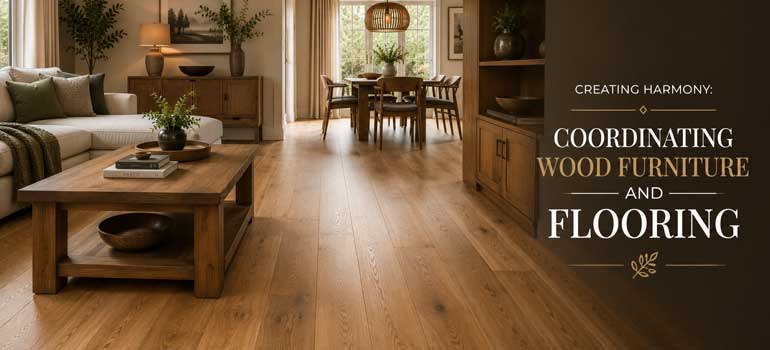
Wood floors and wood furniture together can look genuinely stunning, or genuinely chaotic, and the difference usually comes down to a handful of specific decisions rather than luck. Getting wood-on-wood pairings right is a slightly different challenge from matching furniture to a non-wood floor, since you're now working with multiple wood tones that all need to sit comfortably together.
Understanding Undertones
Every wood colour has two layers to it: the mass tone, the overall colour you register at first glance, and the undertone, the subtler underlying cast that takes a bit longer to notice but has a real influence on how well two pieces of wood actually sit together. Undertones broadly split into warm (leaning red, orange, or yellow) and cool (leaning grey or ash).
A practical way to identify undertone: look at the wood in natural daylight, away from warm artificial lighting, which can disguise a cool undertone or exaggerate a warm one. Hold a warm-toned sample and a cool-toned one side by side, the difference becomes much easier to spot in direct comparison than when judging a single piece in isolation.
As a general rule, contrasting depth works better than contrasting undertone. Dark furniture against a light floor, or vice versa, tends to look considered. Mixing a strongly warm-toned wood with a strongly cool-toned one at similar depths, on the other hand, is what usually creates that slightly "off" feeling people struggle to put their finger on.
Matching Grain, Not Just Colour
Colour gets most of the attention, but grain pattern matters nearly as much for how coordinated a room feels. Species with a bold, prominent grain (oak, ash) read very differently to those with a fine, subtle grain (maple, cherry), and mixing a strongly patterned wood with a very smooth, minimal one can create a similar visual friction to mismatched undertones, even when the colours themselves are compatible. Sticking to broadly similar grain intensity across your flooring and furniture, even if the species and exact colours differ, keeps the room feeling cohesive.
The Two-To-Three Wood Rule
In most standard-sized rooms, two to three different wood tones, species, or finishes is the practical ceiling before a room starts to feel busy rather than considered. A common, reliable approach is treating the floor as the dominant wood tone and choosing one, at most two, complementary furniture woods rather than introducing a new species with every piece. Beyond that number, the eye struggles to read the room as a coherent whole, and it starts to feel like a showroom rather than a considered interior.
Using A Buffer To Ease The Transition
Where two wood tones sit close together but don't blend quite seamlessly, a buffer helps bridge the gap without requiring an exact match. A rug, a cushion, or a decorative object in a colour that draws from both tones gives the eye somewhere to rest between the two woods, softening what might otherwise read as an abrupt transition.
Keep Finish Sheen Consistent Too
It's not just colour and grain, sheen level matters as well. A high-gloss floor paired with heavily matte, raw-textured furniture can feel disconnected even when the underlying wood tones are genuinely well matched. Keeping sheen broadly consistent - matte with matte, satin with satin, gloss with gloss, across the room's major wood surfaces reinforces the sense that everything belongs together.
Wood-On-Wood Matching: Common Questions
How many different wood tones can I mix in one room without it looking chaotic?
Two to three is the general practical ceiling for a standard-sized room. Beyond that, the eye tends to struggle reading the space as coherent rather than busy.
Is it better to match warm woods with warm woods, or is contrast fine?
Contrast in depth (light against dark) generally works better than contrast in undertone. Mixing strongly warm and strongly cool tones at similar depths is usually what creates an unbalanced, slightly off feeling.
Does grain pattern really matter as much as colour when matching wood?
Yes, genuinely. A bold, prominent grain paired with a very smooth, minimal one can create visual friction even when the colours themselves are compatible, so keeping grain intensity broadly similar helps.
Can I change my floor's undertone to better match existing furniture rather than replacing furniture?
Yes, in most cases. Wood floor staining applied after sanding can shift an existing floor's tone and undertone considerably, which is often easier than replacing furniture you already own and like.
Call us on 020 7036 0625 or request a free site visit and we'll help you find the right floor tone to work with your existing furniture.