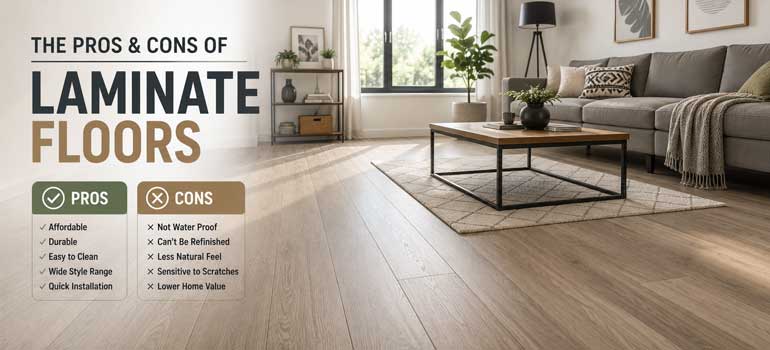
Laminate gets talked about as the budget stand-in for real wood, and that reputation isn't entirely fair anymore. It was introduced in the 1970s as a cheap wood-look product, and some of that early version still shapes how people think about it. Modern laminate is a different product, but it's worth understanding what it actually is before deciding whether it belongs in your home.
What laminate actually is
Laminate is built from five layers, and each one does a specific job. At the bottom sits a backing layer that keeps the board flat and resists moisture creeping up from below. Above that is a high-density fibreboard core, which is the layer that gives the plank its strength and its resistance to knocks and dents. On top of the core is the design layer, a high-resolution printed image of wood grain rather than real timber. That's the part people sometimes mistake for genuine wood when they see it from across a room. The final layer is a clear wear coat, usually melamine resin, which protects the printed image from scratches and everyday wear.
Underneath all of that, laminate is installed as a floating floor over an underlay, which cushions the boards, helps with noise reduction, and evens out small imperfections in the subfloor. It's this floating installation, combined with the printed image layer, that separates laminate from engineered wood, which uses a real timber veneer bonded to a stable core rather than a photograph of one.
Laminate versus engineered and solid wood
The three options get confused with each other more than they should.
Solid wood is exactly what it sounds like: full-depth timber, sanded and finished on site or before installation. It can be refinished many times over its life, which makes it the longest-lasting option, but it's also the most demanding when it comes to humidity and subfloor conditions.
Engineered wood has a real wood veneer, typically a few millimetres thick, bonded to a plywood or HDF base. It looks and feels like solid wood because the surface is solid wood, and it can usually be sanded and refinished at least once or twice, though not as many times as a full solid board.
Laminate has no real wood anywhere in it. What you're seeing and touching is a printed image under a protective coating. That doesn't make it a lesser product in every sense, it just makes it a different one, better suited to some situations than others.
Where laminate makes sense, and where it doesn't
Laminate holds up well in busy households, rental properties, and rooms where budget matters more than the ability to refinish the floor decades from now. Its wear layer is genuinely tough against scuffs and everyday scratches, and unlike solid or engineered wood, it isn't something you'll ever need to sand.
Where it falls short is anywhere with sustained moisture. Standing water can cause the fibreboard core to swell at the joints, and once that happens the board is damaged for good. For kitchens, bathrooms, or anywhere spills are common, LVT flooring is a better fit since it's genuinely waterproof rather than just water-resistant at the seams.
It's also worth being honest about the ceiling on laminate. Because it can't be sanded or refinished, its lifespan is fixed from the day it's installed. A well-maintained engineered wood floor or solid wood floor can be brought back to life repeatedly over decades. Laminate, once it's worn through the top coat, gets replaced rather than restored.
A few things worth clearing up
Some old ideas about wood versus laminate don't really hold up anymore. Real wood flooring isn't necessarily far more expensive than it used to be. There's more competition in the market now than there was a decade or two ago, and prices across all price points have shifted as a result. Maintenance has also got easier across the board. Modern finishes on both wood and laminate mean routine cleaning is mostly a case of regular vacuuming and the occasional damp mop, not the labour-intensive upkeep people sometimes assume.
The one distinction worth remembering is that laminate and engineered wood are not the same thing, even though they're often lumped together. Engineered flooring has real timber on its surface. Laminate has a picture of timber. Both have their place, but they're solving different problems.
Choosing the right one for your room
The right choice usually comes down to how the room gets used day to day rather than which product sounds more premium on paper. A hallway that takes daily foot traffic and the occasional wet umbrella has different needs than a quiet bedroom, and a kitchen has different needs again. If you're weighing up laminate floor installation against wood for a specific room, it helps to talk through the actual conditions of that space rather than choosing on looks alone. Call us on 020 7036 0625 or request a free site visit and we'll help you weigh up what's right for your home before you commit to anything.
FAQ
Is laminate flooring as durable as real wood?
It's genuinely tough against everyday scuffs and scratches, often more so than an unfinished wood surface. Where it falls behind is longevity, since it can't be sanded or refinished the way real wood can once it wears through.
Can laminate flooring get wet?
It can handle occasional spills if they're wiped up promptly, but standing water is a real risk. Prolonged moisture exposure causes the core to swell at the joints, and that damage isn't reversible.
What's the actual difference between laminate and engineered wood?
Engineered wood has a real timber veneer on its surface. Laminate has a high-resolution printed image of wood grain under a protective coating, so despite looking similar, one is genuine timber and the other isn't.
Is laminate a good choice for a rental property?
It's one of the most practical choices for rentals, given its resistance to daily wear, lower cost, and straightforward replacement if a section gets damaged.