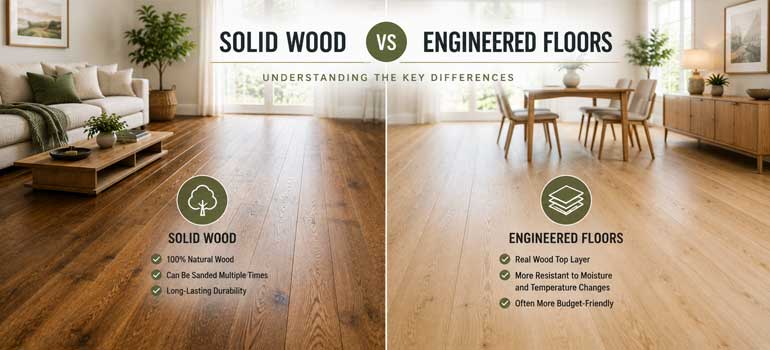
This is one of the most common questions we get asked, and the short answer is straightforward: it comes down to how the board is built. The longer answer, the one that actually matters when you're choosing between them, is about how each construction behaves once it's on your floor.
How each one is actually built
Solid wood is exactly what the name says: a single piece of milled timber, top to bottom. There's no layering, no core material, just one continuous piece of wood.
Engineered wood looks the same on the surface but is built differently underneath. Each plank is made of several layers of plywood or lumber, glued together with the grain running in alternating directions, then topped with a real wood veneer, usually between 2mm and 6mm thick. Once it's finished and fitted, this veneer is genuine timber, so a well-made engineered floor is visually indistinguishable from solid wood, even to people who work with flooring every day.
Where the two actually diverge
Once fitted, both floors can look identical, but they don't behave identically, and this is where the real decision lies.
- Moisture and temperature. Solid wood is a single block of timber, and timber expands and contracts with humidity. In rooms with fluctuating moisture, such as ground-floor rooms in older London properties or spaces near a kitchen, that movement can eventually cause gaps or cupping. Engineered wood's layered, cross-grain construction resists this movement far better, which is why it's the standard choice for properties where humidity control isn't guaranteed.
- Subfloors. Solid wood generally needs to be nailed or glued directly to a stable timber or ply subfloor. Engineered wood can be floated, glued, or fitted over underfloor heating and a wider range of subfloor types, including concrete, which makes it considerably more flexible for renovation projects.
- Underfloor heating. This is one area where engineered wood has a clear practical edge. Its layered construction handles the gradual heat cycles of underfloor heating without the risk of movement that solid wood carries.
- Sound and feel underfoot. Solid wood tends to feel and sound slightly denser and more solid when walked on, a difference some people notice more than others. Engineered wood over a floating installation can sound marginally hollower unless a good underlay is used, though this is easily addressed at installation stage.
Refinishing and lifespan
This is where solid wood pulls ahead. Because the entire board is timber all the way through, a solid floor can be sanded and refinished repeatedly, often five or more times over its lifetime, which is why properly maintained solid floors in Victorian and Edwardian London houses are still original well over a century later. Every sanding project removes a thin layer of worn timber and reveals fresh wood underneath.
Engineered wood can also be sanded and refinished, but only within the depth of its veneer. A 2mm veneer might allow one light refinish; a 6mm veneer can typically handle two or three. Once the veneer is sanded through, the floor needs replacing rather than restoring. That's a meaningful trade-off if you're thinking decades ahead rather than years.
Cost and value over time
Solid wood usually costs more to buy and fit upfront, and that gap is often what pushes people toward engineered wood without looking any further. But the comparison changes once you factor in lifespan. A solid floor that gets refinished every couple of decades can realistically outlast several cycles of a cheaper floor covering, spreading its higher initial cost over a much longer period.
Engineered wood doesn't lose this comparison outright, though. Its lower upfront cost, easier installation across difficult subfloors, and compatibility with underfloor heating often make it the more sensible financial choice for a flat or a room where solid wood simply isn't practical, regardless of budget. The right way to think about cost here isn't "which is cheaper" but "which one avoids problems that would cost more to fix later."
Which one actually suits your property
There's no universally "better" option here, only a better fit for a given room and building.
Solid wood tends to make more sense in stable, drier rooms of a property, and it's often the right choice when matching or extending existing original solid boards, since matching engineered wood alongside solid timber can be visually and structurally awkward. It also makes sense where you want the reassurance of many decades of future refinishing built into the floor from day one.
Engineered wood tends to be the more practical choice for flats, conversions, and any room with underfloor heating or an uncertain subfloor, which describes a large share of London's housing stock. It isn't simply a cheaper substitute for solid timber; it's a genuinely different construction built to solve problems that solid wood struggles with.
If you're weighing up solid wood flooring against engineered wood for a specific room, the honest answer depends on your subfloor, whether you have underfloor heating, and how the room's humidity behaves through the year. That's exactly the kind of thing worth checking in person before committing either way.
Call us on 020 7036 0625 or request a free site visit and we'll assess your specific room and subfloor before recommending either option.
FAQ
Is engineered wood as good as solid wood?
It's not worse, just different. Engineered wood is often the more practical choice for flats, underfloor heating, and less stable subfloors, while solid wood offers more refinishing over its lifetime in the right conditions.
Can you tell the difference between solid and engineered wood once it's fitted?
Visually, no, not even for most professionals. The surface of a well-made engineered floor is genuine wood veneer, so it looks and largely feels identical to solid timber once installed.
How many times can engineered wood flooring be sanded?
It depends on the veneer thickness. A thinner 2mm veneer might allow one light refinish, while a thicker 6mm veneer can typically handle two or three sandings over its life.
Is engineered wood suitable for a London flat?
Very much so. Its stability with underfloor heating and tolerance of a wider range of subfloors, including concrete, makes it a common choice in London flats and conversions specifically.