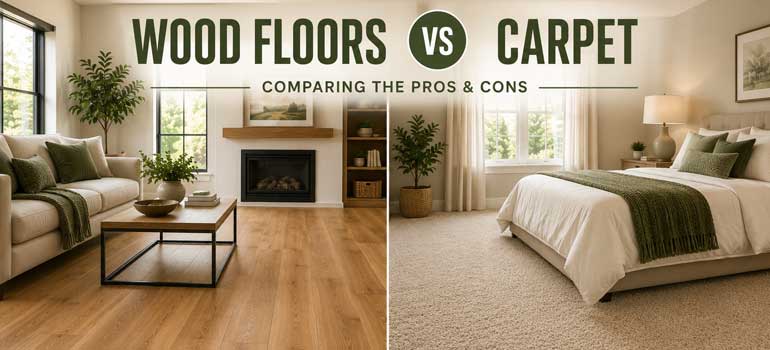
This isn't really a contest with a winner. Wood and carpet solve different problems, and the right choice usually comes down to the room, your budget, and how you actually live day to day rather than one being objectively better than the other.
What carpet does well
Carpet's biggest advantage is comfort. It's warm underfoot, has genuine insulating properties that help retain heat in a room, and softens sound in a way hard flooring never quite manages. That combination makes it a natural fit for bedrooms, where warmth and quiet matter more than durability, and it's often gentler for young children playing on the floor.
It's also the cheaper option upfront, both to buy and to fit, and there's a huge range of textures and colours to choose from if you want to experiment with a room's look without committing to a major structural change.
The trade-off is upkeep. Dust, allergens, and debris work their way into carpet fibres and stay there through normal vacuuming, which is why periodic professional deep cleaning is genuinely necessary rather than optional. Carpet also can't be restored the way wood can. Once it's worn or out of style, replacement is the only option, and it tends to wear out faster than hard flooring under regular foot traffic.
What wood flooring does well
Wood's strength is longevity. A well-maintained floor can genuinely last for generations, and unlike carpet, it can be sanded and refinished rather than replaced when it starts to show its age. That single fact changes the long-term economics considerably, since one floor can effectively outlast several cycles of carpet.
Day-to-day maintenance is also simpler. Regular vacuuming and the occasional damp mop keep it looking presentable, without the trapped dust and allergen buildup that carpet fibres are prone to. That makes wood a better choice for anyone with allergies or asthma, or for households with pets that shed.
The upfront cost is the main drawback, since wood flooring typically costs more to buy and fit than carpet covering the same area. It also needs more careful handling if something does go wrong, such as water damage or deep scratching, since fixing hard flooring properly usually calls for a professional rather than a DIY patch job.
Matching the choice to the room
A few patterns hold up reasonably consistently across most homes:
- Bedrooms often suit carpet well, since warmth and quiet tend to matter more there than durability.
- Living rooms, hallways, and kitchens generally favour wood or a wood-look hard floor, given the higher foot traffic and, in kitchens, the risk of spills.
- Flats and properties with underfloor heating often do better with engineered wood rather than carpet or solid wood, since it handles heat cycling and a wider range of subfloors more reliably.
- Allergy-prone households tend to do noticeably better with hard flooring throughout, simply because there's nowhere for dust and pet dander to hide.
None of this is a hard rule. Plenty of people successfully run carpet through a whole house or wood throughout, and the right answer depends as much on personal preference as on any of the above.
Resale value
If you're weighing this up with an eye on selling later, wood flooring tends to be viewed more favourably by buyers, particularly in period London properties where original or restored floorboards are often seen as a selling point rather than just a practical surface. Carpet doesn't carry the same weight, though a well-maintained, higher-quality carpet in the right room won't count against a property either.
Frequently asked questions
Is wood flooring worth the extra cost compared to carpet?
Over the long term, often yes, since a wood floor can be refinished repeatedly rather than replaced, which spreads its higher upfront cost across decades of use. Whether it's worth it for you also depends on how long you plan to stay in the property.
Which is better for someone with allergies, wood or carpet?
Wood, generally. Carpet fibres trap dust, pollen, and pet dander in a way that's very hard to fully remove even with regular cleaning, while a hard floor has nowhere for allergens to accumulate.
Can I put carpet over an existing wood floor?
It's possible, but it's rarely recommended if the wood floor is in good condition, since it hides a floor that could otherwise be maintained and enjoyed as-is, and trapped moisture underneath carpet can occasionally cause problems for the timber beneath.
Does wood flooring need replacing as often as carpet?
No, and this is one of the biggest practical differences between them. Wood can typically be sanded and refinished multiple times over its life, while carpet has no equivalent option and needs full replacement once it's worn out.
Call us on 020 7036 0625 or request a free site visit and we can talk through which option suits your specific rooms.