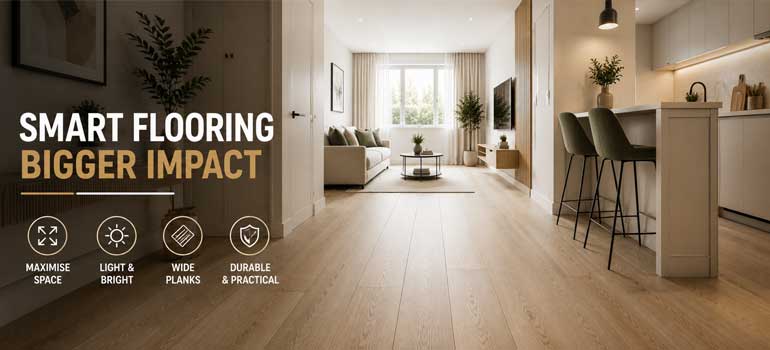
A small room can't be made physically bigger with flooring, but it can be made to feel noticeably bigger, and the flooring choice plays a genuinely large part in that. A few decisions - colour, plank size, and pattern - do most of the work.
Colour Does Most Of The Work
Lighter floor tones reflect more ambient light around a room, which reads visually as more open space. This is the single biggest lever available for making a small room feel larger, and it's particularly effective in rooms that don't get much natural daylight to begin with.
Dark floors aren't off-limits in a small room, but they need the rest of the room working in their favour, pale walls, good lighting, and minimal visual clutter, to avoid making the space feel closed in. Left to compete on their own, dark tones will generally shrink the perceived size of a small room rather than help it.
Plank Width And Orientation
Wider planks reduce the number of visible seams across a floor, and fewer seams reads as a calmer, more continuous surface, which tends to make a room feel bigger than the same floor laid in narrow strips. Laying boards diagonally rather than square to the walls has a similar effect, drawing the eye across the longest available sightline in the room rather than the shortest one.
Both of these work regardless of colour, but they're most effective when paired with a lighter tone rather than fighting against a dark one.
Keep Flooring Consistent Between Rooms
This is one of the more underused tricks for small properties specifically. Where a small room adjoins another space, a hallway, a kitchen, an open-plan living area, running the same flooring continuously between them removes the visual break a threshold or material change creates. Without that break, the eye reads the two spaces as more connected, which makes each individual room feel like part of a larger whole rather than a boxed-off compartment.
Simple Patterns Beat Busy Ones
It's worth being careful here, since the intuitive idea that a bold pattern will "trick the eye" into perceiving more space often works the opposite way in practice. A high-contrast checkerboard or heavily patterned floor tends to visually chop a small room into segments rather than opening it up, since the eye keeps stopping at each change in the pattern instead of reading the floor as one continuous surface.
Simpler options generally serve small rooms better:
- Plain planks in a light, consistent tone create the calmest, most spacious-feeling base.
- Subtle herringbone or chevron in a light wood can add character without breaking up the room the way a bold checkerboard would.
- Save high-contrast patterns for larger rooms, where there's enough space for the eye to read the pattern as a feature rather than clutter.
Practical Choices That Help Too
Small rooms often have awkward corners and tight spaces that are genuinely harder to clean thoroughly, so a floor that's straightforward to maintain matters more here than in a larger, more forgiving room. Wood flooring with a durable, easy-clean finish keeps a small room looking sharp without much effort, regular vacuuming and the occasional damp mop with the right product is usually all it takes. For proper deep cleaning between larger maintenance jobs, professional wood floor cleaning can lift ground-in dirt that a routine mop won't fully reach, particularly in tight corners.
If you already have a darker existing floor and want to shift toward the lighter, more spacious look without replacing it, wood floor staining can achieve that on your existing boards.
Frequently Asked Questions
Does floor colour actually make a room look bigger, or is that just a myth?
It's genuinely effective, not just a decorating myth. Lighter floors reflect more ambient light, which reads visually as more open space, and it's one of the more reliable tricks in interior design specifically because of how consistently it works.
Are wide planks or narrow planks better for a small room?
Wide planks generally work better, since fewer visible seams create a calmer, more continuous-looking floor. Narrow strips can visually break the space up more than a small room can afford.
Should I avoid patterned flooring in a small room altogether?
Not entirely, but keep it subtle. A light herringbone pattern can work well, while bold, high-contrast patterns like checkerboard tend to make a small space feel busier and more chopped up rather than bigger.
Can I lighten my existing dark floor instead of replacing it?
Yes, in most cases. If it's solid or engineered wood, sanding and restaining to a lighter tone can achieve a very similar effect to a full replacement, at a fraction of the cost.
Call us on 020 7036 0625 or request a free site visit and we'll help you choose the right flooring to make the most of a smaller room.