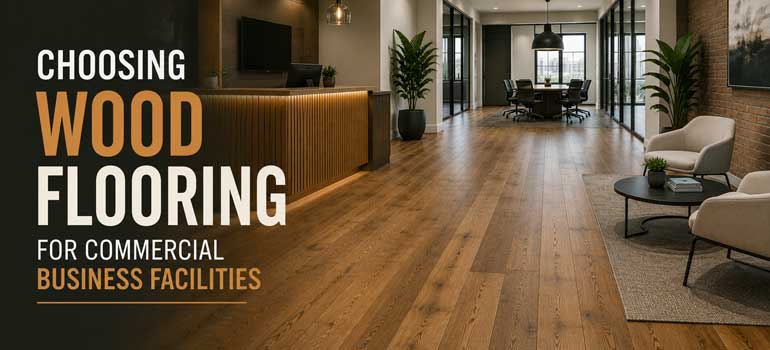
Commercial wood flooring decisions come with a different set of pressures than a home renovation. It's not just personal taste, the floor has to hold up to far heavier use, represent the business to every client or customer who walks in, and be practical for whoever's actually responsible for maintaining it day to day.
Not All Commercial Spaces Have The Same Needs
"Commercial" covers a lot of genuinely different environments, and the right flooring choice shifts depending on which one you're dealing with. A retail unit deals with constant footfall and trolleys or pushchairs, and needs a floor that can shrug off scuffing without looking tired within months. A restaurant or hospitality venue adds spill risk and heavier cleaning schedules into the mix on top of the traffic. A school or educational building faces some of the heaviest daily wear of any commercial category, combined with genuinely tight budgets and long refurbishment cycles between projects. An office, by comparison, generally sees steadier, more moderate use, though reception areas and corridors still take considerably more punishment than private offices or meeting rooms.
Whatever the sector, durability and appearance both matter, but the balance between them shifts depending on which space you're actually fitting out.
Durability Comes First In High-Traffic Commercial Spaces
For any genuinely high-traffic commercial environment, engineered wood is usually the more practical starting point. Its layered, cross-grain construction handles the kind of humidity swings, temperature changes, and sustained footfall that commercial buildings tend to produce far more reliably than solid timber. Solid wood can still work well in lower-traffic commercial areas, private offices, quieter meeting rooms, and boutique retail spaces with lighter footfall, but for anywhere that sees continuous daily use, engineered construction is the safer starting point.
Appearance And What It Signals To Clients
A commercial floor does more than just get walked on, it forms part of how clients, customers, or staff read the space the moment they walk in. Wood flooring generally reads as warm, professional, and considered, which is exactly the impression most businesses want to make. Where opinions differ is on style: it's tempting to reach for something dramatic, deep, rich tones or a bold statement pattern, but in most commercial settings, lighter tones and cleaner lines tend to serve the space better. The floor's job is usually to support the overall impression rather than compete for attention with the products, the menu, or whatever else the space is actually there to showcase.
The Real Trade-Off: Lacquer Versus Oil For Commercial Maintenance
This is one of the more practical decisions in a commercial fit-out, and it's worth understanding properly rather than defaulting to whichever finish looks best in a sample. Lacquer holds up for longer between treatments and is generally the lower-maintenance option day to day, but its glossy, uniform surface makes even fine scratches noticeably visible, which matters in a space that sees heavy daily traffic. Oil finishes give a more natural, forgiving look where minor marks blend in rather than standing out, and they're often easier for an in-house cleaning team to manage without specialist products, but they need periodic re-oiling to stay properly protected, on a more frequent schedule than a lacquered floor typically needs recoating.
Neither is objectively better, it depends on how much your maintenance schedule can realistically accommodate, and how much a scratch-forgiving finish matters against the durability lacquer offers.
Getting A Floor That Lasts
Whatever construction and finish you land on, commercial floors inevitably need attention eventually, and that's where wood genuinely earns its keep over most commercial flooring alternatives. Commercial floor sanding can restore a heavily worn floor to a like-new condition without the cost and disruption of a full replacement, which matters considerably more in a business that can't simply close for an extended refit.
Common Questions About Commercial Wood Flooring
Is engineered wood always the right choice for commercial spaces?
Not always, but it's the safer default for high-traffic areas. Lower-traffic commercial spaces, private offices or quieter boutique settings can work well with solid wood too, depending on the specific conditions.
Should a commercial floor use bold colours and patterns, or something more neutral?
Generally, lighter tones and cleaner lines work better in most commercial settings, letting the floor support the space rather than compete with the products or service being showcased.
Is lacquer or oil better for a commercial floor?
It depends on your priorities. Lacquer lasts longer between treatments but shows scratches more visibly. Oil hides minor marks better and is often easier for in-house teams to maintain, but needs more frequent reapplication.
Can a worn commercial wood floor be restored without closing the business?
In most cases, yes. Commercial sanding work is typically scheduled outside trading hours, evenings or weekends, specifically to avoid disrupting the business.
Call us on 020 7036 0625 or request a free site visit and we'll advise on the right construction and finish for your commercial space.