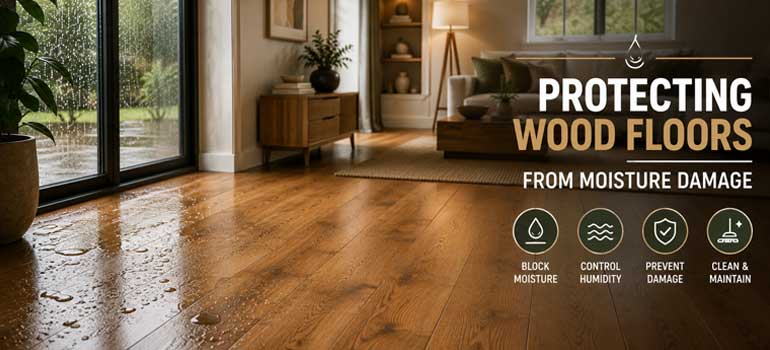
Wood is a genuinely wonderful material for flooring, but it never really stops being wood, even after it's milled, finished, and nailed to your subfloor. It continues to react to the moisture in the air around it for its entire life, and understanding that relationship is the single most useful thing you can know if you want a floor that stays flat, gap-free, and problem-free for decades.
Why Wood Reacts To Moisture At All
Timber is hygroscopic, meaning it naturally absorbs and releases moisture from the surrounding air until it reaches equilibrium with it. When the air around your floor is humid, the wood draws in water vapour and physically expands. When the air is dry, it releases moisture and contracts. This isn't a flaw in the material or a sign of a bad installation, it's simply how wood behaves, and it happens continuously in the background whether you notice it or not.
The scale of the movement is usually small day to day, which is exactly why it's easy to overlook until it's built up into a visible problem.
What Happens When It's Too Dry
This is the more common issue in the UK, particularly through the winter heating season. Central heating dries indoor air significantly, and as the wood loses moisture in response, it shrinks. Individual boards pull slightly away from each other, and over an entire room, that adds up to visible gaps running the length of the floor.
A small amount of seasonal gapping is completely normal and usually closes back up somewhat once the heating season ends. The problem is when it happens repeatedly, year after year, without any humidity control, since each cycle can leave the gaps slightly wider than before. Left unaddressed long enough, this becomes a cosmetic and, eventually, a structural issue that needs proper gap filling to correct.
What Happens When It's Too Humid
The opposite problem shows up more in summer, or in rooms with poor ventilation, damp basements, bathrooms, kitchens with a lot of steam. As the wood absorbs excess moisture, the boards expand, and if they don't have anywhere to go, they press against each other and against fixed obstacles like skirting boards. In milder cases this shows up as boards buckling slightly or edges lifting at the seams, known as cupping. In more severe, prolonged cases it can lead to genuine structural buckling, where boards visibly lift away from the subfloor.
Sustained high humidity also raises the risk of mould developing underneath the floor, particularly where there's limited airflow beneath the boards, which is a separate and more serious problem than cosmetic movement alone.
The Humidity Range Actually Worth Aiming For
Flooring manufacturers and industry bodies are fairly consistent on this: wood flooring performs best when indoor relative humidity is kept somewhere in the 30% to 50% range, ideally with minimal swings between the two ends of that range rather than sitting at one extreme for months and then swinging to the other. A cheap hygrometer, the same kind of device used to monitor humidity in a wine cellar or a cigar box, makes it easy to actually track this rather than guess.
Keeping Humidity Stable Through The Year
A few practical habits make a real difference:
- In winter, when heating dries the air out, a humidifier is the most reliable way to add moisture back into a room without overdoing it. Placing bowls of water on radiators is a traditional trick, but it's far less controllable and easy to either underdo or overdo compared with an actual humidifier.
- In summer, or in a naturally damp room, a dehumidifier or simply improving ventilation, opening windows for short periods rather than leaving them open constantly, helps bring excess moisture back down.
- Avoid extremes in either direction. The goal isn't a single perfect number but keeping the room broadly within the recommended range and avoiding dramatic swings from one season to the next.
- Check problem rooms specifically. Kitchens, bathrooms, and basements are worth monitoring more closely than the rest of the house, since they're naturally more prone to humidity spikes.
Solid Wood Versus Engineered Wood In Unstable Conditions
If your home genuinely struggles to maintain stable humidity, an older property with poor insulation, a room with underfloor heating, or a space near a kitchen or bathroom, it's worth factoring that into your choice of flooring in the first place. Engineered wood's layered, cross-grain construction resists moisture-driven movement considerably better than solid timber, which is exactly why it's so often recommended for rooms where humidity control can't be fully guaranteed.
Cleaning Habits That Avoid Making It Worse
Day-to-day cleaning can unintentionally add to the problem if it's not done carefully. Avoid soaking a mop or leaving standing water on the surface, and always use a cleaning product genuinely intended for wood flooring rather than a generic all-purpose cleaner, since some products leave behind residue that interferes with how the finish handles moisture over time.
When Moisture Damage Needs Professional Repair
Minor seasonal gapping generally isn't cause for concern on its own, but persistent gaps, visible cupping, or any sign of buckling are worth having assessed properly rather than left to correct itself. Depending on the severity, the right fix might be gap filling carried out as part of a full sand, or in more serious cases, a broader sanding and refinishing to flatten and restore the floor properly.
Frequently Asked Questions
What humidity level is actually best for wood flooring?
Most manufacturers and flooring bodies recommend keeping relative humidity somewhere between 30% and 50%, with minimal swings between the two ends of that range through the year.
Is gapping between floorboards in winter normal?
Yes, a small amount is completely normal and often closes up again once the heating season ends. It only becomes a real problem when it happens repeatedly without any humidity control, gradually widening the gaps over successive years.
Can moisture damage to a wood floor be reversed?
Often, yes, depending on severity. Minor gapping can be addressed with gap filling, and moderate movement can often be corrected with sanding and refinishing. Severe, prolonged buckling is harder to fully reverse and may require board replacement in the worst areas.
Is engineered wood really more resistant to humidity than solid wood?
Yes, genuinely. Its layered, cross-grain construction is specifically designed to resist the kind of expansion and contraction that solid wood is more prone to, which is why it's often recommended for rooms with less predictable humidity.
Call us on 020 7036 0625 or request a free site visit if you're seeing gaps, cupping, or buckling and want a proper assessment.