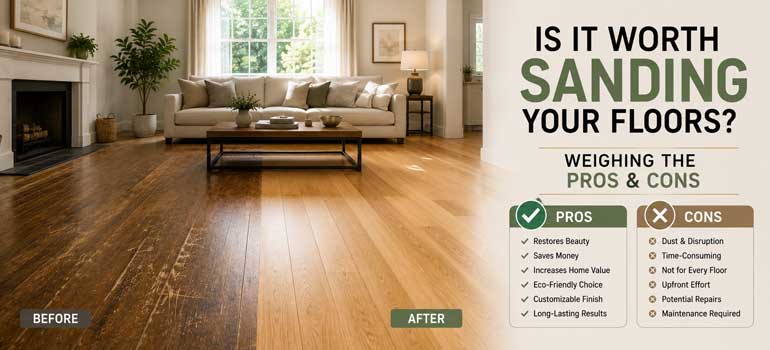
Sanding an old wood floor back to bare timber can genuinely transform a tired room, but it isn't automatically the right move for every floor. Whether it's worth the time, cost, and disruption depends on a handful of specific factors, and it's worth working through them properly before committing either way.
Weighing Age Against Quality
The first thing to consider is what you're actually starting with. If the floor is relatively new and wasn't particularly good quality to begin with, sanding often isn't the best use of money. Competition in the flooring market means genuinely good new flooring is more affordable than it used to be, so replacing a low-grade floor can sometimes make more sense than trying to rescue it.
If what you've got is older but was originally a decent quality floor, sanding is very often the better call. You're not paying for new material, and the character an older floor has developed over the years, something a brand-new floor simply can't replicate, gets preserved rather than thrown out.
Solid Wood vs Engineered Wood: Why This Distinction Matters
Before anything else, you need to know exactly what kind of floor you're dealing with, because it changes what's actually possible.
Solid wood is timber all the way through, and it can genuinely be sanded and refinished many times over its life, often five times or more, which is exactly why solid floors in Victorian and Edwardian London properties are still original well over a century later.
Engineered wood is different. It has a real wood veneer, typically a few millimetres thick, bonded to a stable core, and it can only be sanded within the depth of that veneer. Depending on thickness, that might mean one light refinish, or two or three if the veneer is thicker, but there's a genuine limit, and sanding past it damages the floor permanently rather than restoring it.
If you're not certain which type you have, it's worth getting a professional opinion before any sanding starts, since guessing wrong here can turn a routine refinish into an expensive mistake.
What To Check Before You Commit
Assuming the floor is a good candidate, there's some groundwork worth doing before the sanding itself begins:
- Broken or damaged planks — check whether matching replacements are realistically available, since an odd board that can't be matched will stand out once the whole floor has a fresh, even finish.
- Gaps between boards — sanding won't close these on its own, and in fact tends to make existing gaps more visible rather than less.
- Colour and size matching — if any boards need replacing, confirm you can source something close enough in tone and dimensions before starting.
Where gaps are present, proper gap filling carried out as part of the sanding job is the right sequence. Filling first and sanding afterward gives a clean, flush result that filling on its own after sanding can't achieve.
DIY Or Professional?
Sanding is genuinely more disruptive than people expect. Furniture needs to be fully cleared out, dust gets everywhere unless proper dust extraction equipment is used, and the process itself takes real skill to get an even, flat result without leaving visible machine marks or uneven patches.
A professional job is faster and more predictable, and comes with the equipment and experience to handle problems, like an unexpectedly uneven subfloor, that a first-time DIY attempt often isn't equipped to deal with. Doing it yourself can save money if you're genuinely confident in your ability and willing to invest the time, but if there's real doubt about your skill level for a whole-room job, it's usually cheaper in the long run to hire it out properly the first time than to pay for a professional fix afterward.
Frequently Asked Questions
Is it cheaper to sand an old floor or replace it with new flooring?
It depends on the floor's existing quality and age. A well-built older floor is usually cheaper and more sustainable to sand than replace. In contrast, a low-quality, relatively new floor often isn't worth the cost of sanding compared with new material.
Can engineered wood flooring be sanded as many times as solid wood?
No. Solid wood can typically be sanded and refinished many times over its life, often five or more. Engineered wood is limited by the thickness of its surface veneer, usually allowing one to three refinishes before the veneer is exhausted.
Does sanding fix gaps between floorboards?
Not on its own, and in most cases it makes existing gaps more visible rather than less. Gap filling needs to be done as part of the sanding process, filled first, then sanded flush, for a proper result.
Is DIY floor sanding a realistic option, or should I always hire a professional?
It's possible for a confident, experienced DIYer, but the margin for error is genuinely small, uneven sanding or visible machine marks are hard to fix after the fact. For most people, a professional job is more predictable and often works out cheaper than correcting a DIY attempt gone wrong.
Call us on 020 7036 0625 or request a free site visit and we'll assess your floor and tell you honestly whether sanding is the right call.