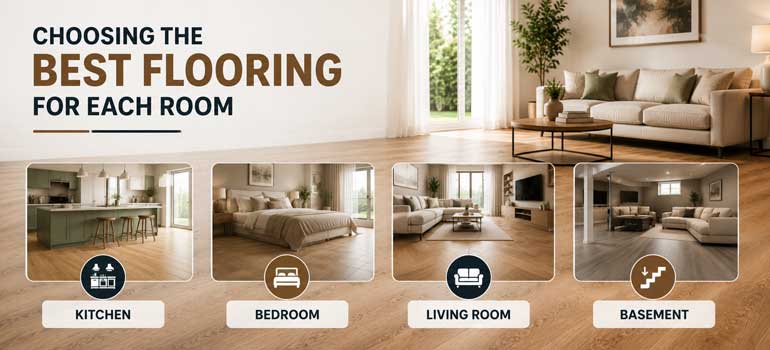
Choosing one flooring type for an entire home rarely works well. Each room has different demands — a kitchen deals with spills and dropped pans, a bedroom sees light foot traffic and prioritises comfort, and a basement has to cope with moisture and temperature swings that would ruin the wrong material. Getting this right room by room, rather than picking a single floor for the whole property, is the difference between a floor that still looks good in ten years and one that needs replacing within three.
Here's how to think through each space in your home.
Kitchen: Prioritise Durability and Moisture Resistance
The kitchen takes more daily punishment than almost any other room — dropped pans, spilt liquids, chair legs scraping across the surface, and near-constant foot traffic. Real solid wood is rarely the right choice here: standing water and grease are hard on a wood finish, and repeated moisture exposure over time can cause boards to swell or cup.
Luxury vinyl tile (LVT) has become the go-to choice for London kitchens because it's genuinely waterproof, not just water-resistant, and modern wood-effect designs are convincing enough that most people can't tell it apart from the real thing at a glance. It also stays comfortable underfoot in winter, unlike stone or tile. If you'd rather have the warmth and grain of real wood, engineered wood with a durable lacquer finish can work in a kitchen provided spills are wiped up promptly, but it will never match LVT's tolerance for standing water.
Bathroom: Waterproof Is Non-Negotiable
Bathrooms and wet rooms are the one place where the flooring decision is simple: it has to be fully waterproof. Standing water around a bath, shower, or basin will damage almost any wood-based product over time, no matter how well it's finished. LVT flooring is the practical option — it's available in wood and stone-effect designs, feels warmer underfoot than ceramic tile, and holds up to daily splashing without any risk of swelling or delamination. For a genuine wet room with a floor-level shower drain, a tiled or resin floor is usually the better specification, so it's worth discussing your exact layout before deciding.
Hallway and Entrance: Built to Take a Beating
Hallways see the heaviest and most concentrated foot traffic in the house, along with grit, moisture, and dirt tracked in from outside. This is another area where practicality should come before appearance. Laminate floor installation in a higher AC-rated (scratch and wear resistant) product performs well here, resists scuffing from shoes and bags, and is straightforward to replace in sections if it does get damaged. A good doormat at the entrance — inside and out — makes a bigger difference to how long any hallway floor lasts than people expect, since most scratches come from grit trapped under shoe soles.
Living Room: Balance Warmth and Practicality
The living room is where most families spend the most time, so both comfort and appearance matter more here than almost anywhere else. Natural wood flooring brings warmth and a sense of quality that's hard to replicate with anything else, and it works particularly well in living rooms with moderate rather than heavy daily traffic. Where the room sees a lot of use — young children, pets, frequent entertaining — a well-specified engineered wood floor offers most of the same look with better dimensional stability.
If the living room sits above another occupied room, or you're in a leasehold flat, it's also worth thinking about noise. Acoustic underlay and soundproofing beneath the floor reduces footstep and impact noise travelling down to the room below — something many London leases actually require in writing before hard flooring can be installed.
Bedroom: Comfort Over Traffic Resistance
Bedrooms see comparatively low foot traffic, which opens up more flooring options than almost any other room. Unlike carpet, a wood or engineered wood floor doesn't trap dust, allergens, or bacteria in its fibres, which makes it a genuinely better choice for anyone with allergies or asthma. The wide range of available tones — from pale, bleached finishes to deep, rich stains — means there's real flexibility to match the mood of the room, whatever style you're going for.
Basement: Manage Moisture First
Basements present a different challenge entirely: higher humidity, less temperature stability, and a greater risk of moisture rising through the subfloor than any other room in the house. Solid or engineered wood is generally not the right choice here, since prolonged exposure to damp conditions can cause warping and cupping over time that no finish can fully prevent. Tiled floors and LVT tend to perform best in these conditions, since neither is affected by ambient moisture in the way wood-based products are.
FAQ
Can I use the same flooring throughout my whole house?
You can, and plenty of people do for the sake of visual flow, especially in open-plan homes. Just be aware that a floor suited to a quiet bedroom isn't necessarily suited to a kitchen, so you may be trading off some practicality for consistency.
What's the most durable flooring for a home with kids and pets?
LVT and well-specified laminate tend to handle scratches, spills, and heavy footfall best. Solid or engineered wood can work too, but it needs a suitably tough finish and a bit more care day to day.
Is real wood ever a bad idea in a kitchen?
It's not off the table, but it's rarely the first choice. Standing water and dropped pans are hard on a wood finish over time, so most people opt for something more moisture-tolerant there and save real wood for lower-risk rooms.
Do I need different flooring on different floors of my house?
Not necessarily, but ground-floor rooms are more likely to have concrete subfloors and higher moisture exposure, which can affect which floor types are suitable. It's worth having each floor assessed individually rather than assuming one answer applies to the whole property.
Getting the Right Advice for Your Home
There's rarely a single "best" flooring type — the right choice depends on how each room in your specific property is actually used, what subfloor you're working with, and how much moisture or traffic it needs to withstand. If you're planning a multi-room project and want advice tailored to your home rather than generic rules of thumb, we offer a free site visit where we assess each room individually and talk through the options that suit it. Call us on 020 7036 0625 or request a free quote online and we'll help you match the right floor to every room in your home.