Monday - Friday 07:30 - 17:30, Saturday 07:30 - 16:00
Parquet Floor Fitting London
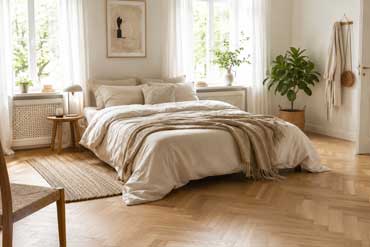
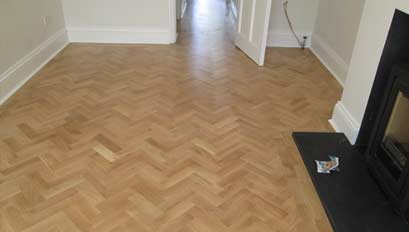
Parquet floor fitting is the installation of small individual wood blocks or short planks arranged in a geometric pattern — most commonly herringbone, chevron, or basket weave — glued directly to a prepared subfloor to create a patterned wood floor that is both structurally permanent and visually distinctive.
Parquet is currently one of the most in-demand flooring specifications in London. Herringbone parquet in particular has seen a significant revival over the past decade, driven by its appearance in London's higher-specification residential interiors and the wider availability of engineered herringbone products that bring the look within reach of a broader range of budgets. At the same time, London's large stock of original Edwardian and Victorian parquet in period properties across the city means restoration and replacement installation remains a consistent part of the work we carry out.
Flooring Services London installs parquet floors across London in both solid and engineered wood formats, covering all major patterns and subfloor types. Parquet fitting is priced from £40/m² for both solid and engineered parquet. A minimum charge of £600 inc. VAT applies. For a full breakdown of all charges, visit our pricing guide.
For parquet repair and restoration — re-laying loose blocks, sourcing replacement sections, and refinishing existing parquet — see our dedicated parquet floor repair page.
Solid vs. Engineered Parquet — Choosing the Right Product for Your London Property
The choice between solid and engineered parquet is the first decision to make, and for London properties, it is largely determined by the subfloor type and whether underfloor heating is present.
Solid parquet blocks — typically 20–22mm thick solid oak in the standard Edwardian block format (230mm x 70mm) or in wider contemporary formats — are the most durable option and the correct specification for period restoration work where matching original floors is the priority. Solid parquet must be glued to a concrete or solid subfloor, or nailed to a timber batten system. It is not suitable for over- or underfloor heating due to the significant movement of thick solid timber with temperature changes.
Engineered parquet — a real hardwood wear layer (typically 3–6mm) bonded to a stable plywood core, cut into herringbone or chevron block shapes — offers the appearance of solid parquet with significantly better dimensional stability. It can be used over underfloor heating, over concrete subfloors (glued or floated), and over timber subfloors. The plywood core resists the expansion and contraction that affects solid timber, making engineered parquet the more practical choice for the majority of London's contemporary residential and commercial installations. The wear layer can be lightly sanded and refinished once or twice over the floor's lifetime.
For London period properties where the brief is to install new parquet consistent with the original Edwardian character of the building, solid oak blocks in the traditional format are the authentic specification. For contemporary London interiors — open-plan apartments, renovated Victorian houses with modern fit-outs, and commercial spaces — engineered herringbone in wider block formats (typically 600mm x 120mm or 600mm x 150mm) is currently the most popular choice.
Parquet Patterns We Install in London
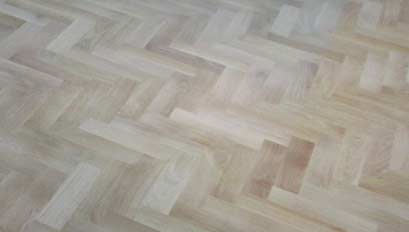
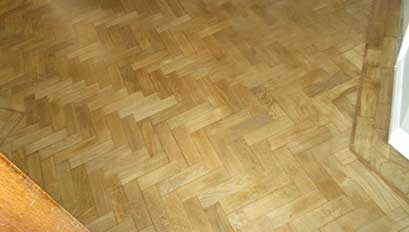
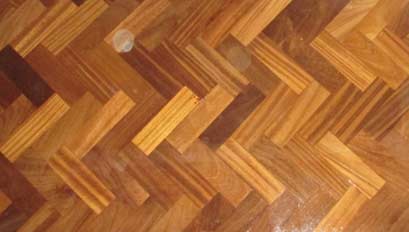
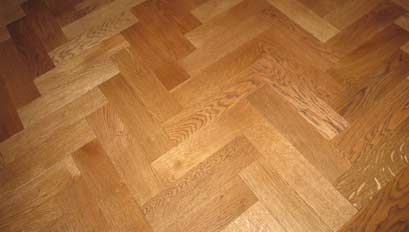
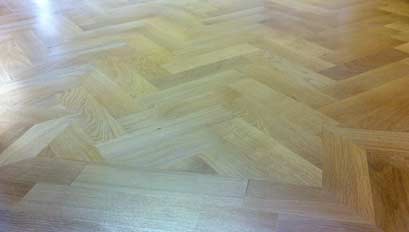
Herringbone
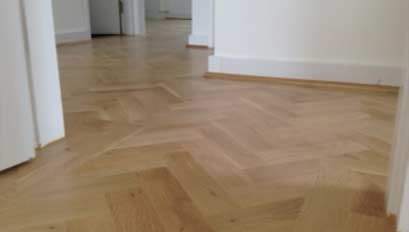
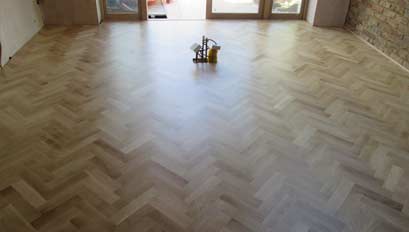
The most widely installed parquet pattern in London, both historically and currently. In traditional herringbone, rectangular blocks are laid at 90 degrees to each other in a V-shaped zigzag pattern across the floor. The pattern creates a strong directional flow that makes rooms appear longer, and the visual complexity of the interlocking blocks gives the floor a richness that straight-lay plank floors cannot replicate.
Traditional herringbone works across all room sizes and proportions, but is particularly effective in hallways and reception rooms — the pattern draws the eye along the length of the space. In London's period conversions and townhouses, herringbone parquet in an entrance hall or drawing room is one of the most sought-after interior features.
Block proportions affect the overall appearance significantly. Narrower blocks (e.g. 70mm x 230mm in solid, 120mm x 600mm in engineered) produce a finer, more intricate pattern associated with the traditional Edwardian look. Wider blocks (150mm x 600mm, 190mm x 760mm) produce a bolder, more contemporary pattern with more visible grain per block — currently the preferred specification in modern London interiors.
Chevron
In chevron parquet, blocks are cut at an angle — typically 45 or 60 degrees — so that the ends of adjacent rows meet in a straight line rather than the staggered joint of herringbone. The result is a more uniform, arrow-like pattern with a clean central spine running the length of the floor.
Chevron requires more precise cutting and layout than herringbone — the angled ends must align exactly across the full width of the floor — and produces more waste material per m² due to the diagonal cuts. It is the more demanding and slightly more expensive pattern to install, but its visual effect is distinctive and well-suited to contemporary London interiors where a more structured, graphic appearance is preferred over the traditional herringbone look.
Basket Weave and Versailles
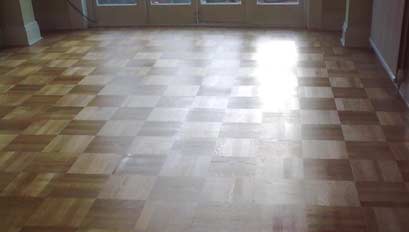
Basket weave — blocks arranged in alternating perpendicular groups to create a woven appearance — and Versailles panels — large square modules with complex internal patterns — are less common in new London installations but are occasionally specified in heritage and high-specification residential projects. We install both patterns and advise on subfloor requirements and layout planning during the site visit.
Subfloor Requirements for Parquet Installation
Parquet is a glued installation in almost all circumstances — it is bonded directly to the subfloor using a flexible wood flooring adhesive and cannot be floated. This means subfloor preparation is more critical for parquet than for any other floor type.
Flatness — the subfloor must be flat to within 3mm over a 1.8m span. Parquet blocks are small and rigid — any subfloor undulation creates visible unevenness across the block joints that cannot be corrected after installation. We apply levelling compound to concrete subfloors and sand down high spots on timber subfloors before parquet installation begins.
Moisture — the most critical factor for parquet longevity. Moisture in a concrete subfloor causes adhesive failure and block lifting; moisture from above (condensation, spills, poor sealing at perimeters) causes blocks to swell and lift at the edges. We measure concrete subfloor moisture using a calibrated hygrometer and specify a damp-proof membrane where readings exceed the adhesive manufacturer's threshold. All of WC2, SW1, W1, and other central London postcodes within the congestion charge zone are assessed on the same basis — building age and subfloor type vary significantly even within short distances in central London.
Concrete subfloors — the standard subfloor for parquet installation in London's flats, conversions, and post-war properties. Parquet is glued directly to the levelled, primed concrete surface using a flexible polyurethane adhesive such as Bona R848 or Mapei Ultrabond Eco S955. The flexibility of the adhesive allows for minor seasonal movement of the blocks without bond failure.
Timber subfloors — parquet can be installed over a stable, well-fixed timber subfloor provided it is adequately rigid and flat. A 12mm or 18mm plywood overlay is often applied over existing floorboards before parquet is glued down, to provide a stiffer and flatter surface than the existing boards alone. We assess existing timber subfloors during the site visit and advise on whether direct installation or a plywood overlay is appropriate.
Underfloor heating — engineered parquet is compatible with UFH; solid parquet is not recommended. For UFH installations, we confirm the maximum surface temperature rating of the specific parquet product and calculate the total floor build-up thermal resistance to ensure the heating system performs correctly after installation.
Parquet Fitting Process
1. Free site visit and assessment — Subfloor assessed for flatness, moisture, and structural condition. Pattern, block format, and timber species are discussed. Written fixed-price quote provided.
2. Subfloor preparation — Levelling compound applied where needed; plywood overlay fitted over timber subfloors where required; damp-proof membrane installed where moisture readings exceed safe thresholds; subfloor primed with appropriate adhesive primer.
3. Layout planning — The centre lines of the room are established and the parquet pattern is mapped out from this point. Starting from the centre ensures the pattern is symmetrical and that any cut blocks at the perimeter are of equal size on both sides — avoiding the narrow, awkward cuts at one wall that result from starting installation at a wall edge. For herringbone, the centre spine of the pattern is established along the main axis of the room.
4. Adhesive application and block laying — Flexible wood flooring adhesive applied to the subfloor in sections using a notched trowel. Blocks are laid into the adhesive in the specified pattern, checked for alignment and level throughout. Expansion gaps of 10–15mm are maintained at all fixed perimeters — walls, door frames, and fixed furniture — to allow for seasonal movement of the floor as a whole.
5. Perimeter cutting — Blocks at room edges and around fixed features cut precisely using a mitre saw. Parquet perimeter cuts require careful measurement to maintain pattern alignment at the boundary — a miscut block at the perimeter disrupts the visual rhythm of the entire floor.
6. Adhesive curing — Floor left undisturbed for the adhesive curing period — typically 24–48 hours, depending on the product. Walking on the floor before the adhesive has cured can shift blocks and disrupt the pattern alignment.
7. Sanding and finishing — For unfinished parquet, sanding is carried out after the adhesive has fully cured. Parquet sanding runs diagonally across the herringbone pattern — typically at 45 degrees — to avoid sanding against the grain of individual blocks. Gap filling, staining (where specified), and two or three finish coats applied. See our floor sanding page for full details. Pre-finished parquet — factory-sanded and lacquered or oiled — is ready for use after the adhesive cures, with no on-site finishing required.
Parquet Floor Fitting Costs in London
| Service | Price |
|---|---|
| Parquet fitting — solid | from £40/m² |
| Parquet fitting — engineered | from £40/m² |
| Gap filling — resin (up to 5mm) | from £7/m² |
| Strip gap filling (over 5mm) | from £15/m² |
| Wood floor staining | from £8/m² |
*All prices shown are exclusive of VAT.
Additional charges may apply for subfloor levelling, plywood overlay, damp-proof membrane, door trimming, and skirting board or beading installation. All charges confirmed in writing after the site visit. Properties within the London ULEZ and Congestion Charge zones may include a daily access surcharge. A detailed breakdown of all charges is available in our pricing guide.
Frequently Asked Questions — Parquet Floor Fitting in London
What is the difference between herringbone and chevron parquet? Both use the same block format but the pattern differs at the joints. In herringbone, blocks are laid perpendicular to each other and the block ends create a staggered, zigzag joint. In chevron, the block ends are cut at an angle so that adjacent rows meet in a straight line, creating an arrow-like pattern with a clean central spine. Herringbone is the traditional London pattern — the one found in original Edwardian properties across the city. Chevron is a more contemporary variation, currently popular in London's renovated period properties and new-build apartments.
Can parquet be installed over underfloor heating? Engineered parquet yes — solid parquet no, or only with very significant restrictions. Engineered parquet's plywood core provides the dimensional stability needed to tolerate UFH temperature cycles. We confirm product compatibility and calculate floor build-up thermal resistance values before every UFH parquet installation.
How long does parquet installation take? A standard reception room or hallway (20–40 m²) typically takes two to three days for installation, including subfloor preparation, block laying, and adhesive curing. Sanding and finishing add a further two to three days for unfinished parquet. Pre-finished parquet reduces the total project time as no on-site finishing is needed. We confirm the expected duration in the written quote.
Can you install parquet to match existing original Edwardian blocks in my London property? Yes — for period restoration projects where new parquet needs to match existing original blocks, we source solid oak in the correct traditional block dimensions (230mm x 70mm x 20mm is the most common Edwardian format) and finish to match the existing floor. An exact match is rarely achievable between new and century-old timber, but the difference is significantly reduced after sanding and finishing across the complete floor.
Is parquet suitable for a kitchen or open-plan kitchen-living area? Engineered parquet with a hard-wax oil or water-based lacquer finish is suitable for kitchen areas where spills are wiped up promptly and standing water does not accumulate around appliances. It is one of the most popular specifications for open-plan kitchen-living areas in London's renovated period properties and modern apartments. We advise on the most appropriate finish for kitchen use during the site visit.
Call us on 020 7036 0625 or request a free quote online — we respond to all parquet floor fitting enquiries the same working day.