Monday - Friday 07:30 - 17:30, Saturday 07:30 - 16:00
Commercial Wood Floor Cleaning in London
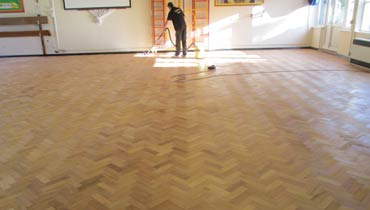
Commercial wood floor cleaning is the professional deep cleaning and maintenance of wood floors in business environments — restaurants, bars, offices, hotels, retail spaces, schools, gyms, and other commercial properties — using specialist equipment, finish-compatible cleaning solutions, and techniques suited to the higher footfall, heavier soiling, and specific finish requirements of commercial flooring.
Commercial wood floors face conditions that residential floors do not. High footfall brings in grit and dirt that acts as a fine abrasive on the floor surface with every step. Cleaning chemicals used by facilities and hospitality teams are often more aggressive than domestic products and can degrade wood floor finishes if the wrong product is used. Spills — food, drink, cleaning fluid — occur more frequently and are sometimes left for longer before being addressed. The result is that a commercial wood floor without a proper maintenance programme deteriorates significantly faster than the same floor in a residential setting.
Flooring Services London carries out commercial wood floor cleaning and maintenance across London, working in the city's restaurants, bars, offices, hotels, retail environments, schools, and public buildings. We schedule all commercial work around your trading hours — typically evenings, early mornings, or weekends — to avoid any impact on your business operations. As part of our full floor maintenance service, commercial cleaning is regularly combined with wood floor recoating, floor polishing, and wood floor re-oiling as part of a complete commercial maintenance programme.
Why Commercial Wood Floors Need Specialist Cleaning
The cleaning routines carried out by in-house facilities and cleaning teams — daily mopping, vacuuming, spray-and-wipe cleaning — are essential for maintaining hygiene and day-to-day appearance, but they cannot address several categories of deterioration that accumulate over time in commercial environments:
Ground-in grit and particulate soiling — fine grit tracked in from London streets embeds in the surface of the floor finish with repeated foot traffic. Daily mopping moves surface dirt but does not extract embedded grit from the finish surface and board joints. Over time this acts as a fine abrasive that progressively dulls and degrades the finish — a process that cannot be reversed by routine cleaning but can be addressed with professional deep cleaning and mechanical scrubbing.
Cleaning product residue and finish contamination — many commercial cleaning products used by facilities teams contain compounds incompatible with wood floor finishes: surfactants that leave a dulling film, wax-based shine products that build up and prevent maintenance treatments from bonding, and acidic or alkaline cleaners that degrade lacquer and oil finishes over time. Professional cleaning uses finish-compatible pH-neutral products that clean effectively without contaminating the surface.
Cooking oil and grease penetration — in restaurant and hospitality environments, airborne cooking oil settles on floor surfaces and is walked in from kitchen areas, creating a greasy film that attracts and holds dirt and is extremely difficult to remove with standard mops and cleaning products. Specialist degreasers compatible with wood floor finishes are required to cut through this contamination without stripping or damaging the finish beneath.
Finish wear and depletion — in high-footfall commercial areas, finish wear is concentrated in defined traffic routes — entrance paths, areas in front of service points, main aisles. Professional cleaning identifies areas of finish depletion and, combined with a wood floor recoating treatment, addresses wear before it reaches the timber beneath.
Stair and edge cleaning — commercial staircases and floor edges accumulate dirt in nosings, risers, and skirting joints that standard mopping does not reach. We clean these areas manually with appropriate brushes and solutions as part of every commercial clean.
Commercial Sectors We Serve in London
Restaurants and Bars
Wood floors are a defining feature of London's restaurant interiors — from the exposed oak dining rooms of Soho and Covent Garden to the reclaimed board floors of Shoreditch bars and the parquet-floored dining rooms of Mayfair and Chelsea. These floors endure some of the most demanding conditions of any commercial environment: heavy furniture, dropped cutlery, drink spills, kitchen oil drift, and hundreds of covers per service.
We carry out deep cleaning and maintenance recoating for London restaurant and bar floors, working after last orders or on dark days to avoid impacting on service. A typical restaurant dining room (50–100 m²) can be deep cleaned and recoated in a single overnight session, ready for opening the following day. For venues where the floor finish is a key part of the interior design — many of London's higher-specification restaurants specify particular sheen levels and finish products — we match the recoat product precisely to the original specification.
Offices
Office wood floors — common in London's converted Victorian and Edwardian commercial buildings, co-working spaces, and modern open-plan office fitouts across the City, Shoreditch, and the West End — accumulate chair castor wear, desk leg indentations, and cleaning product residue from facilities team routines. Deep cleaning and periodic floor polishing or recoating keep office floors looking professional and extend the time between full floor sanding cycles significantly.
We schedule office floor cleaning outside core business hours and work with facilities managers to plan around cleaning schedules, office moves, and fit-out programmes.
Hotels and Hospitality
London's hotel sector — from the boutique hotels of Marylebone and Fitzrovia to the larger properties in Kensington, Paddington, and the City — increasingly features wood floors in lobbies, corridors, bars, and restaurant areas. Hotel floors require the highest standard of appearance maintenance and the most careful product selection, as appearance standards are continuously scrutinised by guests and management alike.
We carry out commercial cleaning and maintenance for hotel wood floors in London, working overnight during low-occupancy periods and coordinating with hotel operations teams to minimise disruption to guests. For heritage hotel properties with original period parquet — a feature of several of London's older hotel buildings — we carry out specialist parquet cleaning and maintenance using the techniques appropriate for historic floors.
Retail
Retail wood floors in London — particularly in the clothing, homeware, and design retail sectors concentrated in areas such as King's Road, Carnaby Street, Marylebone High Street, and Westbourne Grove — are both a practical surface and a key element of the brand environment. A dull or scuffed floor in a retail setting undermines the visual quality of the entire space.
We carry out commercial cleaning and maintenance for retail floors outside trading hours, working around deliveries and staff access schedules. For retail chains with multiple London locations, we can coordinate maintenance programmes across sites.
Schools and Educational Buildings
London's school buildings — from Victorian board schools in inner London boroughs to newer secondary and primary schools across the outer boroughs — typically have large areas of wood or wood-composite sports flooring in gyms, sports halls, and assembly areas, as well as hardwood and engineered flooring in corridors and teaching spaces. These floors require specialist cleaning appropriate to their finish type and the specific demands of educational environments.
We carry out commercial cleaning and maintenance of school floors during holiday periods and weekends, using non-toxic, low-VOC products appropriate for environments occupied by children. For sports hall floors finished with Junckers or similar products, we follow the manufacturer's maintenance specifications to ensure warranty compliance.
Commercial Floor Cleaning Process
1. Assessment and programme planning — We visit the property, assess the floor type, finish, soiling level, and condition, and discuss the scheduling requirements and constraints of the business. We provide a written quote and, for ongoing maintenance programmes, a proposed schedule of visits.
2. Vacuuming and dry debris removal — All loose dirt, dust, and debris are removed with heavy-duty commercial vacuums before any wet cleaning begins. Applying cleaning solutions over dry debris embeds it further into the floor surface.
3. Deep cleaning — Finish-compatible professional cleaning solution applied across the floor and worked in with a single-disc scrubbing machine or auto-scrubber, depending on the floor area and soiling level. Edges, corners, and staircases are cleaned manually. For heavily soiled areas — kitchen thresholds, entrance zones — additional dwell time and mechanical agitation are applied.
4. Residue removal and neutralisation — Cleaning solution and loosened soiling removed by wet vacuum or mop and bucket, followed by a clean water rinse to neutralise any residue. The floor is left clean, damp, and ready for the next stage.
5. Maintenance treatment (where specified) — Where deep cleaning is followed by wood floor recoating, floor polishing, or wood floor re-oiling, the maintenance treatment is applied after the floor has dried fully from the cleaning stage. Combining cleaning and maintenance treatment in a single visit is the most efficient and cost-effective approach for commercial clients.
6. Final inspection — Floor inspected under working light conditions before handover to ensure an even result, no missed areas, and no residue from cleaning or treatment products. All equipment has been removed from the premises.
Commercial Floor Maintenance Programmes
For London commercial clients with ongoing maintenance requirements, we offer scheduled maintenance programmes combining periodic deep cleaning, recoating, polishing, and condition assessments at agreed intervals. A structured maintenance programme is consistently more cost-effective than reactive treatment — addressing finish wear before it reaches the timber, extending the interval between full floor sanding cycles, and keeping the floor in a condition that reflects well on the business at all times.
Programmes are tailored to the specific property, floor type, footfall level, and budget. We can manage programmes across single sites or multiple London locations, coordinating with facilities managers, operations teams, or property managers as required.
Frequently Asked Questions — Commercial Floor Cleaning in London
Can you work outside our trading hours?
Yes — this is standard for all our commercial work in London. We typically start after last orders or closing time for restaurants and hospitality venues, in the early morning before staff arrive for offices and retail, and during holiday and weekend periods for schools. We confirm the exact working window in advance and ensure the floor is ready for use before the property reopens.
How often does a commercial wood floor in London need professional cleaning?
It depends on footfall and floor use, but as a general guide: restaurant and bar floors benefit from a professional deep clean every three to six months; office floors every six to twelve months; retail and hotel lobby floors every three to six months; school floors once or twice a year during holiday periods. These intervals are approximate — the actual condition of the floor is the best guide, and a structured maintenance programme with regular condition assessments is the most reliable way to keep commercial floors in good condition.
What is the difference between commercial floor cleaning and a full floor restoration?
Commercial cleaning and maintenance treatments — deep cleaning, recoating, polishing — work on the finish layer of the floor, restoring its appearance and protection without touching the timber beneath. A full floor sanding and restoration removes the finish entirely, sands the timber back to bare wood, and applies a completely fresh finish system. Restoration is needed when the finish has failed beyond the point where maintenance treatments can restore it. A properly maintained commercial floor typically needs a full restoration every eight to fifteen years depending on traffic and maintenance history.
Do you provide documentation for commercial clients — method statements, COSHH data sheets, and insurance?
Yes. We provide public liability insurance certificates, method statements, and COSHH data sheets for all products used on request. For schools, hotels, and other environments where documentation is required before contractors can access the site, we supply these as a matter of course.
Can you manage floor maintenance across multiple London locations?
Yes. We work with commercial clients across multiple sites in London, coordinating schedules and providing consistent standards across locations. Contact us to discuss a multi-site maintenance programme.
Call us on 020 7036 0625 or request a free quote online — we respond to all commercial floor cleaning enquiries the same working day.