Monday - Friday 07:30 - 17:30, Saturday 07:30 - 16:00
Stairs Sanding in London
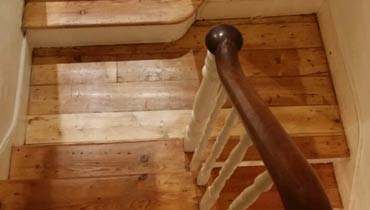
Stairs sanding is the professional restoration of wooden staircase treads, risers, and string cappings — removing worn finish, scratches, paint, and surface damage using specialist stair sanding tools, then refinishing to match or complement the floors on adjacent landings and hallways.
A wooden staircase is the most heavily used surface in any London home. Every trip up and down the stairs concentrates wear on the same narrow strip of each tread — the front third of the tread surface, where every foot lands. This concentrated wear means staircases typically need sanding and refinishing more frequently than the floors they connect, and the wrong finish choice will show its limitations within months of application.
Stairs sanding is also technically more demanding than flat floor sanding. The shape of each tread — with a bullnose or pencil-round nosing at the front, a riser below, spindle bases in the tread surface, and a string capping along the side — means that machine access is limited, hand work is extensive, and every component must be sanded and finished consistently to produce a result that looks correct as a complete staircase rather than a series of individually sanded treads.
Flooring Services London sands and refinishes wooden staircases across London for residential and commercial clients, working in period Victorian and Edwardian properties, modern townhouses, and converted apartments throughout all London boroughs. Our floor restoration price guide covers all charges in full.
Stairs Sanding vs. Staircase Fitting — What Is the Difference?
These are two distinct services that are sometimes confused:
Stairs sanding restores existing wooden treads — removing the old finish, surface damage, and wear from the timber that is already in place, then refinishing it. The staircase structure stays exactly as it is. This is the right service when the existing treads are in reasonable structural condition and can be restored.
Staircase floor fitting replaces the existing tread surface with new hardwood — fitting new oak or pine treads, risers, and string capping over the existing staircase structure. This is the right service when the existing treads are too thin, too damaged, or too worn to be restored through sanding alone.
We assess the existing treads during the site visit and recommend honestly which service is appropriate. In many London period properties where the original pine treads have been carpeted for decades, restoration through sanding produces a far better result than replacement — and at lower cost.
London Staircases We Sand
London's period housing stock presents a wide variety of staircase types, each with specific sanding requirements:
Victorian and Edwardian pine staircases — the most common staircase type in London's terraced and semi-detached period properties. Original pine treads in these staircases are typically 25–32mm thick — significantly thicker than modern stair treads — giving them ample depth to be sanded multiple times over their lifetime. Many have been carpeted for decades and are in excellent condition beneath the carpet, requiring only a moderate sand to remove the carpet gripper marks and old surface before refinishing.
Hardwood staircases in period and Georgian properties — higher-specification period properties across Mayfair, Kensington, Islington, and similar inner London areas frequently have original oak or mahogany staircases. These hardwood treads are dense, tight-grained, and respond exceptionally well to a professional sand and refinish. Mahogany in particular, once common in Georgian London townhouses, produces a stunning result after careful sanding and an oil or wax finish.
Painted staircases — a large proportion of London period staircases were painted at some point, often with gloss oil paint that has hardened over decades. Paint removal through sanding is entirely achievable — the coarse sanding stage strips it completely — but it requires appropriate starting grits and sometimes a heavier initial pass than a standard unpainted staircase. Lead paint identification and handling protocol applies in pre-1960s properties.
Modern and contemporary staircases — newer London properties and loft conversions frequently have oak or engineered wood staircases that need periodic sanding and refinishing as the original factory finish wears. For engineered wood treads, wear layer thickness is assessed before sanding — as with engineered floor boards, the real wood surface layer limits how many times the tread can be sanded.
Open-riser staircases — increasingly common in London's contemporary conversions and loft extensions, open-riser staircases have no riser boards between treads. Both the top and underside of each tread are visible, requiring sanding and finishing on all visible faces — more time-consuming than closed-riser staircases.
Why Staircase Sanding Requires a Different Approach
Several specific challenges make staircase sanding more involved than flat floor sanding:
Limited machine access — the shape of a staircase tread — typically 220–280mm deep with a nosing at the front — is too narrow and complex for a full-size belt or drum sander. We use smaller specialist stair sanders, detail sanders, and oscillating tools for the main tread surface, followed by hand sanding with appropriate blocks and profiles for the nosing, the riser face, and the string capping.
Nosing sanding — the bullnose or pencil-round nosing at the front of each tread is the most worn part of the staircase and the most technically demanding to sand consistently. The curved profile must be followed precisely with a shaped sanding block or detail tool to produce a smooth, even result across all treads. An inconsistent nosing — flat in some places, still rounded in others — is immediately visible when looking along the staircase.
Spindle bases — where spindles or balusters are fitted directly through the tread surface, the tread around each spindle base must be sanded and finished by hand. Machine access is impossible close to a spindle, and the finish must be applied carefully to avoid staining the spindle itself.
Matching adjacent floors — in most London staircase sanding projects, the goal is to produce a finish that matches or complements the floors on the hall below and the landing above. This requires using the same finish product and sheen level as the adjacent floors, and sometimes a light stain adjustment to bring the tread colour in line with the surrounding floor tone.
Safety during work — the staircase must remain accessible during the project for an occupied London property. We work in a way that keeps at least one side of the staircase passable at all times and schedule finish coats to allow adequate drying overnight before the staircase is used the following morning.
Sanding a staircase alongside floors on the same project? Call us on 020 7036 0625 or request a free site visit — combining staircase and floor sanding in a single project is more cost-efficient and produces the most consistent finish result across the entire property.
Stairs Sanding Process
1. Free site visit and assessment — We examine the treads, check their thickness and condition, identify the existing finish and any paint layers, assess the nosing profile and spindle configuration, and confirm whether restoration or replacement is the appropriate approach. Written fixed-price quote provided.
2. Preparation — Carpet and gripper rods removed where applicable. All tread surfaces are checked for protruding nail heads, which are punched below the surface before sanding. Loose treads or risers secured. Knotting solution applied to prominent pine knots on period staircases.
3. Main tread sanding — Specialist stair sander or detail sander used on the main tread field area, working parallel to the tread grain. Starting grit depends on the condition:
- Painted treads — 36 or 40 grit to remove paint
- Old varnish or worn finish — 60 or 80 grit
- Light surface wear only — 80 or 100 grit
Progressive sanding through finer grits to the final smooth surface.
4. Nosing sanding — Bullnose or pencil-round nosing sanded using a shaped sanding block that follows the profile precisely. This stage is entirely by hand — no machine can follow a curved nosing consistently. Each tread nosing sanded through the same grit sequence as the main field.
5. Riser sanding — Riser face sanded if included in the scope — closed risers sanded parallel to the grain, finished to match the tread surface. Open risers and painted risers treated according to the specific specification.
6. String capping sanding — String capping sanded along its length, following the angle of the staircase. Detail sanding at the junction between capping and tread at each step level.
7. Corner and spindle detail — Hand sanding around spindle bases and in any corners machine access cannot reach. Particularly relevant at the base of the staircase where the stringer meets the hall floor level.
8. Finishing — Finish coats applied tread by tread, working from the top of the staircase downward so that the finished surface is not walked on during application. Two or three coats applied with adequate drying time between coats. Full details on all finish options are on our floor sealing and finishing page.
Finish Options for Staircases
The finish on a staircase tread must be significantly more durable than on a flat floor — the concentrated impact loading of foot traffic on a narrow tread surface wears finish far faster than the distributed loading across a floor area.
Bona Traffic HD — our standard recommendation for all London staircase treads. A two-component water-based lacquer offering maximum hardness and abrasion resistance. Available in extra-matt, matt, and satin sheens. The extra-matt or matt finish is the most popular in London residential staircases — it provides Bona Traffic HD's exceptional durability with a natural, low-sheen appearance. Three coats are recommended for staircases where two would be standard on a flat floor.
Osmo Polyx Oil — for staircases where a natural oil finish is preferred over lacquer. More maintenance-intensive than Bona Traffic HD on a heavily used staircase — re-oiling will be needed more frequently than on flat floors — but produces the most natural appearance and is easier to spot-repair on individual treads without refinishing the entire staircase.
Wax — appropriate for period staircases in owner-occupied properties where authentic character is the priority and the owner is prepared to invest in regular floor waxing maintenance. Not recommended for rental properties or staircases with heavy daily use.
Stairs Sanding Costs in London
Staircase sanding is priced on a survey as costs vary significantly depending on staircase configuration, number of treads, nosing profile, spindle type, and whether risers and string capping are included in the scope.
| Service | Price |
|---|---|
| Stairs sanding and refinishing | Priced on survey |
| Floor sanding, buffing & varnishing (adjacent floors) | from £25/m² |
| Floor sanding, buffing & oiling (adjacent floors) | from £25/m² |
All prices shown are exclusive of VAT. All prices confirmed in writing after the free site visit. Properties within the London ULEZ and Congestion Charge zones may include a daily access surcharge stated explicitly in every quote.
Frequently Asked Questions — Stairs Sanding in London
Can you sand a staircase that has been carpeted for 30 years? Yes — and carpeted staircases are often in much better condition than expected when the carpet comes up. Carpet protects the tread surface from foot traffic and UV light, and the original pine or hardwood beneath is frequently in excellent condition apart from gripper rod tack holes at the perimeter and occasional surface staining. We assess the condition of the treads as part of the site visit and confirm whether restoration is achievable before any work is booked.
Can the staircase be used while it is being sanded? Yes — we work in occupied London properties regularly and always ensure the staircase remains accessible throughout the project. We typically sand and finish alternate treads in sequence to allow one side of the staircase to be used while the other is drying, and we schedule the final finish coat on each tread to allow overnight drying before morning use. We discuss the access arrangement with you before work begins.
How do I match the staircase finish to my hall and landing floors? We use the same finish product and sheen level on the staircase as on the adjacent floors — if we are sanding and finishing the hall and landing floors as part of the same project, the match is straightforward. If the adjacent floors were previously finished by another contractor, we identify the existing product and sheen during the site visit and use a compatible product on the staircase to produce the closest achievable result.
My staircase has painted risers — do you sand those too? We can sand and refinish risers as part of the staircase sanding project, or leave them painted where the client prefers the contrast between natural wood treads and white painted risers — a popular look in London period properties. We discuss and confirm the riser treatment during the site visit and include it in the written quote accordingly.
How long does staircase sanding take? A standard straight flight of 12–14 steps with closed risers and string capping typically takes two to three days including sanding and three finish coats with overnight drying between coats. More complex staircases — with winding treads, open risers, or intricate spindle configurations — take longer. We confirm the expected duration in the written quote after the site visit.
Call us on 020 7036 0625 or request a free quote online — we respond to all stairs sanding enquiries the same working day.