Monday - Friday 07:30 - 17:30, Saturday 07:30 - 16:00
Flooring Services Little Ilford — Floor Sanding, Fitting & Repair in E12
Little Ilford is one of Newham's quieter, more settled neighbourhoods — a place where the housing stock reflects the area's Victorian origins more consistently than its modern reputation might suggest. The name itself predates Manor Park, its better-known modern identity: the ancient parish of Little Ilford, recorded in the Domesday Book, gave way to the suburban streets that were laid out from the 1880s onwards as Manor Farm fields were sold for development. The result is a network of Victorian and Edwardian terraced houses running through E12, most of them modest in scale but solidly built, with suspended timber subfloors, original pine boards, and the kind of straightforward structural integrity that makes them excellent candidates for restoration work.
What distinguishes Little Ilford from its neighbours is its character rather than its architecture. This is an area of long-established family ownership — properties that have often been in the same household for decades, with original features intact precisely because they were never subjected to the successive waves of renovation that stripped period detail from more fashionable parts of east London. The Durham Road Conservation Zone near Manor Park station preserves a particularly intact pocket of late-Victorian development. And with Manor Park station now on the Elizabeth Line, the area's practical value to commuters has increased significantly, bringing renewed owner-occupier interest to streets that were previously bypassed in favour of better-connected postcodes.
To arrange a free site visit or discuss your project, call us on 020 7036 0625 or request a free estimate.
Floor Sanding and Finishing in Little Ilford
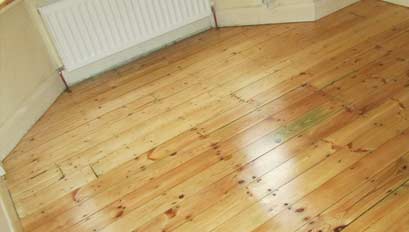
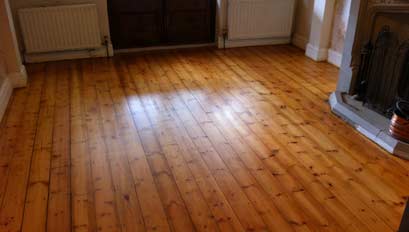
Floor sanding is the process of mechanically removing the worn surface layer of a timber floor using industrial belt and edge equipment, then applying a new protective finish to restore its appearance and extend its serviceable life. In Little Ilford's Victorian terraced housing, this work is especially rewarding because the floors have so often been simply carpeted and left — meaning the original pine boards beneath are frequently in far better condition than their age would suggest, with sufficient thickness for a full restoration.
The typical scenario in an E12 terrace runs as follows. Carpet comes up to reveal original softwood boards, nailed to joists over a ventilated void. We inspect for structural soundness, check board thickness, look for any signs of damp from below, and assess whether previous sanding has already removed significant material. Where the boards are sound and thick enough — and in Little Ilford's older housing stock, this is more often the case than not — a full sand and refinish is the most cost-effective way to transform a room.
Finish options we discuss at the site visit include:
- Lacquer — the hardest-wearing choice; practical for hallways and living rooms in family homes where the floor takes daily punishment from children, pets, and footwear
- Hardwax oil — a natural, lower-sheen finish that suits the grain and character of older pine well; repairable in sections without a full refinish if individual boards get scratched
- Staining before sealing — shifts the natural colour of the timber, useful where boards have varied tones from different replacement timbers over the years, or where an owner wants to move away from the natural orange of Victorian pine toward a cooler or darker aesthetic
Gap filling is standard practice in Little Ilford properties before any finish is applied. The suspended timber construction means boards have been moving seasonally for over a century, and the gaps that develop between them are filled with flexible resin matched to the board tone — a more durable result than rigid fillers, which crack and fall out as the floor continues to move.
Where a job includes the staircase, we sand and refinish the stairs in the same session to ensure a consistent finish from the hallway to the upper floor. For an overview of what sanding costs across different floor sizes and conditions, our pricing guide covers this in detail.
Thinking of lifting the carpet in your Little Ilford home? Call us on 020 7036 0625 or book a free site visit — we'll assess the boards and tell you honestly what's achievable.
Wood Floor Fitting in Little Ilford
When the original boards are beyond restoration — too thin from previous sanding, replaced by chipboard, or too badly damaged by moisture or woodworm — fitting a new floor is the right path. Little Ilford's suspended timber subfloors offer genuine flexibility in terms of product choice, and we assess subfloor condition and room characteristics before recommending anything.
Solid wood is a strong option in E12's older terraced houses where joist condition is good and subfloor ventilation is adequate. Secret-nailed directly to the joists in the traditional manner, solid boards offer the longest possible lifespan — multiple re-sands over several decades before replacement becomes necessary — and suit the more modestly proportioned rooms of Little Ilford's terraces well when specified in narrower widths. European oak or character-grade boards with natural variation in grain and colour fit the unpretentious character of these properties better than uniform, heavily processed finishes.
Engineered wood covers the situations where solid is less appropriate: ground-floor rooms where moisture levels are uncertain, rooms with underfloor heating in newer extensions or conversions, and anywhere where a glue-down to concrete is required. It is dimensionally stable across a wider range of conditions than solid and is available in a broad range of species, widths, and finishes — from natural and lightly brushed oak in narrower widths that suit Victorian room proportions, to wider character boards for larger rooms or rear extensions where more space is available.
Little Ilford's family-home character means we regularly fit floors as part of broader kitchen extension and ground-floor reconfiguration projects — open-plan layouts where a single product runs through kitchen, dining, and living areas without transitions. For these situations we discuss the best product and finish for the specific use before committing to a specification.
Where new floors are being fitted over existing suspended timber subfloors with any flex, we overlay with plywood before laying — this eliminates movement that would otherwise cause joints to work loose over time and boards to squeak underfoot.
LVT Installation in Little Ilford
Luxury vinyl tile is widely used across Little Ilford's family housing stock, particularly in kitchens, ground-floor open-plan spaces, and rental properties where durability and ease of maintenance take priority. LVT is waterproof, resilient under heavy use, and requires no specialist maintenance — practical qualities that resonate in a neighbourhood characterised by busy family homes and a significant private rental market along Romford Road and the surrounding streets.
In Little Ilford's Victorian terraces, the subfloor preparation required before LVT is laid is the critical part of the job:
- Suspended timber subfloors — the norm in E12's period housing — need a plywood overlay before LVT, screwed at close centres to eliminate the flex that causes click-lock joints to fail prematurely
- Ground-floor concrete — where this exists in conversions or extensions — is tested for moisture before laying and levelled with self-levelling compound where undulation is present
- Subfloor condition assessment is always the first step; a floor that looks flat to the eye may have enough variation at 2m span to cause problems with a glued or clicked product
For landlords managing rental properties in E12, LVT offers a particularly strong return — robust enough to last several tenancies without refinishing, available in realistic wood formats that present well in letting photographs, and straightforward to clean and maintain. We can typically complete a standard room installation in a single day once preparation is done. For full details on product options and installation approach, see our LVT and vinyl flooring section.
Wood Floor Repair in Little Ilford
Little Ilford's Victorian terraces develop flooring issues in predictable patterns after 120-plus years of seasonal movement, occupation, and the occasional period of neglect between ownership changes. The most common repair work we carry out in E12 covers:
- Squeaking boards — the most frequent complaint; caused either by loose nails or boards rubbing at the joints, and correctly diagnosed before treating rather than applying surface fixes that mask the underlying problem
- Open gaps — widened joints between boards, filled with flexible resin before refinishing to prevent draughts, reduce dirt accumulation, and create a cleaner finished appearance
- Individual damaged boards — replaced with matching timber, sourced to correspond as closely as possible to the width, thickness, and species of the surrounding boards
- Moisture-damaged sections — assessed to establish the extent of the damage and, critically, whether the source of moisture has been resolved before any repair is carried out
For engineered floor repairs in Little Ilford's more recently renovated properties, the approach depends on the wear layer thickness and the nature of the damage. Surface issues in a floor with a thick wear layer can often be addressed with a localised spot treatment; delamination or lifting across a wider area requires a fuller assessment before advising on repair versus replacement.
Where woodworm is present — not uncommon in E12's older properties, where boards have spent periods in damp or poorly ventilated conditions — we assess the structural impact and advise honestly on whether the affected boards need replacing or the floor remains sound enough to treat and restore.
Wood Floor Maintenance in Little Ilford
Regular maintenance is what keeps a restored floor in good condition between full sanding jobs and is significantly less disruptive and less expensive than either a full sand or a replacement. In Little Ilford's predominantly family-owned housing stock, the maintenance requirement varies between property types and how the floor is used.
For oiled floors — chosen by many E12 owner-occupiers who want a natural, repairable finish — we carry out re-oiling every two to four years, depending on foot traffic. The process involves thoroughly cleaning and degreasing the surface, then applying a compatible oil that replenishes the protective layer and revives the timber's colour and grain. It is a one-day job for most rooms and adds measurably to how long the floor lasts before a full restoration is needed.
For lacquered floors showing dullness or minor surface wear without structural damage to the timber, recoating is the appropriate maintenance treatment — a fresh coat of lacquer applied over the existing finish without the disruption and dust of full sanding. Done at the right point in the floor's life cycle, it restores appearance and protection at a fraction of full restoration cost.
For landlords in Little Ilford, scheduling a maintenance visit during a void between tenancies is one of the best investments in a rental floor. The cost of a recoat or re-oil is typically a small fraction of a full sand, and maintaining the floor consistently is what prevents the incremental build-up of damage that eventually makes a full job unavoidable. We are happy to advise on the right maintenance interval for your floor type, finish, and tenancy pattern.
Frequently Asked Questions — Flooring in Little Ilford E12
Little Ilford is often referred to as Manor Park — does that affect which areas you cover? Not at all. Little Ilford and Manor Park are the same area — Little Ilford is the historic parish name, Manor Park the more commonly used modern name, and both refer to the E12 postcode. We cover the full area including the streets around Manor Park station, Romford Road, the Durham Road Conservation Zone, and the surrounding residential streets through to the E12 boundary.
My E12 terrace has been in my family for decades and the floors have never been touched — is that a good or bad thing for restoration? Generally very good. Floors that have never been sanded retain their full original thickness — typically 22–25mm for Victorian pine boards — giving the maximum number of future sands and the best possible base for restoration. Floors that have been left under carpet rather than subjected to repeated DIY sanding or water damage are frequently in excellent condition. We assess board condition, thickness, and any signs of moisture at the free site visit.
Is solid wood or engineered wood a better choice for a Little Ilford Victorian terrace? For the upper floors and main reception rooms of a well-maintained E12 terrace with good subfloor ventilation, solid wood is a strong choice — it offers the longest lifespan and suits the scale of these rooms well. For ground-floor rooms with any history of damp, rooms above concrete, or anywhere with underfloor heating in a rear extension, engineered wood is the safer specification. We assess the specific subfloor conditions at the site visit and recommend accordingly rather than defaulting to one product for every situation.
The kitchen in my Little Ilford house has concrete and I want a wood-look floor — what are my options? Both engineered wood and LVT work well over concrete, provided the slab is dry and reasonably flat. Engineered wood gives the most authentic timber appearance and feel; LVT offers complete waterproofing, which matters in a kitchen setting where spills are common. The right choice depends on how you want the floor to feel underfoot, how much water exposure it is likely to see, and your budget. We discuss this at the estimate stage based on your specific room and use.
How long does a floor sanding job take in a typical Little Ilford terrace? For a standard two-bedroom E12 terrace — living room, hallway, and one additional room — sanding and the first finish coat typically takes one to two days. The floor should be kept clear for a further 12 to 24 hours after the final coat depending on the finish type before it can be walked on. We confirm a precise timeline at the estimate stage based on the actual floor area and condition.
Working Across Little Ilford
We cover all of Little Ilford and the surrounding E12 area, including Manor Park, the Durham Road Conservation Zone, the streets between Romford Road and the City of London Cemetery, and the residential roads through to the Forest Gate and East Ham borders. Whether your project is restoring original Victorian boards, fitting new engineered or solid wood, installing LVT in a kitchen or rental property, repairing damaged sections of an existing floor, or maintaining a restored floor between tenancies, we provide a free no-obligation estimate before any work begins.
Call us on 020 7036 0625 or request a free quote. We're available Monday to Friday 07:30–17:30 and Saturday 07:30–16:00.
Flooring Services in Little Ilford
As a trusted local flooring company, we offer a comprehensive range of flooring services in Little Ilford and surrounding areas. Whether you need new flooring installed, existing floors repaired, or expert advice on the best flooring options for your property, our experienced team is here to help.
Floor Fitting
Wood floor fitting is the process of installing flooring such as engineered wood, solid wood, parquet, or laminate, ensu...
Floor Sanding
Floor sanding is the process of removing the top layer of a wooden floor using professional sanding equipment to elimina...
Wood Floor Repair
Wood floor repair involves fixing damaged, worn, or unstable areas of a wooden floor, including replacing boards, fillin...
Floor Maintenance
Wood floor maintenance includes cleaning, polishing, buffing, and re-coating wooden floors to preserve their appearance,...
Solid Wood Floor Sanding
Solid wood floor sanding is the process of removing the top layer of solid timber flooring to eliminate wear, scratches,...
Engineered Floor Sanding
Engineered wood floor sanding is the process of carefully removing the top wear layer of an engineered floor to restore ...
Gap Filling
Wood floor gap filling involves sealing gaps between floorboards or parquet blocks to improve stability, appearance, and...
Floor Sealing
Floor sealing refers to the application of a protective finish, such as lacquer or oil, to a wooden floor after sanding,...
Commercial Floor Sanding
Commercial floor sanding involves restoring wooden floors in high-traffic environments by removing worn finishes, surfac...
Engineered Floor Fitting
Engineered wood floor fitting involves installing multi-layered wooden boards designed for stability, allowing them to p...
Laminate Floor Installation
Laminate floor fitting involves installing multi-layer synthetic flooring boards designed to replicate the appearance of...
Floorboards Fitting
Floorboards fitting covers the installation of timber floorboards, ensuring correct preparation, alignment, and fixing f...
Floor Insulation Fitting
Floor insulation fitting involves installing insulating materials beneath a floor structure to reduce heat loss, improve...
Floorboards Repair
Floorboard repair covers the restoration of damaged, loose, or worn timber boards, addressing issues such as movement, s...
Floor Scratch Repair
Wood floor scratch repair focuses on restoring damaged areas of a wooden floor by reducing or removing surface scratches...
Floor Polishing
Floor polishing focuses on enhancing the appearance of wooden floors by restoring shine, improving surface protection, a...
Parquet Floor Sanding
Parquet floor sanding involves carefully restoring patterned wooden flooring by removing worn finishes, surface damage, ...
Floorboards Sanding
Floorboards sanding focuses on restoring timber boards by removing worn finishes, surface damage, and imperfections, cre...
Stairs Sanding
Stair sanding involves restoring wooden staircases by removing worn finishes, surface damage, and imperfections, prepari...
Wood Floor Staining
Floor staining enhances the appearance of wooden floors by applying coloured finishes that change the tone of the wood w...
School Floor Sanding
School floor sanding focuses on restoring wooden floors in educational environments by removing wear, surface damage, an...
Solid Wood Floor Fitting
Solid wood floor fitting requires careful preparation and precise installation, as natural timber reacts to changes in t...
Parquet Floor Fitting
Parquet floor fitting involves installing patterned wooden flooring with precision, ensuring correct alignment, subfloor...
Staircase Floor Fitting
Staircase floor fitting involves installing wooden elements on staircases, including treads, risers, and trims, ensuring...
Soundproofing Wood Flooring
Soundproof floor fitting focuses on reducing airborne and impact noise by installing suitable underlay and flooring syst...
Solid Wood Floor Repair
Solid wood floor repair covers the restoration of damaged timber flooring by replacing worn boards, treating surface iss...
Engineered Floor Repair
Engineered wood floor repair focuses on restoring damaged or worn engineered flooring by addressing surface issues and, ...
Parquet Floor Repair
Parquet floor repair involves restoring patterned wooden flooring by fixing damaged blocks, stabilising loose sections, ...
Wood Floor Cleaning
Wood floor cleaning involves using suitable products and techniques to remove dirt, maintain the finish, and protect the...
Floor Waxing
Floor waxing and recoating involves renewing the protective layer of a wooden floor by removing old wax or finish build-...
Floor Stripping
Floor stripping refers to the removal of old wax, polish, or finish layers from a floor using specialised products, prep...
Wood Floor Re-Oiling
Wood floor re-oiling focuses on renewing the protective oil finish of a wooden floor, enhancing its natural appearance w...
Wood Floor Recoating
Wood floor recoating involves applying a new protective finish over an existing one without full sanding, helping to ref...
Commercial Floor Cleaning
Commercial floor cleaning focuses on deep cleaning and maintenance of flooring in high-traffic environments, removing em...
LVT Floor Installation
LVT floor installation involves fitting luxury vinyl tiles or planks with precision, ensuring correct subfloor preparati...
All our flooring services in Little Ilford come with a free, no-obligation estimate. We pride ourselves on quality workmanship and competitive pricing across all London boroughs.
Floor Sanding in E12 — Aldersbrook, Grove Park, Lee, Little Ilford, Manor Park, Mottingham
The E12 postcode district covers Aldersbrook, Grove Park, Lee, Little Ilford, Manor Park, Mottingham in London. Our team regularly works on period conversions, Victorian terraces, and modern apartments throughout E12. Whether you have hardwood boards, parquet, or engineered flooring, we provide professional floor sanding with a free site visit and no-obligation quote.
For detailed area information, see our Flooring Services in Little Ilford page.
Frequently Asked Questions
How much does floor sanding cost in Aldersbrook, Grove Park, Lee, Little Ilford, Manor Park, Mottingham, E12?
Floor sanding in Aldersbrook, Grove Park, Lee, Little Ilford, Manor Park, Mottingham, E12 typically costs £25 to £45 per square metre depending on floor condition and finish type. Gap filling and repairs are priced separately.
How long does floor sanding take in Aldersbrook, Grove Park, Lee, Little Ilford, Manor Park, Mottingham, E12?
Most residential floor sanding jobs in Aldersbrook, Grove Park, Lee, Little Ilford, Manor Park, Mottingham, E12 are completed in 1-2 days. Lacquering or oiling adds drying time.
Is your floor sanding process dust-free in Aldersbrook, Grove Park, Lee, Little Ilford, Manor Park, Mottingham, E12?
We use modern dustless sanding equipment that captures 98%+ of airborne particles, keeping your Aldersbrook, Grove Park, Lee, Little Ilford, Manor Park, Mottingham, E12 property clean.
Do you offer free site visits in Aldersbrook, Grove Park, Lee, Little Ilford, Manor Park, Mottingham, E12?
Yes, we offer free, no-obligation site visits in Aldersbrook, Grove Park, Lee, Little Ilford, Manor Park, Mottingham, E12. Our surveyor assesses the floor and provides a detailed quote on the spot.
Also available in E12:
Wood Floor Fitting in Aldersbrook, Grove Park, Lee, Little Ilford, Manor Park, Mottingham, E12