Monday - Friday 07:30 - 17:30, Saturday 07:30 - 16:00
Flooring Services Barbican — Floor Sanding, Fitting & Repair in EC2
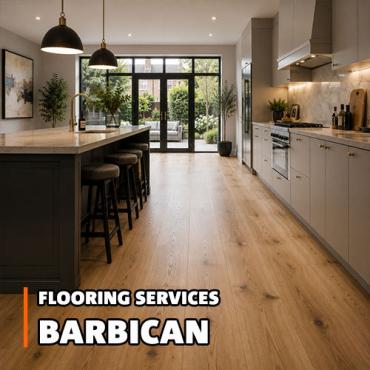
Barbican is one of London's most architecturally singular neighbourhoods — a self-contained residential and cultural estate in EC2, built between the late 1960s and early 1980s on a 40-acre site cleared by wartime bombing, designed by architects Chamberlin, Powell and Bon as one of the most ambitious residential developments in mid-century British architecture. The estate's three towers — Cromwell, Shakespeare, and Lauderdale — along with its lower terrace blocks, garden courts, podium walkways, and arts complex, including the Barbican Centre, house approximately 4,000 residential units in a self-contained urban environment unlike anything else in London.
For flooring, the Barbican presents a specific set of characteristics that make it completely distinct from every other London neighbourhood. The residential units are almost entirely leasehold flats in a Grade II listed building, which means any flooring work must navigate both the building's listed status and the City of London Corporation's estate management requirements for the Barbican. The flat construction is in-situ reinforced concrete throughout — there are no suspended timber subfloors anywhere in the Barbican Estate. Subfloor conditions are concrete; the sound insulation performance of concrete between storeys must be maintained by acoustic underlay specifications in any new floor installation, and the specific character of Brutalist interior architecture shapes what floor specifications suit these spaces aesthetically.
Beyond the estate itself, the broader Barbican area — the streets of EC2 around Beech Street, Silk Street, Whitecross Street, and the City fringe — contains a mix of converted Victorian commercial buildings, modern residential and office developments, and the cultural and educational institutions clustered around the arts complex.
Flooring Services London has been carrying out floor sanding, floor fitting, wood floor repair, and floor maintenance in the Barbican and surrounding EC2 area for over 20 years, working in Barbican Estate apartments, City fringe offices, and the wider residential and commercial property stock of the area. All pricing is confirmed in writing following a free site visit — our full pricing guide covers all services in detail.
Flooring in the Barbican Estate — What Makes It Different
Working in the Barbican Estate is unlike working anywhere else in London, for several specific reasons:
Grade II listed building status — the Barbican Estate was listed in 2001, recognising its architectural and historic significance. While the listing primarily protects the external fabric and communal areas rather than the interiors of individual flats, any significant alteration to a flat — including floor installation — should be considered in the context of the listing and the City of London Corporation's estate management policies. We advise on any relevant considerations during the site visit.
Concrete subfloors throughout — every flat in the Barbican Estate has a concrete subfloor. There are no suspended timber subfloors anywhere in the estate. This means solid hardwood installation by secret nailing is not appropriate in Barbican flats — engineered wood, LVT, and laminate installed floating or glued over appropriate underlay are the correct specifications. The concrete subfloor condition varies across the estate — some flats have had multiple previous floor installations and the concrete may have residual adhesive, levelling compound, or uneven sections that need addressing before a new floor is laid.
Acoustic performance requirements — the Barbican Estate management has specific requirements for acoustic performance in new hard floor installations. The in-situ concrete construction provides good airborne sound insulation between flats but concrete transmits impact sound very efficiently — footsteps in a Barbican flat are very clearly audible to the neighbour below without adequate acoustic underlay. The estate management requires a minimum acoustic performance standard for new hard flooring, typically specified as a minimum ΔLw impact sound reduction value, and this requirement must be met before any new hard floor installation proceeds. We advise on compliant specifications and provide written documentation for the Barbican Estate management on request — this is standard practice for all Barbican flat installations.
Access and logistics — the Barbican Estate's podium walkway system, the limited vehicle access to the estate's residential blocks, and the building management's contractor access requirements all need to be factored into project planning. We are experienced with the specific access arrangements of the estate and plan every Barbican project accordingly.
The aesthetic of Brutalist interiors — the interior character of a well-designed Barbican flat — exposed concrete ceilings, large windows overlooking the estate's lakes and gardens, clean geometric lines — suits specific floor specifications better than others. Wide-plank engineered oak in natural, lightly brushed, or smoked tones complements the raw concrete and architectural honesty of a Barbican interior particularly well. Highly polished or very light floors can clash with the materiality of the architecture; natural oil finishes and matt or extra-matt lacquers are generally the most sympathetic finish choices.
Wood Floor Sanding in the Barbican
Floor sanding in the Barbican Estate covers engineered wood floors installed in previous fit-outs that are now due for restoration. Given that all Barbican flats have concrete subfloors, the installed floors are almost exclusively engineered wood, LVT, or laminate — solid hardwood is extremely rare.
Engineered floor sanding — where the existing floor is engineered wood with sufficient wear layer remaining, sanding and refinishing restores the floor's appearance and renews its protective coating without the cost of full replacement. Wear layer assessment is essential before any Barbican engineered floor sanding is committed — many engineered floors installed in Barbican flats in the 1990s and early 2000s have relatively thin wear layers that may be at or near the end of their sandable life. We measure wear layer thickness during the site visit and confirm the remaining sanding life before any work is booked.
Dust-free sanding equipment is used on every Barbican job — the estate's enclosed communal corridors and the proximity of neighbouring flats make dust control particularly important. Our extraction systems capture up to 99% of airborne particles throughout every sanding job.
All of EC2 falls within both the ULEZ zone and the Congestion Charge area — applicable daily access surcharges are always stated explicitly in the written quote. All prices confirmed in writing following the free site visit.
Wood Floor Fitting in the Barbican
New floor installation in Barbican Estate flats is one of the most specific and carefully considered flooring briefs in London:
Acoustic compliance first — before any other specification is discussed, the acoustic requirement must be confirmed. The Barbican Estate management specifies a minimum acoustic performance standard for new hard flooring, and this drives the underlay choice. High-performance rubber acoustic underlay — typically achieving a minimum ΔLw of 17–21 dB depending on the product — is the standard specification for Barbican flat installations. We confirm the exact requirement for each flat, specify a compliant underlay, and provide written documentation for the estate management before any work begins.
Engineered wood — the most commonly specified new floor in Barbican flats. Wide-plank engineered oak in natural brushed or lightly smoked tones suits the Brutalist interior aesthetic particularly well. The concrete subfloor in Barbican flats allows glued or floating installation — we recommend glued installation where possible as it produces a more solid, less resonant result underfoot and reduces the hollow sound that floating floors can produce over concrete. Moisture assessment of the concrete before installation is standard — concrete subfloors can retain residual moisture for years and a damp-proof membrane may be needed.
LVT flooring — increasingly popular in Barbican flats, particularly in kitchens and areas where waterproof performance is a priority. LVT's fully waterproof construction is well-suited to the Barbican's concrete subfloors, and the range of realistic wood and stone effects in modern LVT products suits the architectural character of many Barbican interiors.
Herringbone parquet — a popular specification in Barbican flats where the geometric patterning of herringbone references the architectural geometry of the estate itself. Engineered herringbone in wide-format blocks over acoustic underlay is the correct specification for Barbican concrete subfloors.
Wood Floor Repair in the Barbican
The most common repair requirements in Barbican Estate flats relate to the age of existing engineered floor installations:
Surface scratch and finish repair — engineered floors in Barbican flats that show surface scratches and finish wear but have sufficient wear layer remaining for light sanding can be restored through a combination of localised sanding and recoating, or through a full sanding and refinishing where the condition warrants it.
Delamination and board movement — engineered floors in older Barbican fit-outs occasionally show delamination at board edges or movement at joints caused by moisture variation or original adhesive failure. We assess the extent of the issue during the site visit and advise on whether repair, re-bonding, or full replacement is the most appropriate approach.
Commercial floor repair in EC2 offices — the City fringe offices and commercial properties around Beech Street, Aldersgate Street, and the wider EC2 area require periodic floor repair and maintenance. We carry out all commercial work outside operational hours with full health and safety documentation.
Planning a flooring project in the Barbican? Call us on 020 7036 0625 or request a free site visit — we respond to all Barbican and EC2 enquiries the same working day and are experienced in working within Barbican Estate management requirements.
Floor Maintenance in the Barbican
For Barbican Estate flats with existing engineered wood or oil-finished floors, regular professional maintenance extends the floor's life significantly between full restoration cycles. Wood floor recoating refreshes a lacquered floor in a single day without sanding; re-oiling renews the protective oil treatment of hard-wax oiled floors on an annual or biannual basis. Both are far less disruptive and less expensive than a full restoration and are the correct approach for a floor that is wearing gradually but structurally sound.
For the City fringe commercial properties around EC2, scheduled floor maintenance programmes — periodic deep cleaning, recoating, and condition assessments — keep commercial floors in good condition and reduce the frequency and cost of full restoration cycles. Full details on all maintenance services and pricing are available on our floor maintenance guide.
Why Barbican Property Owners Choose Flooring Services London
- Barbican Estate expertise — we understand the specific requirements of working in the Barbican Estate: Grade II listed building considerations, acoustic underlay compliance, concrete subfloor installation, estate management documentation, and the specific access arrangements of the estate
- Acoustic specification as standard — every Barbican flat installation includes acoustic underlay specification and written documentation for estate management before work begins
- Concrete subfloor specialists — moisture assessment, damp-proof membrane specification, and glued engineered wood installation over concrete are all standard parts of our Barbican work
- Dust-free sanding — essential in the Barbican's enclosed communal corridors and densely occupied residential blocks
- Fixed-price written quotes — assessed in person, confirmed before work starts. ULEZ and Congestion Charge surcharges always stated explicitly
- Rated 4.93/5 from verified customers across London
Frequently Asked Questions — Flooring in the Barbican
Does the Barbican Estate's listed building status affect what flooring I can install? The Grade II listing of the Barbican Estate primarily protects the external fabric and communal architectural features rather than the interiors of individual flats. However, the City of London Corporation's Barbican Estate management has its own requirements for internal alterations including new flooring — specifically acoustic performance standards for any new hard floor. We advise on the relevant requirements during the site visit and provide written documentation for the estate management as part of every Barbican installation.
What acoustic underlay do I need for a Barbican Estate flat? The Barbican Estate management specifies a minimum acoustic impact sound reduction performance for new hard flooring, typically expressed as a minimum ΔLw value. High-performance rubber acoustic underlay achieving 17–21 dB ΔLw is the standard specification for most Barbican flat concrete subfloor constructions. We confirm the exact requirement for your specific flat, recommend a compliant product, and provide the written specification for estate management approval before installation begins.
Can you sand and restore an existing engineered wood floor in a Barbican flat? Yes — provided the wear layer has sufficient thickness remaining for safe sanding. Engineered floors in older Barbican fit-outs are often approaching the limit of their sandable life, so wear layer assessment before booking any sanding work is essential. We measure the wear layer during the site visit and give an honest assessment of the remaining sanding life and whether restoration or replacement is the more appropriate approach.
What floor specification suits a Barbican flat interior best? Wide-plank engineered oak — 180–220mm width — in a natural brushed or lightly smoked tone, finished with hard-wax oil or extra-matt lacquer, is the specification that most consistently suits the Brutalist interior character of the Barbican's apartments. The natural tone of the timber complements the exposed concrete and the large windows overlooking the estate's gardens and lakes. Highly polished finishes and very light or very dark colours can work in the right interior but are less universally appropriate than a mid-natural tone in a matt or extra-matt finish.
How do you handle access and vehicle restrictions in the Barbican Estate? The Barbican Estate's podium walkway system and limited vehicle access to residential blocks require careful planning. We confirm access arrangements with each client before the start date, schedule materials delivery for times when vehicle access is possible, and where necessary hand-carry equipment through the estate's pedestrian walkways. Early starts from 07:30 help with access before the estate reaches peak activity.
We cover all Barbican postcodes within EC2 and regularly work in neighbouring areas including the City of London, Aldgate, Clerkenwell, Islington, Shoreditch, and Finsbury.
Call us on 020 7036 0625 or request a free quote online — we respond to all Barbican enquiries the same working day.
Flooring Services in Barbican
As a trusted local flooring company, we offer a comprehensive range of flooring services in Barbican and surrounding areas. Whether you need new flooring installed, existing floors repaired, or expert advice on the best flooring options for your property, our experienced team is here to help.
Floor Fitting
Wood floor fitting is the process of installing flooring such as engineered wood, solid wood, parquet, or laminate, ensu...
Floor Sanding
Floor sanding is the process of removing the top layer of a wooden floor using professional sanding equipment to elimina...
Wood Floor Repair
Wood floor repair involves fixing damaged, worn, or unstable areas of a wooden floor, including replacing boards, fillin...
Floor Maintenance
Wood floor maintenance includes cleaning, polishing, buffing, and re-coating wooden floors to preserve their appearance,...
Solid Wood Floor Sanding
Solid wood floor sanding is the process of removing the top layer of solid timber flooring to eliminate wear, scratches,...
Engineered Floor Sanding
Engineered wood floor sanding is the process of carefully removing the top wear layer of an engineered floor to restore ...
Gap Filling
Wood floor gap filling involves sealing gaps between floorboards or parquet blocks to improve stability, appearance, and...
Floor Sealing
Floor sealing refers to the application of a protective finish, such as lacquer or oil, to a wooden floor after sanding,...
Commercial Floor Sanding
Commercial floor sanding involves restoring wooden floors in high-traffic environments by removing worn finishes, surfac...
Engineered Floor Fitting
Engineered wood floor fitting involves installing multi-layered wooden boards designed for stability, allowing them to p...
Laminate Floor Installation
Laminate floor fitting involves installing multi-layer synthetic flooring boards designed to replicate the appearance of...
Floorboards Fitting
Floorboards fitting covers the installation of timber floorboards, ensuring correct preparation, alignment, and fixing f...
Floor Insulation Fitting
Floor insulation fitting involves installing insulating materials beneath a floor structure to reduce heat loss, improve...
Floorboards Repair
Floorboard repair covers the restoration of damaged, loose, or worn timber boards, addressing issues such as movement, s...
Floor Scratch Repair
Wood floor scratch repair focuses on restoring damaged areas of a wooden floor by reducing or removing surface scratches...
Floor Polishing
Floor polishing focuses on enhancing the appearance of wooden floors by restoring shine, improving surface protection, a...
Parquet Floor Sanding
Parquet floor sanding involves carefully restoring patterned wooden flooring by removing worn finishes, surface damage, ...
Floorboards Sanding
Floorboards sanding focuses on restoring timber boards by removing worn finishes, surface damage, and imperfections, cre...
Stairs Sanding
Stair sanding involves restoring wooden staircases by removing worn finishes, surface damage, and imperfections, prepari...
Wood Floor Staining
Floor staining enhances the appearance of wooden floors by applying coloured finishes that change the tone of the wood w...
School Floor Sanding
School floor sanding focuses on restoring wooden floors in educational environments by removing wear, surface damage, an...
Solid Wood Floor Fitting
Solid wood floor fitting requires careful preparation and precise installation, as natural timber reacts to changes in t...
Parquet Floor Fitting
Parquet floor fitting involves installing patterned wooden flooring with precision, ensuring correct alignment, subfloor...
Staircase Floor Fitting
Staircase floor fitting involves installing wooden elements on staircases, including treads, risers, and trims, ensuring...
Soundproofing Wood Flooring
Soundproof floor fitting focuses on reducing airborne and impact noise by installing suitable underlay and flooring syst...
Solid Wood Floor Repair
Solid wood floor repair covers the restoration of damaged timber flooring by replacing worn boards, treating surface iss...
Engineered Floor Repair
Engineered wood floor repair focuses on restoring damaged or worn engineered flooring by addressing surface issues and, ...
Parquet Floor Repair
Parquet floor repair involves restoring patterned wooden flooring by fixing damaged blocks, stabilising loose sections, ...
Wood Floor Cleaning
Wood floor cleaning involves using suitable products and techniques to remove dirt, maintain the finish, and protect the...
Floor Waxing
Floor waxing and recoating involves renewing the protective layer of a wooden floor by removing old wax or finish build-...
Floor Stripping
Floor stripping refers to the removal of old wax, polish, or finish layers from a floor using specialised products, prep...
Wood Floor Re-Oiling
Wood floor re-oiling focuses on renewing the protective oil finish of a wooden floor, enhancing its natural appearance w...
Wood Floor Recoating
Wood floor recoating involves applying a new protective finish over an existing one without full sanding, helping to ref...
Commercial Floor Cleaning
Commercial floor cleaning focuses on deep cleaning and maintenance of flooring in high-traffic environments, removing em...
LVT Floor Installation
LVT floor installation involves fitting luxury vinyl tiles or planks with precision, ensuring correct subfloor preparati...
All our flooring services in Barbican come with a free, no-obligation estimate. We pride ourselves on quality workmanship and competitive pricing across all London boroughs.
Wood Floor Fitting in EC2 — Barbican, Shoreditch, Spitalfields, The City
The EC2 postcode district covers Barbican, Shoreditch, Spitalfields, The City in London. Our team regularly works on period conversions, Victorian terraces, and modern apartments throughout EC2. Whether you have hardwood boards, parquet, or engineered flooring, we provide professional wood floor fitting with a free site visit and no-obligation quote.
For detailed area information, see our Flooring Services in Barbican page.
Frequently Asked Questions
How much does wood floor fitting cost in Barbican, Shoreditch, Spitalfields, The City, EC2?
Wood floor fitting prices in Barbican, Shoreditch, Spitalfields, The City, EC2 typically range from £35 to £60 per square metre, depending on the floor type and layout complexity. We provide a free quote after a site visit.
How long does floor fitting take in Barbican, Shoreditch, Spitalfields, The City, EC2?
Most floor fitting projects in Barbican, Shoreditch, Spitalfields, The City, EC2 are completed within 1-3 days depending on room size and floor type.
Do you offer free site visits in Barbican, Shoreditch, Spitalfields, The City, EC2?
Yes, we offer free, no-obligation site visits in Barbican, Shoreditch, Spitalfields, The City, EC2 and surrounding areas. We assess your subfloor, take measurements, and provide a detailed quote.
What types of flooring do you fit in Barbican, Shoreditch, Spitalfields, The City, EC2?
We fit solid hardwood, engineered wood, parquet, herringbone, laminate, and LVT flooring throughout Barbican, Shoreditch, Spitalfields, The City, EC2.
Also available in EC2:
Floor Sanding in Barbican, Shoreditch, Spitalfields, The City, EC2