Monday - Friday 07:30 - 17:30, Saturday 07:30 - 16:00
Flooring Services Blackfriars — Floor Sanding, Fitting & Repair in EC4
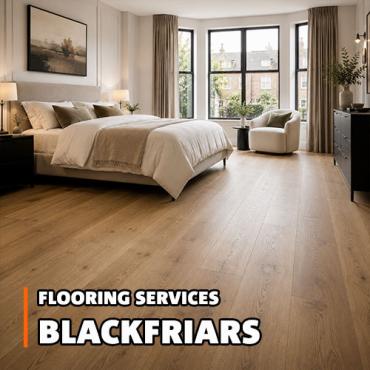
Blackfriars occupies a distinctive position in central London — an EC4 postcode on the western edge of the City of London, where the medieval city boundary meets the Thames at Blackfriars Bridge and the streets running north from the river transition from the riverside development of the Victoria Embankment through the former newspaper district of Fleet Street and its surrounding lanes toward Ludgate Hill and St Paul's.
The area's character is defined by its history as the centre of British print media and journalism. The streets around Fleet Street — New Bridge Street, Bouverie Street, Whitefriars Street, Tudor Street, and the network of courts and alleys between them — were occupied for over two centuries by newspaper printing houses, publishers, and the legal chambers of the Temple to the west. The departure of the national press from Fleet Street in the 1980s left a large stock of Victorian and Edwardian commercial buildings that have been progressively converted since then — into offices, residential loft apartments, hotels, and the mix of commercial and hospitality uses that now defines this part of EC4.
For flooring, Blackfriars presents a predominantly commercial and converted-building brief. The area has relatively little traditional residential housing stock — the Victorian terraces common in neighbouring Southwark and the Georgian streets of adjacent Holborn are largely absent from EC4 itself. What Blackfriars does have in abundance is converted Victorian and Edwardian commercial buildings with large, open-plan concrete and stone subfloors, significant office and legal chambers premises along Fleet Street and the Temple approach, and a growing residential conversion stock in the streets around the Embankment.
Flooring Services London has been carrying out floor sanding, floor fitting, wood floor repair, and floor maintenance in Blackfriars and the surrounding EC4 area for over 20 years, working in converted commercial buildings, City offices, legal chambers, and riverside residential properties throughout the neighbourhood. All pricing is confirmed in writing following a free site visit — our full pricing guide covers all services in detail.
Wood Floor Sanding in Blackfriars
Converted Victorian and Edwardian commercial buildings — the former newspaper printing houses, publishing offices, and commercial premises of Fleet Street and its surrounding streets have been converted over the past three decades into offices, residential loft apartments, boutique hotels, and mixed-use spaces. These buildings typically have large, open-plan floor areas with concrete or stone subfloors, and where engineered wood floors were installed during conversion fit-outs in the 1990s and 2000s, those floors are now approaching the age where professional sanding and refinishing is the appropriate maintenance treatment.
Engineered floor sanding in Blackfriars' converted buildings requires the same careful wear layer assessment as any engineered floor — we measure the real hardwood surface layer thickness before any sanding is committed and confirm the remaining sanding life before work is booked. For floors where the wear layer is insufficient for safe sanding, recoating or replacement is the more appropriate approach.
Legal chambers and professional offices — Blackfriars sits adjacent to the Temple — the Inns of Court of the Inner Temple and Middle Temple, which contain some of the most historically significant interiors in London, including original panelled rooms with period hardwood and parquet floors dating from the 17th and 18th centuries. The Temple's chambers, dining halls, and common rooms have wood floors of genuine historical significance, requiring the most specialist approach to restoration. We carry out floor sanding in professional, legal and institutional premises in and around the Temple outside operational hours, with full documentation as standard.
Fleet Street offices and media premises — the remaining offices and commercial premises along Fleet Street and the surrounding streets require periodic commercial floor sanding and maintenance. All commercial work is scheduled outside business hours with method statements, COSHH data sheets, and insurance certificates provided before any contractor access.
Riverside residential conversions — the apartment buildings along the Victoria Embankment and the residential conversions in streets approaching Blackfriars Bridge contain a mix of engineered wood and solid hardwood floors in properties where the residents have a very clear view of the Thames. These are generally high-specification residential properties where finish quality and minimal disruption are both significant priorities.
All of EC4 falls within both the ULEZ zone and the Congestion Charge area — applicable daily access surcharges are always stated explicitly in the written quote before work begins. All prices confirmed in writing following the free site visit. All prices shown are exclusive of VAT.
Finishes we apply in Blackfriars: For the converted commercial and loft apartment stock of EC4, Bona Traffic HD lacquer in matt or extra-matt is the standard commercial-grade specification — maximum durability with a natural, non-shiny appearance that suits the raw architectural character of converted Victorian premises. For the historic chambers and institutional spaces of the Temple, hard-wax oil or traditional wax is the more appropriate finish — sympathetic to the age and character of the original timber.
Wood Floor Fitting in Blackfriars
New floor installation in Blackfriars reflects the area's predominantly commercial and converted-building character:
Large open-plan concrete subfloor installations — the converted commercial buildings of Fleet Street and its surrounding streets typically have large open-plan concrete subfloors — the original ground-level industrial floors of the former printing houses, often reinforced and very substantial. Wide-plank engineered wood installation over appropriate underlay is the standard specification for these spaces. The industrial character of many Blackfriars conversions suits wide, brushed or lightly smoked oak boards of 180–220mm width — the scale of the boards complements the scale of the spaces.
Where the conversion is residential, acoustic underlay is typically required under the lease. Where the conversion is commercial, the underlay specification is driven by the acoustic performance requirements of the specific building rather than a lease clause.
Legal chambers and historic building fit-outs — new floor installation in the Temple's chambers and historic Inns of Court buildings requires the most careful product selection and sensitivity to the character of the building. Period-appropriate solid hardwood or wide-plank engineered oak in sympathetic natural finishes is the most appropriate specification. We advise on product selection in the context of the specific building and its historic character.
Riverside apartment installations — the high-specification residential properties along the Victoria Embankment and in the streets approaching Blackfriars Bridge typically have concrete subfloors, underfloor heating systems in some units, and the acoustic performance requirements of purpose-built residential developments. We carry out full moisture assessment, UFH compatibility checks where relevant, and acoustic underlay specification for every Blackfriars residential installation.
LVT for commercial and hospitality use — the hospitality venues, hotel lobbies, and restaurant premises increasingly found in Blackfriars' converted commercial stock require commercial-grade LVT or engineered wood with appropriate finish specifications. LVT's fully waterproof construction and commercial wear ratings make it a practical choice for high-footfall hospitality environments.
Historic Floors in the Temple — A Special Case
The Inner Temple and Middle Temple — the ancient Inns of Court that occupy the streets between Fleet Street and the Embankment just to the west of Blackfriars — contain some of the oldest and most significant historic interiors in London. The Middle Temple Hall, completed in 1573, has original Elizabethan oak flooring still in use. The chambers, common rooms, and dining halls of both Inns contain panelled rooms with period hardwood floors, parquet, and original wide-plank oak of a historical significance that demands the most specialist approach to any restoration work.
Flooring work in the Temple requires specific sensitivity to the listed building status of many of its buildings, the institutional requirements of the Inns of Court, and the historical significance of the floors themselves. We approach restoration work in the Temple with the same care and documentation as any other Grade I or Grade II* listed building in our portfolio, advising on appropriate finishes, sourcing period-matched timber where repairs are needed, and providing full documentation before any work begins.
Planning a flooring project in Blackfriars? Call us on 020 7036 0625 or request a free site visit — we respond to all EC4 enquiries the same working day and are experienced working in the specific institutional and commercial environments of this part of London.
Floor Maintenance in Blackfriars
For Blackfriars' commercial and office premises, scheduled floor maintenance programmes are the most cost-effective approach to keeping wood floors in good condition between full restoration cycles. Periodic recoating refreshes a lacquered commercial floor's appearance and protection without the disruption of a full sand — particularly practical for the City offices and legal chambers of EC4 where business continuity is a priority. All commercial maintenance is carried out outside operational hours.
For residential properties in Blackfriars' converted buildings, recoating and re-oiling maintenance services keep floors in excellent long-term condition and extend the interval before a full sanding cycle is needed. Full details on all maintenance services and pricing are available on our floor maintenance guide.
Why Blackfriars Property and Business Owners Choose Flooring Services London
- EC4 and City fringe experience — we work regularly throughout Blackfriars, Fleet Street, the Temple, St Paul's, and the surrounding EC4 area. We understand the specific building types, access constraints, and institutional requirements of this part of London
- Historic building expertise — from the Elizabethan floors of the Temple to the Victorian commercial conversions of Fleet Street, we bring genuine knowledge of historic floor restoration to every EC4 project
- Commercial scheduling — all City office and commercial work carried out outside operational hours, with full health and safety documentation as standard
- Dust-free sanding — essential in the Temple's historic chambers and the occupied residential conversions of the Embankment
- Fixed-price written quotes — assessed in person, confirmed before work starts. ULEZ and Congestion Charge surcharges are always stated explicitly
- Rated 4.93/5 from verified customers across London
Frequently Asked Questions — Flooring in Blackfriars
Can you restore historic wood floors in the Temple's legal chambers? Yes — and this is some of the most specialist restoration work we carry out in EC4. The Temple's chambers and institutional rooms contain original hardwood and parquet floors of genuine historical significance, some dating from the 17th and 18th centuries. We approach this work with the sensitivity it demands — advising on appropriate finishes, sourcing period-matched timber where repairs are needed, and working within any listed building or institutional requirements that apply to the specific building.
Can you fit engineered wood in a Blackfriars converted Victorian commercial building? Yes — large open-plan concrete subfloor installations in Blackfriars' converted commercial stock are a regular part of our EC4 work. We carry out moisture assessment, specify appropriate underlay, and install wide-plank engineered wood to a commercial standard. Full details on our floor fitting services and pricing are available on our floor fitting and restoration price guide.
Do you carry out commercial floor sanding for City offices and legal chambers in Blackfriars? Yes — we work regularly in EC4's commercial and legal premises, sanding and maintaining office and chambers floors outside business hours. We provide full health and safety documentation, including method statements, COSHH data sheets, and insurance certificates before any commercial work begins.
How do you manage the Congestion Charge and ULEZ for Blackfriars EC4 jobs? All of EC4 falls within both the ULEZ zone and the Congestion Charge area. Applicable daily surcharges are always included explicitly in the written quote — never added after the fact.
Can you work in residential apartment buildings along the Victoria Embankment? Yes — riverside residential properties along the Embankment are part of our regular EC4 work. We are experienced with the access requirements of purpose-built residential developments, the acoustic underlay specifications of modern apartment buildings, and the UFH compatibility requirements increasingly common in high-specification riverside properties.
We cover all Blackfriars postcodes within EC4 and regularly work in neighbouring areas including Fleet Street, the Temple, St Paul's, Ludgate Hill, Holborn, and Southwark.
Call us on 020 7036 0625 or request a free quote online — we respond to all Blackfriars enquiries the same working day.
Flooring Services in Blackfriars
As a trusted local flooring company, we offer a comprehensive range of flooring services in Blackfriars and surrounding areas. Whether you need new flooring installed, existing floors repaired, or expert advice on the best flooring options for your property, our experienced team is here to help.
Floor Fitting
Wood floor fitting is the process of installing flooring such as engineered wood, solid wood, parquet, or laminate, ensu...
Floor Sanding
Floor sanding is the process of removing the top layer of a wooden floor using professional sanding equipment to elimina...
Wood Floor Repair
Wood floor repair involves fixing damaged, worn, or unstable areas of a wooden floor, including replacing boards, fillin...
Floor Maintenance
Wood floor maintenance includes cleaning, polishing, buffing, and re-coating wooden floors to preserve their appearance,...
Solid Wood Floor Sanding
Solid wood floor sanding is the process of removing the top layer of solid timber flooring to eliminate wear, scratches,...
Engineered Floor Sanding
Engineered wood floor sanding is the process of carefully removing the top wear layer of an engineered floor to restore ...
Gap Filling
Wood floor gap filling involves sealing gaps between floorboards or parquet blocks to improve stability, appearance, and...
Floor Sealing
Floor sealing refers to the application of a protective finish, such as lacquer or oil, to a wooden floor after sanding,...
Commercial Floor Sanding
Commercial floor sanding involves restoring wooden floors in high-traffic environments by removing worn finishes, surfac...
Engineered Floor Fitting
Engineered wood floor fitting involves installing multi-layered wooden boards designed for stability, allowing them to p...
Laminate Floor Installation
Laminate floor fitting involves installing multi-layer synthetic flooring boards designed to replicate the appearance of...
Floorboards Fitting
Floorboards fitting covers the installation of timber floorboards, ensuring correct preparation, alignment, and fixing f...
Floor Insulation Fitting
Floor insulation fitting involves installing insulating materials beneath a floor structure to reduce heat loss, improve...
Floorboards Repair
Floorboard repair covers the restoration of damaged, loose, or worn timber boards, addressing issues such as movement, s...
Floor Scratch Repair
Wood floor scratch repair focuses on restoring damaged areas of a wooden floor by reducing or removing surface scratches...
Floor Polishing
Floor polishing focuses on enhancing the appearance of wooden floors by restoring shine, improving surface protection, a...
Parquet Floor Sanding
Parquet floor sanding involves carefully restoring patterned wooden flooring by removing worn finishes, surface damage, ...
Floorboards Sanding
Floorboards sanding focuses on restoring timber boards by removing worn finishes, surface damage, and imperfections, cre...
Stairs Sanding
Stair sanding involves restoring wooden staircases by removing worn finishes, surface damage, and imperfections, prepari...
Wood Floor Staining
Floor staining enhances the appearance of wooden floors by applying coloured finishes that change the tone of the wood w...
School Floor Sanding
School floor sanding focuses on restoring wooden floors in educational environments by removing wear, surface damage, an...
Solid Wood Floor Fitting
Solid wood floor fitting requires careful preparation and precise installation, as natural timber reacts to changes in t...
Parquet Floor Fitting
Parquet floor fitting involves installing patterned wooden flooring with precision, ensuring correct alignment, subfloor...
Staircase Floor Fitting
Staircase floor fitting involves installing wooden elements on staircases, including treads, risers, and trims, ensuring...
Soundproofing Wood Flooring
Soundproof floor fitting focuses on reducing airborne and impact noise by installing suitable underlay and flooring syst...
Solid Wood Floor Repair
Solid wood floor repair covers the restoration of damaged timber flooring by replacing worn boards, treating surface iss...
Engineered Floor Repair
Engineered wood floor repair focuses on restoring damaged or worn engineered flooring by addressing surface issues and, ...
Parquet Floor Repair
Parquet floor repair involves restoring patterned wooden flooring by fixing damaged blocks, stabilising loose sections, ...
Wood Floor Cleaning
Wood floor cleaning involves using suitable products and techniques to remove dirt, maintain the finish, and protect the...
Floor Waxing
Floor waxing and recoating involves renewing the protective layer of a wooden floor by removing old wax or finish build-...
Floor Stripping
Floor stripping refers to the removal of old wax, polish, or finish layers from a floor using specialised products, prep...
Wood Floor Re-Oiling
Wood floor re-oiling focuses on renewing the protective oil finish of a wooden floor, enhancing its natural appearance w...
Wood Floor Recoating
Wood floor recoating involves applying a new protective finish over an existing one without full sanding, helping to ref...
Commercial Floor Cleaning
Commercial floor cleaning focuses on deep cleaning and maintenance of flooring in high-traffic environments, removing em...
LVT Floor Installation
LVT floor installation involves fitting luxury vinyl tiles or planks with precision, ensuring correct subfloor preparati...
All our flooring services in Blackfriars come with a free, no-obligation estimate. We pride ourselves on quality workmanship and competitive pricing across all London boroughs.
Floor Sanding in EC4 — Blackfriars, The City
The EC4 postcode district covers Blackfriars, The City in London. Our team regularly works on period conversions, Victorian terraces, and modern apartments throughout EC4. Whether you have hardwood boards, parquet, or engineered flooring, we provide professional floor sanding with a free site visit and no-obligation quote.
For detailed area information, see our Flooring Services in Blackfriars page.
Frequently Asked Questions
How much does floor sanding cost in Blackfriars, The City, EC4?
Floor sanding in Blackfriars, The City, EC4 typically costs £25 to £45 per square metre depending on floor condition and finish type. Gap filling and repairs are priced separately.
How long does floor sanding take in Blackfriars, The City, EC4?
Most residential floor sanding jobs in Blackfriars, The City, EC4 are completed in 1-2 days. Lacquering or oiling adds drying time.
Is your floor sanding process dust-free in Blackfriars, The City, EC4?
We use modern dustless sanding equipment that captures 98%+ of airborne particles, keeping your Blackfriars, The City, EC4 property clean.
Do you offer free site visits in Blackfriars, The City, EC4?
Yes, we offer free, no-obligation site visits in Blackfriars, The City, EC4. Our surveyor assesses the floor and provides a detailed quote on the spot.
Also available in EC4:
Wood Floor Fitting in Blackfriars, The City, EC4