Monday - Friday 07:30 - 17:30, Saturday 07:30 - 16:00
Flooring Services Manor Park — Floor Sanding, Fitting & Repair in E12
Manor Park came into existence as a name when the railway arrived. Before Manor Park station opened in 1872, this part of east London was open farmland belonging to the old Manor Farm estate — the same Little Ilford parish recorded in the Domesday Book. The station brought commuters, and commuters brought demand for housing. Streets of terraced and semi-detached Victorian houses were laid out rapidly across the surrounding fields through the 1880s and 1890s, giving Manor Park its defining architectural character: solid, well-proportioned late-Victorian and Edwardian homes built for City workers and tradespeople with a direct line to Liverpool Street.
That heritage is visible in the fabric of the neighbourhood today. The Durham Road Conservation Zone, designated in 1984, preserves one of the most intact pockets of late-Victorian residential development in east London — streets near the station built to a consistent, higher-than-average standard that have survived largely unaltered. Away from the conservation area, the streets between Romford Road and Woodgrange Park contain a varied mix: original bay-fronted terraces at varying scales, some with high ceilings and original fireplaces still intact, alongside 1920s and 30s infill where gaps in the Victorian street pattern were filled more modestly. The City of London Cemetery borders the area to the east, and the proximity of Wanstead Flats to the north gives Manor Park a greener feel than many east London neighbourhoods of equivalent density.
The flooring work we carry out in Manor Park reflects this housing character directly — Victorian board restoration, new solid and engineered installations in properties being properly renovated for the first time, and practical, durable solutions for the area's active rental sector. Call us on 020 7036 0625 or request a free estimate to arrange a no-obligation site visit.
Floor Sanding and Finishing in Manor Park
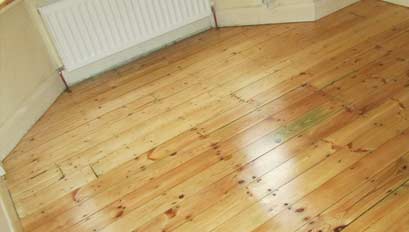
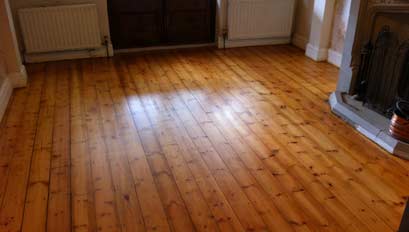
The Victorian and Edwardian houses that make up the majority of Manor Park were almost universally fitted with softwood pine floorboards as standard — suspended on joists over a ventilated void and in many cases carpeted before the boards were ever worn enough to warrant attention. Lifting that carpet decades later frequently reveals floors in far better condition than expected: the carpet has acted as protection, and the boards beneath can be thick, dry, and entirely viable for restoration.
Whether a Manor Park floor is a candidate for sanding is assessed at the free visit. We check board thickness, look for evidence of previous sanding, assess moisture levels at the subfloor, and examine the boards for structural damage or woodworm. In the conservation zone properties and the more substantial semi-detached houses near the station — often built by developer Cameron Corbett to a higher specification than the surrounding terraces — we frequently find boards that have never been touched. In properties with more transient ownership history, previous sanding may have already reduced the available material significantly.
The sanding process moves through progressively finer grits: belt sanding across the main floor area, edge equipment for the perimeter, bay window recesses, and detailed work around hearths and built-in furniture where machines cannot reach. Once the surface is clean and level, gaps between boards are addressed with professional gap filling — flexible resin in a tone matched to the timber — before any finish is applied. This is particularly important in Manor Park's older properties, where a century of seasonal movement has opened joints that rigid fillers would simply crack out of.
Sealing sets the floor's character. We carry out professional floor sealing in lacquer, hardwax oil, and stained finishes depending on how the room is used and the owner's aesthetic preference:
- Lacquer suits Manor Park's busier family homes and hallways where surface hardness and ease of cleaning matter most
- Hardwax oil gives a more natural, lower-sheen result that enhances the grain of older pine without the plastic sheen a heavy lacquer can produce — and is repairable in sections without a full refinish
- Staining before sealing is used where boards have inconsistent colour from replacement timbers added over the years, or where an owner wants to shift Victorian pine toward a cooler or darker tone; our wood floor staining service covers this in full
Want to know what's under the carpet in your Manor Park home? Call us on 020 7036 0625 or book a free site visit — we'll inspect the boards and give you an honest assessment of what restoration would involve.
Wood Floor Fitting in Manor Park
When original boards are beyond restoration — too thin from previous sanding, replaced at some point by chipboard, or too badly damaged by moisture or woodworm — fitting a new floor is the right path. Manor Park's Victorian suspended timber subfloors offer genuine product flexibility, but we assess conditions before making any recommendation.
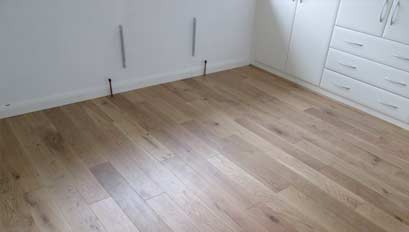
Solid timber floorboards are the natural choice for E12's older terraces where joist condition is good and subfloor ventilation is adequate. Fitting solid floorboards by secret-nailing directly to the joists is the traditional installation method — reversible, stable, and producing a floor that can be sanded multiple times over its life. For the conservation zone properties and the more substantial semi-detached houses near the station, solid oak in a character or prime grade suits both the room proportions and the period character of the building. Narrower boards in natural or lightly brushed finishes sit most naturally in the more modestly proportioned rooms of the smaller terraces throughout E12.
Engineered wood is specified wherever solid is less appropriate: ground-floor rooms with any history of damp, rear extensions on concrete slabs, or spaces with underfloor heating. The dimensional stability of an engineered board across varying humidity is a genuine technical advantage in east London's older housing stock, where heating patterns tend to be intermittent and subfloor ventilation is variable. Engineered floor fitting covers everything from narrow natural oak planks suited to Victorian room proportions to wider smoked and brushed formats for open-plan layouts in extended properties.
For open-plan ground floor configurations — increasingly common as Manor Park owners remove the wall between the rear reception and kitchen — a single floor specification needs to work across all three zones. Whether that is timber throughout, LVT throughout, or timber in the living areas and LVT in the kitchen is a conversation we have at the estimate stage based on the specific layout, subfloor, and how the space will be used.
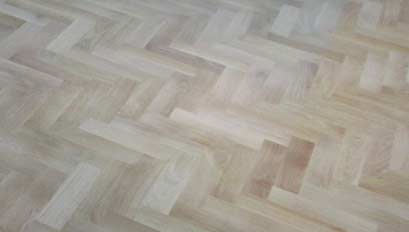
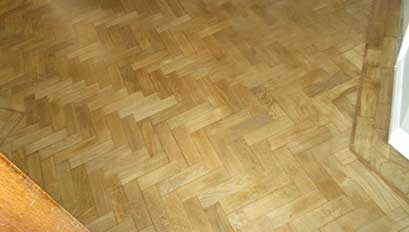
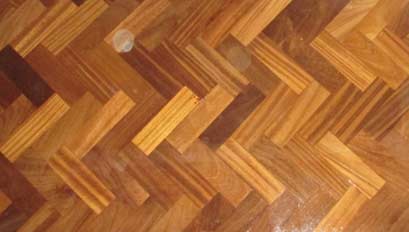
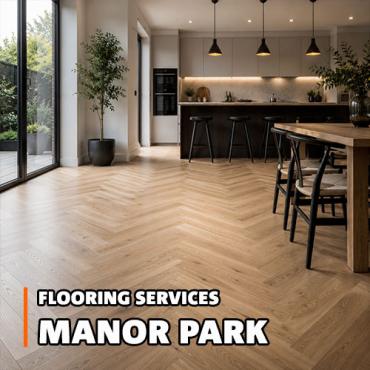
Parquet is fitted in Manor Park both as a period-appropriate restoration in the conservation zone and as a new design choice in renovated properties. Herringbone parquet fitting in engineered oak has become a consistently popular specification for Manor Park hallways — it references the area's Victorian character with a contemporary execution that suits both restored and newly renovated interiors.
LVT Installation in Manor Park
LVT (luxury vinyl tile) occupies a clear and practical role across Manor Park's housing market, particularly in the area's active rental sector. The streets off Romford Road contain a high proportion of tenanted properties, and landlords need floors that handle intensive use across successive tenancies without specialist maintenance between them. LVT — waterproof, resilient, realistic in appearance, and cleanable with nothing more than a mop — meets that requirement better than most alternatives.
Correct subfloor preparation is what separates a Manor Park LVT installation that lasts from one that fails within a year. Victorian terraced subfloors in E12 are almost universally suspended timber, and LVT laid directly over a springy floor will see its click-lock joints work loose under foot traffic as the substrate flexes. Our preparation process for Manor Park terraces involves:
- Checking the existing floorboards for structural soundness and any signs of moisture from below
- Overlaying with structural plywood screwed at close centres across the full area — this creates a rigid, flat base and eliminates the flex that causes failure
- Assessing levels across the overlaid surface and addressing any remaining variation at threshold and transition points
For ground-floor rooms on concrete — found in some Manor Park conversions and rear extensions — we carry out moisture testing before committing to any product, and use self-levelling compound where the slab surface has undulations. The preparation steps add time to the job but are the reason our LVT installations hold up correctly for years. For full product and installation details, see our LVT and vinyl flooring section.
Wood Floor Repair in Manor Park
Wood floor repair in Manor Park's Victorian housing stock covers a familiar range of issues that develop over time through seasonal movement, occupation, and the occasional period of deferred maintenance between ownerships. The most frequent jobs we are called to in E12 involve:
- Squeaking and movement — the most common complaint in period terraces; identifying whether the cause is loose nail fixings or boards rubbing at the joints determines the correct remedy, and treating the wrong cause produces no improvement
- Open gaps between boards — a standalone repair using flexible gap filling where an owner wants to address draughts or appearance before selling or letting, without commissioning a full sanding job
- Surface scratches and worn finish — floor scratch repair for localised damage; shallow surface scratches in an otherwise sound lacquered floor can often be treated without sanding the whole room
- Damaged or missing individual boards — replaced with matching timber, sourced for width, thickness, and species to produce as close a visual result as the age of the original allows
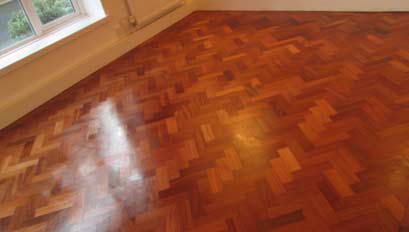
For parquet floors in the larger Manor Park properties, repair involves regluing or replacing individual blocks, removing old adhesive cleanly before relaying, and carrying out parquet floor sanding over the repaired area to bring the surface back to a consistent level before resealing.
Where moisture is the underlying cause of damage — as it sometimes is in Manor Park's older ground-floor rooms where original damp-proofing has deteriorated over time — we confirm the source has been identified and resolved before carrying out any repair work. Patching a moisture-damaged floor without treating the cause produces a repair that fails within the first heating season.
Wood Floor Maintenance in Manor Park
A timber floor in a Manor Park Victorian terrace, properly maintained, can last the lifetime of the building. Original pine boards in some E12 houses are already well over a century old and still structurally sound. That longevity does not happen without care — it requires maintenance treatments timed correctly to the floor's condition rather than allowed to deteriorate to the point where only a full restoration will suffice.
For oiled and hardwax-finished floors, the key treatment is wood floor re-oiling — typically every two to four years depending on foot traffic and sun exposure. The process involves thoroughly cleaning and degreasing the surface, then applying a compatible oil that replenishes the protective layer and restores the timber's colour and grain. For a busy family home in Manor Park with oiled floors throughout, re-oiling the hallway and kitchen areas more frequently than bedrooms and spare rooms reflects how different areas of the floor actually wear.
For lacquered floors that have dulled or developed minor surface wear without damage to the timber itself, wood floor recoating is the correct maintenance treatment — a fresh lacquer coat applied over the existing finish without full sanding. Timed correctly, it extends the protective life of the finish by several years at a fraction of full restoration cost. The right moment to recoat is when the finish is visibly thinning but before the timber itself starts showing wear marks; missing this window makes a full sand the only viable option.
For landlords across Manor Park, scheduling a recoat or re-oil during a void between tenancies is one of the simplest and most cost-effective ways to protect a flooring investment. We work with many E12 landlords on a rolling maintenance basis and can advise on the right interval for your specific floor type, finish, and tenancy frequency.
Frequently Asked Questions — Flooring in Manor Park E12
What distinguishes the Durham Road Conservation Zone properties from other Manor Park houses when it comes to flooring? The conservation zone properties near Manor Park station were built to a higher specification than much of the surrounding Victorian terrace stock — wider boards, better-quality joists, and greater original board thickness in many cases. They are frequently excellent candidates for full restoration, and some contain parquet in hallways and reception rooms that is worth carefully assessing for repair rather than replacement. We treat each property on its own merits at the site visit, but conservation zone homes in E12 often surprise their owners with the quality of what is underneath the carpet.
My Manor Park property has a rear kitchen extension on concrete — can I run the same floor through from the original Victorian section? A continuous visual run is achievable, but the product and method change at the junction between the original suspended timber floor and the concrete slab. In the Victorian section, solid or engineered wood is fitted on the joists; over the concrete extension, engineered or LVT is the correct specification. We match board width, species, and finish as closely as possible between the two sections so the floor reads as continuous, with the junction either concealed with a flush threshold strip or, where floor levels align, eliminated entirely.
How do I know whether my Manor Park floorboards have been sanded too many times to be restored again? The key is board thickness. Original Victorian pine boards were typically laid at 22–25mm; each professional sanding removes approximately 1–2mm of material. Boards below around 18mm are approaching the point where further sanding risks going through the structural layer. We measure thickness at the site visit and look for secondary indicators — boards that flex noticeably underfoot, very shallow nail punches, or visible joist shadow at the edges. Where the boards are too thin for another sand, we advise honestly on replacement options rather than proceeding with work that risks making the floor worse.
Is there a difference between re-oiling and recoating — and how do I know which one my Manor Park floor needs? Yes — they are different treatments for different finish types. Re-oiling is for floors finished with hardwax oil or a penetrating oil; the oil has soaked into the timber and needs replenishing as it depletes through use. Recoating is for lacquered floors; the lacquer sits on top of the timber as a film and can be refreshed with a new coat before it wears through entirely. If you are unsure which finish is on your floor, we can identify it at the site visit — it affects both the maintenance approach and the products used.
Can you match new boards to the Victorian pine already in my Manor Park terrace? Closely, in most cases. Victorian pine varies in width, thickness, and grain depending on the original supplier and construction period, and a perfect match is rarely achievable — but a close match in species and width, which patinates toward the surrounding floor's colour over time, is possible for most repairs. Where a larger section requires replacing rather than individual boards, we discuss whether fitting new floorboards across the whole room produces a better result than a visually distinct patch repair in the centre of a floor.
Working Across Manor Park
We cover all of Manor Park and the surrounding E12 area, including the Durham Road Conservation Zone, Woodgrange Park, Sherringham Avenue, Dersingham Avenue, the streets between Romford Road and the City of London Cemetery, and the residential roads running to the Forest Gate and Little Ilford boundaries. Whether your project is sanding original Victorian boards, fitting solid oak in a renovated terrace, installing LVT for a rental property, repairing a parquet hallway, or maintaining a restored floor between tenancies — we provide a free no-obligation estimate before any work begins.
Call us on 020 7036 0625 or request a free quote. We're available Monday to Friday 07:30–17:30 and Saturday 07:30–16:00.
Flooring Services in Manor Park
As a trusted local flooring company, we offer a comprehensive range of flooring services in Manor Park and surrounding areas. Whether you need new flooring installed, existing floors repaired, or expert advice on the best flooring options for your property, our experienced team is here to help.
Floor Fitting
Wood floor fitting is the process of installing flooring such as engineered wood, solid wood, parquet, or laminate, ensu...
Floor Sanding
Floor sanding is the process of removing the top layer of a wooden floor using professional sanding equipment to elimina...
Wood Floor Repair
Wood floor repair involves fixing damaged, worn, or unstable areas of a wooden floor, including replacing boards, fillin...
Floor Maintenance
Wood floor maintenance includes cleaning, polishing, buffing, and re-coating wooden floors to preserve their appearance,...
Solid Wood Floor Sanding
Solid wood floor sanding is the process of removing the top layer of solid timber flooring to eliminate wear, scratches,...
Engineered Floor Sanding
Engineered wood floor sanding is the process of carefully removing the top wear layer of an engineered floor to restore ...
Gap Filling
Wood floor gap filling involves sealing gaps between floorboards or parquet blocks to improve stability, appearance, and...
Floor Sealing
Floor sealing refers to the application of a protective finish, such as lacquer or oil, to a wooden floor after sanding,...
Commercial Floor Sanding
Commercial floor sanding involves restoring wooden floors in high-traffic environments by removing worn finishes, surfac...
Engineered Floor Fitting
Engineered wood floor fitting involves installing multi-layered wooden boards designed for stability, allowing them to p...
Laminate Floor Installation
Laminate floor fitting involves installing multi-layer synthetic flooring boards designed to replicate the appearance of...
Floorboards Fitting
Floorboards fitting covers the installation of timber floorboards, ensuring correct preparation, alignment, and fixing f...
Floor Insulation Fitting
Floor insulation fitting involves installing insulating materials beneath a floor structure to reduce heat loss, improve...
Floorboards Repair
Floorboard repair covers the restoration of damaged, loose, or worn timber boards, addressing issues such as movement, s...
Floor Scratch Repair
Wood floor scratch repair focuses on restoring damaged areas of a wooden floor by reducing or removing surface scratches...
Floor Polishing
Floor polishing focuses on enhancing the appearance of wooden floors by restoring shine, improving surface protection, a...
Parquet Floor Sanding
Parquet floor sanding involves carefully restoring patterned wooden flooring by removing worn finishes, surface damage, ...
Floorboards Sanding
Floorboards sanding focuses on restoring timber boards by removing worn finishes, surface damage, and imperfections, cre...
Stairs Sanding
Stair sanding involves restoring wooden staircases by removing worn finishes, surface damage, and imperfections, prepari...
Wood Floor Staining
Floor staining enhances the appearance of wooden floors by applying coloured finishes that change the tone of the wood w...
School Floor Sanding
School floor sanding focuses on restoring wooden floors in educational environments by removing wear, surface damage, an...
Solid Wood Floor Fitting
Solid wood floor fitting requires careful preparation and precise installation, as natural timber reacts to changes in t...
Parquet Floor Fitting
Parquet floor fitting involves installing patterned wooden flooring with precision, ensuring correct alignment, subfloor...
Staircase Floor Fitting
Staircase floor fitting involves installing wooden elements on staircases, including treads, risers, and trims, ensuring...
Soundproofing Wood Flooring
Soundproof floor fitting focuses on reducing airborne and impact noise by installing suitable underlay and flooring syst...
Solid Wood Floor Repair
Solid wood floor repair covers the restoration of damaged timber flooring by replacing worn boards, treating surface iss...
Engineered Floor Repair
Engineered wood floor repair focuses on restoring damaged or worn engineered flooring by addressing surface issues and, ...
Parquet Floor Repair
Parquet floor repair involves restoring patterned wooden flooring by fixing damaged blocks, stabilising loose sections, ...
Wood Floor Cleaning
Wood floor cleaning involves using suitable products and techniques to remove dirt, maintain the finish, and protect the...
Floor Waxing
Floor waxing and recoating involves renewing the protective layer of a wooden floor by removing old wax or finish build-...
Floor Stripping
Floor stripping refers to the removal of old wax, polish, or finish layers from a floor using specialised products, prep...
Wood Floor Re-Oiling
Wood floor re-oiling focuses on renewing the protective oil finish of a wooden floor, enhancing its natural appearance w...
Wood Floor Recoating
Wood floor recoating involves applying a new protective finish over an existing one without full sanding, helping to ref...
Commercial Floor Cleaning
Commercial floor cleaning focuses on deep cleaning and maintenance of flooring in high-traffic environments, removing em...
LVT Floor Installation
LVT floor installation involves fitting luxury vinyl tiles or planks with precision, ensuring correct subfloor preparati...
All our flooring services in Manor Park come with a free, no-obligation estimate. We pride ourselves on quality workmanship and competitive pricing across all London boroughs.